Some time ago, a friend pointed me to an academic article on “the rhetoric of crisis” in recent horror film criticism. The writer, Stephen Hantke, starts with a very simple observation: Although business is booming, fans and critics agree that “the American horror film is in a [creative] slump.” Hantke goes on to quote the final chapters of several studies of horror films (including mine) to prove his point. All of these studies, he notes, focus on a well-established canon of classics rather than examining the films of the most recent two decades. Hantke interprets this as proof that the genre is in trouble and suggests that, if people want to see something other than sequels and remakes to the well-established classics, we have to explain why the recent sequels and remakes aren’t working for us as well as the originals did. Seems simple enough, right?
It’s got me thinking about my reaction to Rob Zombie’s redux of “Halloween.” I simply couldn’t help comparing it to the original, and for me the remake didn’t live up. Why? I just never got emotionally involved with the characters. I didn’t feel that the victims were sympathetic enough, or that the killer was mysterious enough.
Not long after I saw the remake of “Halloween,” I went to see the Coen Brothers movie “No Country for Old Men” and I got to thinking that Anton Chigurh is a more interesting variation on Michael Myers. Not just because he uses a murder weapon that makes Myers look boring by comparison… but because he’s a human being without a conscience – a “faceless” menace who believes that life and death are as random and meaningless as the outcome of a single coin toss.
My opinion: Zombie’s remake of “Halloween” should have featured an Anton Chigurh.
Chigurh is as relentless as the Michael Myers of Zombie’s film, but actually has more in common with Carpenter’s original concept of Michael Myers as the boogeyman. Chigurh is an abstraction – he represents different things to different characters. The Vietnam generation characters (Josh Brolin and Woody Harrelson) regard him as a stumbling block that they have to personally overcome. The World War II-generation character (played by Tommy Lee Jones) regards him rather as a monster that can’t ever be entirely destroyed. At the end of the film, I couldn’t help thinking that the apathetic Chigurh represents the Iraq War generation – he is as hardened to the reality (necessity?) of violence as Zombie’s Michael Myers. The genius of “No Country for Old Men” lies in its perspective on him. It is through Jones’s character that Chigurh becomes the mythical monster of a horror film – not simply an agent of physical death, but a generator of the less tangible fears that lie at the core of the horror genre.
The suspense in Carpenter’s original film comes from our understanding that the monster is death, death is inevitable and unknowable, and the randomness of death is sometimes unendurable. Zombie’s “Halloween” does work on one level – as a slice of life narrative with a clear beginning, middle and end. But Carpenter’s “Halloween” is a myth. (Carpenter himself understands myths only too well, being a dedicated fan of America’s greatest mythological art form – the western.) Like “No Country for Old Men,” the original “Halloween” reveals the unknown through its honest inability to offer a reassuring explanation for the things we fear the most.
I think perhaps that’s where so many recent horror sequels and remakes have fallen short of their predecessors – they lack a sense of magic and mystery, the supernatural and THE UNKNOWN. For more thoughts on this topic, check out my review of “Pulse” on classic-horror.com, a great little website devoted to the horror film “canon.”
Monday, February 11, 2008
Sunday, February 10, 2008
Griffith Park - Take Two
A few months ago, we went to Griffith Park to see the Old Los Angeles Zoo. Unfortunately, the entire southeast section of the park was closed due to last summer’s wildfire. Griffith has been slowly recovering ever since - the main road that cuts through the center of the park is still closed. Many of the hiking trails finally reopened in January, then got closed again after unexpected rains caused mudslides. Yesterday was the first truly warm day Los Angeles has had for a few weeks, so it seemed like an opportune time to try again.
We decided to enter the park from Los Feliz, east of Bronson Canyon and the Hollywood sign. On the way, we stopped to marvel at the Ennis House in Glendower Avenue. The Ennis House is probably the most famous house designed by Frank Lloyd Wright in the city of Los Angeles – owing to the fact that it has appeared in a number of hugely successful films and TV shows. Built in 1924, the house made one of its earliest appearances in the 1958 William Castle schlocker “The House on Haunted Hill.” It was featured as the titular home of eccentric millionaire Fredrick Loren (played by Vincent Price), who held an unusual overnight party inside. It later appeared as a filmmaker’s residence in the 1975 adaptation of the quintessential Hollywood novel “The Day of the Locust,” as Deckard’s apartment building in Ridley Scott's “Blade Runner” (1982), and as Angel’s gothic pad in the TV series “Buffy the Vampire Slayer.” Perhaps least notably, it was the home of Thomas Ian Griffith’s manipulative martial arts instructor in “The Karate Kid Part III” (1989), a film that featured the house’s incredible view of downtown Los Angeles.
The Ennis house, like Griffith Park, has been threatened recently by both wildfires and mudslides. In 1994, the Northridge earthquake caused significant damage to the southern retaining wall, prompting the National Trust for Historic Preservation to put the house on its 11 Most Endangered list. In 2005, the Ennis House Foundation was formed to raise money for restoration and, thanks to them, the house is no longer in immanent danger. Hopefully, it will be reopened to the public in the near future.
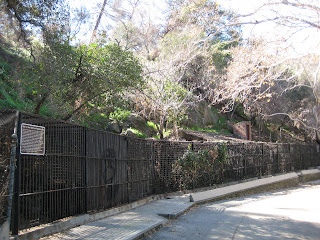
I was surprised to see that the Old Zoo in Griffith Park was also in relatively good shape, as I'd assumed that the fire had reached it. There haven’t been any animals in the cages since 1965, but there have been plenty of filmmakers in there. When I first moved to Los Angeles and got interested in seeking out film locations, I read an article in the L.A. Times saying that “Zoltan, Hound of Dracula” (1978) was filmed here. I’ve never seen “Zoltan, Hound of Dracula,” (if any blog readers can comment on this one, I’d LOVE to hear about it), nor do I plan to. I can already fully appreciate the creepiness of the setting.
The old lion cages are now an elaborate picnic grounds (though they were briefly re-converted to lion cages for the 2004 movie “Anchorman” with Will Farrell). Just behind the walls are a series of long, steep stairwells, leading to dark, empty storage rooms that look like they belong in Candyman's Cabrini Green.
Lest you get the idea that this section of Griffith Park is not family-friendly, I should point out the nearby Merry-Go-Round. Constructed in 1926, the carousel supposedly served as the inspiration for Disneyland. According to Griffith Park historian Mike Eberts, Walt Disney brought his daughters here and started dreaming...
Further north, on the way out of the park, there’s another big attraction for kiddies and film geeks. The miniature railroad at Los Angeles Live Steamers is where Steve Martin wooed Bernadette Peters in “The Jerk” (1979). The train operators offer free rides (to geeks of all ages) on Sundays, from 11am to 3pm.
So there you have it. From the house on haunted hill to 1/8 scale trains. Fun for the whole family.
 Ennis House (view from the south - featuring the fully restored retaining wall)
 (a more familiar vantage point)
 These textile blocks form all the outside walls of Frank Lloyd Wright's modern Mayan temple
 View from the front patio.
 Griffith Park - coming back to life
 Old Los Angeles Zoo


We decided to enter the park from Los Feliz, east of Bronson Canyon and the Hollywood sign. On the way, we stopped to marvel at the Ennis House in Glendower Avenue. The Ennis House is probably the most famous house designed by Frank Lloyd Wright in the city of Los Angeles – owing to the fact that it has appeared in a number of hugely successful films and TV shows. Built in 1924, the house made one of its earliest appearances in the 1958 William Castle schlocker “The House on Haunted Hill.” It was featured as the titular home of eccentric millionaire Fredrick Loren (played by Vincent Price), who held an unusual overnight party inside. It later appeared as a filmmaker’s residence in the 1975 adaptation of the quintessential Hollywood novel “The Day of the Locust,” as Deckard’s apartment building in Ridley Scott's “Blade Runner” (1982), and as Angel’s gothic pad in the TV series “Buffy the Vampire Slayer.” Perhaps least notably, it was the home of Thomas Ian Griffith’s manipulative martial arts instructor in “The Karate Kid Part III” (1989), a film that featured the house’s incredible view of downtown Los Angeles.
The Ennis house, like Griffith Park, has been threatened recently by both wildfires and mudslides. In 1994, the Northridge earthquake caused significant damage to the southern retaining wall, prompting the National Trust for Historic Preservation to put the house on its 11 Most Endangered list. In 2005, the Ennis House Foundation was formed to raise money for restoration and, thanks to them, the house is no longer in immanent danger. Hopefully, it will be reopened to the public in the near future.
I was surprised to see that the Old Zoo in Griffith Park was also in relatively good shape, as I'd assumed that the fire had reached it. There haven’t been any animals in the cages since 1965, but there have been plenty of filmmakers in there. When I first moved to Los Angeles and got interested in seeking out film locations, I read an article in the L.A. Times saying that “Zoltan, Hound of Dracula” (1978) was filmed here. I’ve never seen “Zoltan, Hound of Dracula,” (if any blog readers can comment on this one, I’d LOVE to hear about it), nor do I plan to. I can already fully appreciate the creepiness of the setting.
The old lion cages are now an elaborate picnic grounds (though they were briefly re-converted to lion cages for the 2004 movie “Anchorman” with Will Farrell). Just behind the walls are a series of long, steep stairwells, leading to dark, empty storage rooms that look like they belong in Candyman's Cabrini Green.
Lest you get the idea that this section of Griffith Park is not family-friendly, I should point out the nearby Merry-Go-Round. Constructed in 1926, the carousel supposedly served as the inspiration for Disneyland. According to Griffith Park historian Mike Eberts, Walt Disney brought his daughters here and started dreaming...
Further north, on the way out of the park, there’s another big attraction for kiddies and film geeks. The miniature railroad at Los Angeles Live Steamers is where Steve Martin wooed Bernadette Peters in “The Jerk” (1979). The train operators offer free rides (to geeks of all ages) on Sundays, from 11am to 3pm.
So there you have it. From the house on haunted hill to 1/8 scale trains. Fun for the whole family.
 Ennis House (view from the south - featuring the fully restored retaining wall)
 (a more familiar vantage point)
 These textile blocks form all the outside walls of Frank Lloyd Wright's modern Mayan temple
 View from the front patio.
 Griffith Park - coming back to life
 Old Los Angeles Zoo


Subscribe to:
Posts (Atom)