This week I picked up a book whose title was practically an invitation: “Why Read?” by Mark Edmundson (Bloomsbury, 2004). I was aware of the author, a distinguished Humanities professor at the University of Virginia, because I’d read two of his previous books – a memoir about his favorite teacher (“Teacher: The One Who Made the Difference”) and a study of Gothic culture in pre-millennial America (“Nightmares on Main Street”). The latter was recommended to me by one of my own favorite teachers, Dr. Robert Geary, who taught English Literature for many years at James Madison University.
I can sum up my formal education in three significant steps: Mrs. Hamilton (1st grade) got me writing. Ms. Marshall (9th grade) turned me into a critical thinker. Dr. Geary (junior year of college) helped me to solidify my beliefs - simply by asking big questions. I mention this because Edmundson is the same kind of teacher - one who asks the big questions - and his 2004 book might as well have been called “Why Teach?”
Edmundson, like all great teachers, feels a burden of responsibility for the intellectual and emotional development of his students. And, like all great teachers, he has very specific ideas about what he needs to accomplish and how he should go about it. Throughout the book he promotes the education philosophy of Humanism, which he defines as “the belief that it is possible for some of us, and maybe more than some, to use secular writing as the preeminent means for shaping our lives.” This is hardly a new concept... it goes back to Matthew Arnold and beyond. I recently read a 1908 book by Harvard professor Irving Babbitt, in which he defends Humanism from encroaching perspectives, saying that “what is wanted is not training for service and training for power, but training for wisdom and training for character.” In other words, it is not the job of the teacher to prep their students just for a career but for life. “How to Be a Human Being 101”… these are your tuition dollars at work. It's an idea that was apparently very much at odds with the American education system in 1908, and is even more at odds with American culture in 2008.
In his book, Babbitt makes a clear distinction between wisdom and the accumulation of information – a distinction that greatly influenced the life and work of his student T.S. Eliot. I have spent the past four years studying Eliot – not just because I am curious about his work but because I am deeply curious about how he tried to live his life. He was not a practitioner of art for money’s sake, nor of art for art’s sake. He studied everything he could get his hands on, and wrote endlessly, as a way of better understanding himself and the world around him. He sought wisdom through an endless stream of ideas from different philosophies, different religions and different cultures. He did not simply gather these ideas like an Internet encyclopedia; he assimilated them into his own perspective on the world via a process that Babbitt likens to alchemy of the soul.
Edmundson wants the same thing for his students. They ask: Why read? He answers: So that we can better address the most vital questions in life. Who am I? What might I become? I remember being bowled over by such thoughts as I read “The Catcher in the Rye” for the first time in a high school English class. Should one believe in God? What is truth? How does one lead a good life? These questions popped up time and time again, demanding to be answered, when I took Ms. Marshall’s course on the history of Western philosophy. The questions remained just as vital when I took Dr. Geary’s course on Theodicy in Literature four years later. What is this world in which I find myself? How might it be changed for the better? Edmundson has an answer: Read. Teach.
In the more disheartening sections of his book, the author claims that the humanities are suffering in 21st century American universities. “Universities,” he says, “have become sites not for human transformation but for training and for entertaining. Unconfronted by major issues, students use the humanities as they can. They use them to prepare for lucrative careers. They acquire marketable skills. Or, they find in their classes sources of easy pleasure. They read to enjoy, but not to become other than they are.” Irving Babbitt said much the same thing in 1908. In his book “Literature and the American College,” he maintained that the humanities needed to be protected from being overrun by science and business, as they had once needed to be protected from religion. Not much has changed. The number of students who study the humanities (whether by choice or by requirement) continues to decline, and the discipline itself has been fractured since the so-called "culture wars" of the 1990s.
Edmundson argues that business and religion now pose the biggest threat to the kind of education he is promoting. In our current political climate, professors often avoid the topic of religion. “We teachers strike an unspoken agreement with religion and its dispensers,” Edmundson admits, guiltily, “They do their work, we do ours.” Speaking for myself, I can say that the exceptions to this unspoken rule were the courses that influenced me the most: Ms. Marshall’s course on Western philosophy and Dr. Geary’s course on Theodicy in Literature. These two classes stand out against all the others because they dealt with the most important questions I could ask. Like all students, I wanted – above all – to know how I fit into the world. The books I read in those classes helped me gradually to figure that out, in just the manner that Edmundson describes: “the reader may encounter aspects of themselves that, while they have perhaps been in existence for a long time, have remained unnamed, undescribed, and therefore in a certain sense unknown.”
Why read? Because that is how we stimulate the alchemy of the soul.
Why teach? Because without such introductions to the literature of universals, very few of us would know how or where to begin looking for our place in the world. There are simply too many things vying for students’ attention - often we don't find Socrates or Freud or T.S. Eliot without a pretty strong push in that direction. Students (hell, even adults) need help in discriminating between worlds of competing influences. It’s worth noting Edmundson’s stipulation that the teacher should not simply teach the things that form his or her personal worldview, but point students toward the texts that help them form or revise their own worldviews.
Toward the end of his book, Edmundson mentions Northrop Frye, author of a study of William Blake entitled "Fearful Symmetry," as an example of an ideal teacher – a type of critic who reinvigorates the classics for modern audiences: “A valuable literary critic is not someone who debunks canonical figures, or who puts writers into their historical contexts, or, in general, one who propounds new and brilliant theories of interpretation. A valuable critic, rather, is one who brings forth the philosophy of life latent in major works of art and imagination. He makes the author’s implicit wisdom explicit, and he offers that wisdom to the judgment of the world.” Edmundson demands the same thing of critics of T.S. Eliot: “The true T.S. Eliot scholar is not a grubber after Eliot-related facts, or the creator of ingeniously baroque readings of Eliot. He is not the source of minutiae for the Eliot newsletter or any other such thing… He is, or ought to be, Eliot’s disciple. He is responsible for so immersing himself in Eliot that only he and very few others can plausibly bring Eliot’s vision alive in the current world, which, as the critic deeply believes (or why would he have become a deep student of Eliot to begin with?), has sore need of it.” This is what I've tried to achieve with my study of T.S. Eliot.
Edmundson describes the job of the teacher, the scholar, and the critic alike as “offering past wealth to the present.” It’s a job, he maintains, that is more necessary than ever – as humanities curricula move away from the literary canon in favor of pop culture entertainment, away from universals in favor of ephemeral particulars, away from wisdom in favor of accumulated information. It’s a job that is necessary because it encourages Babbitt’s “subtle alchemy by which mere learning is transmuted into culture.” And without culture, what do we have? Just a lot of information without the wisdom to use it for a better life.
Saturday, April 12, 2008
Monday, April 07, 2008
THE WILD WEST, PART 3: RED ROCK CANYON
It’s hard to get a feel for what Death Valley must have been like for pioneers. Today, we have reliable maps and roads and cars that keep us (as long as we use common sense) from putting our lives in danger. Even the die-hard runners of the Badwater 135, who rely on their feet instead of their vehicles to traverse the hostile landscape, know what they’re up against. Not so for William Lewis Manly, who instead of heading due west toward the Sierras (where he would have found plenty of water) turned southwest toward Antelope Valley. Along the way, he and his companion passed Searles Dry Lake and the Trona Pinnacles, crossed land that now belongs to the China Lake Naval Air Weapons Station, dipped into Last Chance Canyon in Red Rock park, and climbed the hills near Santa Clarita (west of Palmdale), where they finally found refuge. To be sure, this is all beautiful country – especially in the spring – but the journey was a true test of endurance. These places are constant reminders of Nature’s dominion over life – giving and taking away as she sees fit.
 The Sierras (view from the east)
 Lake Isabella (in the Sierras)
 Searles (dry) Lake
 Red Rock in spring
 Joshua tree in bloom
 Southern end of Last Chance Canyon
 Last Chance
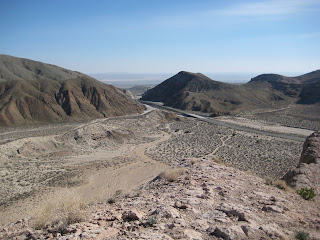 View from the Red Cliffs, looking south toward Antelope Valley
 Antelope Valley Poppy Preserve
 The Sierras (view from the east)
 Lake Isabella (in the Sierras)
 Searles (dry) Lake
 Red Rock in spring
 Joshua tree in bloom
 Southern end of Last Chance Canyon
 Last Chance
 View from the Red Cliffs, looking south toward Antelope Valley
 Antelope Valley Poppy Preserve
Friday, April 04, 2008
THE WILD WEST, PART 2: LONE PINE & THE ALABAMA HILLS
I wasn’t raised on westerns the way many film fans were. Maybe it’s because of my age – the western has been a relatively dead genre for most of my life. I remember going to the theater with my dad in 1992 to see Clint Eastwood’s “Unforgiven.” I liked it, but I couldn’t appreciate it the way he could because I wasn’t familiar with the genre conventions. I’d never seen a “classic” western. I didn’t know who John Ford and Howard Hawks were. I hadn’t even bothered to watch any of the post-modern spaghetti westerns on TV, though they aired on TBS practically every Saturday afternoon. It wasn’t until I started taking film classes in college that I realized what I was missing.
One course in particular, taught by Ralph A. Cohen (founder of the American Shakespeare Center), instructed me and my peers in the lost art of two “dead” American genres: the musical and the western. I never got too hooked on musicals, though I loved the RKO movies with Fred Astaire and Ginger Rogers (especially “Swing Time”) and I watched Bob Fosse’s “All That Jazz” repeatedly. Westerns were another story - I loved every single film we watched.
I now realize that the course focused pretty exclusively on the “classic” period of the American western, starting with John Ford’s 1939 film “Stagecoach” and ending with his 1962 film “The Man Who Shot Liberty Valance.” Since moving to Los Angeles, I’ve branched out a little more – into the b-westerns of the 1930s and postmodern westerns that have been popping up randomly since the 1970s like lone gunslingers on an empty plain. The main thing that has renewed my interest is the fact that this genre relies heavily on scenery – not just as a backdrop, but as an aspect of the storytelling – and much of the scenery from these films is more or less in my backyard.
In Lone Pine this past weekend, I realized that I was walking on sacred ground for western fans. Location scout Dave Holland wrote a book about the films (mostly westerns) shot in and around Lone Pine and the neighboring Alabama Hills – from a Fatty Arbuckle short called “The Roundup” (1920) to iconic westerns like “The Lone Ranger” (1938), “Rawhide” (1951) and “Bad Day at Black Rock” (1955). From the “eastern” colonial epic “Gunga Din” (1939) to the Humphrey Bogart / Ida Lupino film noir “High Sierra” (1941). From modern-day science fiction B-movies like “Tremors” (1991) and “Crossworlds” (1997) to recent action films like “G.I. Jane” (1997) and “Gladiator” (2000). Mind you: these are just a few of the titles that jumped out at me as I went down the list. Holland names literally dozens of old westerns that I have yet to watch.
A few weeks ago, I felt so bad about my ignorance of the genre that I asked a few knowledgeable people, including film critic Dennis Fischer and a fellow filming locations blogger ("The Great Silence"), to compile a list of “must-sees.” In addition to the legendary westerns of John Ford and Howard Hawks and genre staples like “High Noon” (1952), “Shane” (1953) and “The Big Country” (1958), they pointed me to the films of Anthony Mann (“Winchester ’73,” “Bend of the River,” “The Naked Spur,” “The Far Country,” “The Man from Laramie,” “The Tin Star”) and Budd Boetticher (“Seven Men from Now,” “The Tall T,” “Decision at Sundown,” “Buchanan Rides Alone,” “Westbound,” “Ride Lonesone,” “Comanche Station”). Boetticher shot a fair number of his films in the Alabama Hills, right out the front door of our hotel. Unfortunately, I was unable to identify any specific filming locations. No matter… Dave Holland has already done that work in his excellent book, and “The Great Silence” has provided numerous posts on the Alabama Hills and on the Lone Pine Film History Museum (a nice companion to the Gene Autry Museum in Griffith Park).
In the introduction to his book, Holland enthusiastically writes: “If as a kid, you went to the movies on Saturday afternoons for a dime at that little neighborhood theater over by the cleaners or were a baby boomer kid raised on Saturday morning TV, then these rugged rocks and narrow passes were the scene of so many of the great cowboy adventures with Hopalong Cassidy and Gene Autry and Roy Rogers. And Tom Mix and Ken Maynard and Buck Jones. And The Lone Ranger and Annie Oakley, and Have Gun, Will Travel. On the other hand, if you were a little older and went to the movies on Saturday nights down town, then the Alabama Hills weren’t associated with the cowboy heroes at all. Instead, you remember the ‘A’ pictures: Gregory Peck as The Gunfighter or Clint Eastwood as Joe Kidd or Kirk Douglass in his first Western, Along The Great Divide.” I wasn’t around to experience the A pictures or the B pictures in the theater, but reading this book and visiting these hills sure makes me wish I had been. The best I can do is to watch the films on DVD and plan another trip to Lone Pine in the not-too-distant future. Maybe for the annual film festival in October…
In the meantime, I’ll be doing my homework – my Netflix queue is full, and I’ve been reading up on the genre. Last week, I came across an internet article that categorized westerns into four distinct phases: Early Westerns, covering the period between the battle of the Alamo (1836) and the Civil War / Middle Westerns, covering the period between the Civil War and the Indian Wars at Wounded Knee (1890) / Late Westerns, covering the period between Wounded Knee and the Mexican Revolution (1920) / and Postmodern Westerns (Spaghetti westerns? Space westerns?). I think it’s fascinating to look at the genre in terms of American history… though probably also a bit frustrating. From what I can tell, the classic Hollywood westerns weren’t half as concerned with history as they were with entertainment.
In his 1973 book “The Western: From Silents to Seventies” (Penguin), film critic George Fenin wrote that, in the postmodern era, the western has become more ambitious – serving as “a tool for interpretation of that era in terms that we can understand, and hopefully a weapon against repetition in the future of the evils of frontier mentality, its violence and intolerance.” This, he says, is why the Western is today more “relevant” than ever before… “Spurred by the cinema’s re-creation, past errors and injustices may be corrected and possibly even kept from being repeated.” This seems like an apt explanation for why we’re witnessing a minor Western-revival (“Deadwood,” “3:10 to Yuma,” “There Will Be Blood,” “No Country for Old Men,” etc.) in the age of the Iraq War. Maybe this is a genre that’s long overdue for a comeback – a genre that could give a new generation of Americans a taste of history, reminding us of founding principles and mistakes.
In his influential 1992 book “Culture Wars,” James Davison Hunter argued that “our most fundamental ideas about who we are as Americans are now at odds.” I believe this is even more true in 2008 than it was in 1992. And what genre could better address “who we are as Americans”? It shows us at our worst (in our ignorant obsession with violence and power) and at our best (fighting for our beliefs, even when hopelessly outgunned by mobs and bureaucrats). I say keep ‘em coming…
 This is the last leg of the Badwater ultramarathon, leading up to Mt. Whitney. It's also where Humphrey Bogart eluded police in "High Sierra."
 Khyber Pass (from “Gunga Din”)
 Movie Road in Alabama Hills
 Movie Road, looking west. If I'm not mistaken, this is where "Tremors" was shot.
Screenwriter S.S. Wilson explains the origins of the film: "The original idea for Tremors was written while I worked down on the China Lake Naval Base as a film editor, one of my first jobs. While out hiking near town, I became aware of what is called an Ant lion. They make cone shaped holes in the sand, when an ant comes by the Ant lion will flick dirt up and suck the ant into its hole. I was hiking on some large rocks, similar to the ones in the Alabama Hills, when I happened to see this happen. I thought to myself, 'what would happen if there was something like that under the sand and I couldn't get off this rock?'"
 The Lone Pine Film Museum is now home to the giant graboid worms.
Next – “The Wild West, Part 3: Red Rock Canyon”
One course in particular, taught by Ralph A. Cohen (founder of the American Shakespeare Center), instructed me and my peers in the lost art of two “dead” American genres: the musical and the western. I never got too hooked on musicals, though I loved the RKO movies with Fred Astaire and Ginger Rogers (especially “Swing Time”) and I watched Bob Fosse’s “All That Jazz” repeatedly. Westerns were another story - I loved every single film we watched.
I now realize that the course focused pretty exclusively on the “classic” period of the American western, starting with John Ford’s 1939 film “Stagecoach” and ending with his 1962 film “The Man Who Shot Liberty Valance.” Since moving to Los Angeles, I’ve branched out a little more – into the b-westerns of the 1930s and postmodern westerns that have been popping up randomly since the 1970s like lone gunslingers on an empty plain. The main thing that has renewed my interest is the fact that this genre relies heavily on scenery – not just as a backdrop, but as an aspect of the storytelling – and much of the scenery from these films is more or less in my backyard.
In Lone Pine this past weekend, I realized that I was walking on sacred ground for western fans. Location scout Dave Holland wrote a book about the films (mostly westerns) shot in and around Lone Pine and the neighboring Alabama Hills – from a Fatty Arbuckle short called “The Roundup” (1920) to iconic westerns like “The Lone Ranger” (1938), “Rawhide” (1951) and “Bad Day at Black Rock” (1955). From the “eastern” colonial epic “Gunga Din” (1939) to the Humphrey Bogart / Ida Lupino film noir “High Sierra” (1941). From modern-day science fiction B-movies like “Tremors” (1991) and “Crossworlds” (1997) to recent action films like “G.I. Jane” (1997) and “Gladiator” (2000). Mind you: these are just a few of the titles that jumped out at me as I went down the list. Holland names literally dozens of old westerns that I have yet to watch.
A few weeks ago, I felt so bad about my ignorance of the genre that I asked a few knowledgeable people, including film critic Dennis Fischer and a fellow filming locations blogger ("The Great Silence"), to compile a list of “must-sees.” In addition to the legendary westerns of John Ford and Howard Hawks and genre staples like “High Noon” (1952), “Shane” (1953) and “The Big Country” (1958), they pointed me to the films of Anthony Mann (“Winchester ’73,” “Bend of the River,” “The Naked Spur,” “The Far Country,” “The Man from Laramie,” “The Tin Star”) and Budd Boetticher (“Seven Men from Now,” “The Tall T,” “Decision at Sundown,” “Buchanan Rides Alone,” “Westbound,” “Ride Lonesone,” “Comanche Station”). Boetticher shot a fair number of his films in the Alabama Hills, right out the front door of our hotel. Unfortunately, I was unable to identify any specific filming locations. No matter… Dave Holland has already done that work in his excellent book, and “The Great Silence” has provided numerous posts on the Alabama Hills and on the Lone Pine Film History Museum (a nice companion to the Gene Autry Museum in Griffith Park).
In the introduction to his book, Holland enthusiastically writes: “If as a kid, you went to the movies on Saturday afternoons for a dime at that little neighborhood theater over by the cleaners or were a baby boomer kid raised on Saturday morning TV, then these rugged rocks and narrow passes were the scene of so many of the great cowboy adventures with Hopalong Cassidy and Gene Autry and Roy Rogers. And Tom Mix and Ken Maynard and Buck Jones. And The Lone Ranger and Annie Oakley, and Have Gun, Will Travel. On the other hand, if you were a little older and went to the movies on Saturday nights down town, then the Alabama Hills weren’t associated with the cowboy heroes at all. Instead, you remember the ‘A’ pictures: Gregory Peck as The Gunfighter or Clint Eastwood as Joe Kidd or Kirk Douglass in his first Western, Along The Great Divide.” I wasn’t around to experience the A pictures or the B pictures in the theater, but reading this book and visiting these hills sure makes me wish I had been. The best I can do is to watch the films on DVD and plan another trip to Lone Pine in the not-too-distant future. Maybe for the annual film festival in October…
In the meantime, I’ll be doing my homework – my Netflix queue is full, and I’ve been reading up on the genre. Last week, I came across an internet article that categorized westerns into four distinct phases: Early Westerns, covering the period between the battle of the Alamo (1836) and the Civil War / Middle Westerns, covering the period between the Civil War and the Indian Wars at Wounded Knee (1890) / Late Westerns, covering the period between Wounded Knee and the Mexican Revolution (1920) / and Postmodern Westerns (Spaghetti westerns? Space westerns?). I think it’s fascinating to look at the genre in terms of American history… though probably also a bit frustrating. From what I can tell, the classic Hollywood westerns weren’t half as concerned with history as they were with entertainment.
In his 1973 book “The Western: From Silents to Seventies” (Penguin), film critic George Fenin wrote that, in the postmodern era, the western has become more ambitious – serving as “a tool for interpretation of that era in terms that we can understand, and hopefully a weapon against repetition in the future of the evils of frontier mentality, its violence and intolerance.” This, he says, is why the Western is today more “relevant” than ever before… “Spurred by the cinema’s re-creation, past errors and injustices may be corrected and possibly even kept from being repeated.” This seems like an apt explanation for why we’re witnessing a minor Western-revival (“Deadwood,” “3:10 to Yuma,” “There Will Be Blood,” “No Country for Old Men,” etc.) in the age of the Iraq War. Maybe this is a genre that’s long overdue for a comeback – a genre that could give a new generation of Americans a taste of history, reminding us of founding principles and mistakes.
In his influential 1992 book “Culture Wars,” James Davison Hunter argued that “our most fundamental ideas about who we are as Americans are now at odds.” I believe this is even more true in 2008 than it was in 1992. And what genre could better address “who we are as Americans”? It shows us at our worst (in our ignorant obsession with violence and power) and at our best (fighting for our beliefs, even when hopelessly outgunned by mobs and bureaucrats). I say keep ‘em coming…
 This is the last leg of the Badwater ultramarathon, leading up to Mt. Whitney. It's also where Humphrey Bogart eluded police in "High Sierra."
 Khyber Pass (from “Gunga Din”)
 Movie Road in Alabama Hills
 Movie Road, looking west. If I'm not mistaken, this is where "Tremors" was shot.
 Screenwriter S.S. Wilson explains the origins of the film: "The original idea for Tremors was written while I worked down on the China Lake Naval Base as a film editor, one of my first jobs. While out hiking near town, I became aware of what is called an Ant lion. They make cone shaped holes in the sand, when an ant comes by the Ant lion will flick dirt up and suck the ant into its hole. I was hiking on some large rocks, similar to the ones in the Alabama Hills, when I happened to see this happen. I thought to myself, 'what would happen if there was something like that under the sand and I couldn't get off this rock?'"
 The Lone Pine Film Museum is now home to the giant graboid worms.
Next – “The Wild West, Part 3: Red Rock Canyon”
Subscribe to:
Posts (Atom)