Showing posts with label 50s sci fi. Show all posts

Wednesday, June 21, 2017

John Carpenter Revisited: DARK STAR (1974)

John Carpenter on the set of DARK STAR
When I was about seven years old, I watched John Carpenter’s THE FOG on late night TV.  I was not allowed to watch R-rated movies, so I had to press my face against the screen of the tiny black-and-white TV set in my bedroom and turn the sound way down so  my parents wouldn’t know what I was doing.  During the third act, my heart was pounding... not just because I was afraid for the people of Antonio Bay, but because I was deathly afraid that someone would make me stop watching the movie before I could see how it ended.  The circumstances were just right that night for the fog to seep into my imagination and stay there. 

In subsequent years, John Carpenter’s other films began to make a big impression on me, one-by-one.  They didn’t just influence my taste in movies; they influenced my perspective on the world, fueling a sometimes-unhinged balance of romanticism and cynicism.  Most viewers these days seem to assume that Carpenter is a resolute cynic.  He can be.  But he’s also a filmmaker whose work doesn’t lend itself to quick, easy interpretations or intellectualization.  He’s what critics used to call a “pure cinema” filmmaker.  He tells stories through pictures in motion, plus sound, and his stories are meant to flood the viewer with emotion—not to be picked apart as metaphors, allegories, or political treatises.  (Which is not to say that his films do not sometimes function brilliantly as metaphors, allegories, or political treatises.  Ahem, THEY LIVE.) 

This week, I’m gearing up to re-watch all of John Carpenter’s movies, from DARK STAR to THE WARD.  Because I’m a writer by trade (and compulsion), I will also be writing about them.  And because I don’t like to do anything in a simple, casual way (did I mention “compulsion”?), I will also be watching each film on a double bill with a non-Carpenter film.  The pairings will not be random, but they might seem random at first.  I will do my best to explain as I go….
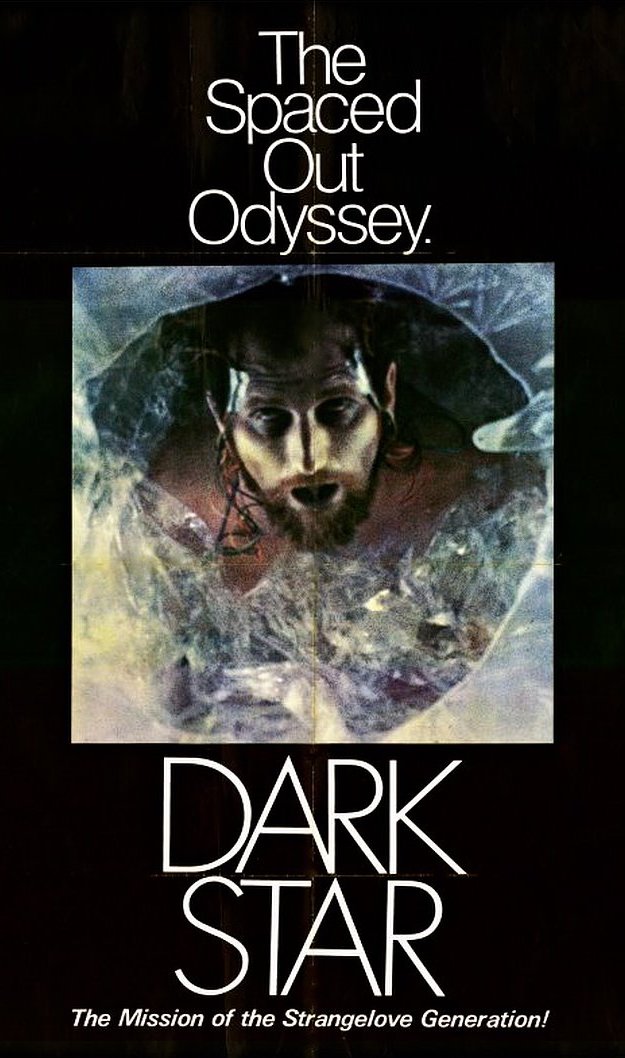

I’m kicking things off with John Carpenter’s first theatrical feature, DARK STAR.  “Theatrical” is a bit of a stretch, since DARK STAR is an expanded student film.  Carpenter and his USC film school chum Dan O’Bannon began working on it in 1970, and kept working on it for three years.  During that time, an old b-movie producer named Jack Harris came along and gave them a few extra bucks to expand the film for theatrical release.  The two starry-eyed film students did just that, and DARK STAR was released in 1974 to universal silence.

Carpenter and O’Bannon were undoubtedly disheartened by the film’s commercial failure… but it didn’t slow them down for very long.  Five years later, they were both being hailed as creative geniuses—for HALLOWEEN and ALIEN, respectively.  After that, DARK STAR was granted a second life on VHS as the brainchild of two young prodigies.  Naturally, the film has been viewed as a forerunner of the more-famous films.  Some people insist that the beach ball “alien mascot” in DARK STAR was the prototype for the xenomorph in ALIEN.  O’Bannon himself more or less confirmed this when he said that the rationale for making ALIEN was “If you can’t make it funny, make it scary.”  By drawing the comparison, O’Bannon also more or less claimed that he was the primary creator of the “alien mascot” sequence. 

I have always loved this little guy.

Dan O'Bannon (as Sgt. Pinback) in a tight spot.
Carpenter has refuted the claim.  Watching the sequence today, it’s easy to view it as a stylistic forerunner to the suspense sequences in HALLOWEEN.  The studied reliance on long takes, the careful establishment of geography, and the absolute faith in silence and ambient drones all scream "John Carpenter.This sequence is obviously the work of a strong visual storyteller developing his style.

A few years ago, I interviewed Carpenter for my horror doc NIGHTMARES IN RED, WHITE AND BLUE, and he told me that the great thing about film school was that it forced him to take the time to figure out why certain techniques worked.  This is something that viewers today—especially young viewers—don’t do as much, because so many movies are available to us that we rarely study them obsessively.  (Or am I projecting?  I’ll speak for myself…) I was humbled by Carpenter’s simple observation that watching movies and really studying movies, as a prospective filmmaker, is two different things.

One of the films that Carpenter studied endlessly at USC was Stanley Kubrick’s DR. STRANGELOVE, OR HOW I LEARNED TO STOP WORRYING AND LOVE THE BOMB.  Tonally it has a lot in common with DARK STAR, so I almost picked DR. STRANGELOVE as the second film on my double bill.  I might just as easily have picked Kubrick’s subsequent film 2001: A SPACE ODYSSEY.  DARK STAR is obviously an adoring mashup of these two films, fusing the satirical humor of one with the awe and wonder of the other.  The filmmakers themselves advertised this point with a pair of tag lines identifying the film as a “spaced-out odyssey” and a “mission of the Strangelove Generation.” 

But instead of harping on these comparisons (or because it’s already been done) I decided to watch a different film—the film that turned John Carpenter into a sci-fi enthusiast. In a 1978 interview on “The Slow Evolution of DARK STAR,” the director said, “I was only eight years old when I first saw FORBIDDEN PLANET, but… the young eyes that watched the invisible Id creature make its huge footprints in the sand of Altair 4 and finally saw the thing fully illuminated in the flowing laser beams would never be the same.”  In later interviews, he claimed that it was this experience that made him want to become a filmmaker—because he wanted to emotionally transport people away from their problems and mundane realities, to other worlds.  

FORBIDDEN PLANET
The first time I saw FORBIDDEN PLANET was at a midnight show at the NARO Theater in Norfolk, Virginia—in a gorgeously lush CinemaScope print and stereophonic sound, and with a very enthusiastic audience.  I guess you could say that the experience was the opposite of my experience of watching THE FOG for the first time…. but the effect was the same.  The effect of all great movies on all receptive viewers (regardless of the screen size) is the same: They transport you. 

Some aspects of FORBIDDEN PLANET have not dated well, but many of the visuals remain hypnotic.  The matte painting used in the Krell ventilator shaft, for instance, is just as awe-inspiring as any digital effect in 2017.  (And surely it was an influence on the elevator shaft sequence in DARK STAR.)  I was also moved by the stop-motion sequence in which Morbius shows off his hi-tech security system…. perhaps because of how low-tech it is.  Such effects seemed exotic in the early 1950s… and now they seem exotic again, like all practical effects in a digital world.  It’s not about nostalgia for something quaint; it’s about stimulating the imagination by showing audiences something they aren’t used to seeing.


If nothing else, re-watching this film a few days ago transported me to another time: 1950s America, the heyday of science fiction cinema, and a time when so much of our collective knowledge about outer space was based on speculation.  There’s an inherent sense of starry-eyed wonder in FORBIDDEN PLANET—and that’s why the film is still compelling, more than fifty years later.

DARK STAR is, in my opinion, even more of a product of its time.  In the early 70s, science fiction movies were in a transitional phase, between 2001 and STAR WARS.  I think DARK STAR has more in common with contemporary films like SILENT RUNNING or SOYLENT GREEN than it does with with FORBIDDEN PLANET or STAR WARS.  Thankfully, unlike SILENT RUNNING and SOYLENT GREEN, DARK STAR has a sense of humor to give it some lasting vitality. 

In his book The Films of John Carpenter, author John Kenneth Muir suggests that the film was actually ahead of its time.  Muir characterizes DARK STAR as “the first slacker film,” a forerunner to the self-conscious Gen X cinema of filmmakers like Richard Linklater, Quentin Tarantino, and Kevin Smith.  Sarcasm and satire mostly overwhelm the sense of awe and wonder in DARK STAR, but the battle between cynicism and romanticism rages on in all John Carpenter's subsequent films.  

Thursday, May 26, 2016

THE WICKED WEST


A few years ago, I decided to write a followup to my 2004 book Nightmares in Red, White and Blue, a cultural study of American horror films. 

At first, I imagined it as a book about horror remakes, reboots and “re-imaginations”—because those were dominating the genre at the time.  (This was somewhere in the lull between “torture porn” and PARANORMAL ACTIVITY.)   I outlined the book, started doing research, and even wrote a first chapter… then changed my mind.

When I came back around to the project a year or two later, I decided to make it a book entirely about supernatural / metaphysical horror films—focusing especially on films made since the mid-1980s.  I had been working for several years on a Discovery Channel series called A HAUNTING, which seemed to be in line with the latest trends in the horror genre, and I had strong opinions about why and how such stories work.  So I started writing.  Again I created a full outline, did some in-depth research, and completed a first chapter.  I was feeling pretty good about it, but somewhere along the line I got distracted.

One of the things that distracted me was exploring L.A.  Every weekend, my wife and I would go hiking at scenic spots in and around the city, and I quickly realized that every scenic spot in and around L.A. has been featured in a movie at some point.  Many of the more remote locations have a long history of use as filming locations, especially in westerns.  Although I had never been a particular fan of westerns—I naively thought it was a genre built on clichés—visiting these filming locations prompted me to start watching some studio-era westerns I'd never seen.  I found a great old-fashioned video store called Eddie Brandt’s Saturday Matinee that had a lot of stuff never released on DVD.  After that I was hooked.

Somehow, over the next few years, my prospective horror book became a book about westerns.  Initially, I thought of it as “a book about the other great American film genre about violence."  I had an idea that westerns generally presented a very conservative perspective on violence, while horror films are more liberal.  But that simplistic notion disappeared once I actually started watching the movies.  My hope is that end result of my cinematic exploration will be a compelling introduction to the genre for people like me: members of a certain generation (raised on action, horror and sci-fi films) who have never really given westerns a chance. 

2015 was a big year for westerns.  Films like THE HATEFUL EIGHT, THE REVENANT, and BONE TOMAHAWK made a big impression on younger moviegoers—in part, I think, because they aren't what we expect from westerns.  They are adventures, thrillers, horror films.  But still westerns.  Personally, I don’t believe that any genre is ever pure.  I can’t write about the horror genre without also writing about psychological thrillers and dark sc-fi, and sometimes even comedy.  I don’t think anyone can, or should, write about westerns in this day in age without also considering “hidden westerns” that are more readily identified with other genres.  (I borrow the term "hidden westerns" from filmmaker John Carpenter, who has made more than his fair share of hidden westerns.) 

When I started obsessing about westerns, I noticed that the most comprehensive and authoritative books on the subject tend to assume that the genre basically died in the mid-1970s, with maybe a few gasps of new life in the early 90s and late 2000s.  Being a horror fan, of course I love the idea that the western genre is undead… returned from the grave, somehow transformed by its years in purgatory.  Hence the title of my book: The Quick, The Dead and the Revived.

It’s not a book about horror-westerns.  It’s a book about the most intelligent and influential western films from 1939 to 2010, in the same way that Nightmares and Red, White and Blue was about the most intelligent and influential American horror films from 1931 to 2000.  I tried to examine all of the classic A-westerns.  There are three chapters alone on the 1950s, the decade that produced the most iconic films in the genre.  There’s also a chapter on spaghetti westerns, as well as chapters on urban westerns of the 1970s, space westerns of the 1980s, neo-westerns of the 1990s, and the postmodern westerns of the 2000s.  I think the book proves, beyond a shadow of a doubt, that the genre remains vital—if still somewhat hidden and underappreciated.

Now, because I know that my name on a book cover is probably not going to draw my fellow horror fans to the western genre, I want to point to some places where the two genres overlap in interesting ways.  I think most horror enthusiasts are vaguely aware of the more overt attempts to blend the two genres—mostly B-movies and DTV features about ghosts, vampires and zombies in the Old West.  Stuff like CURSE OF THE UNDEAD (1959), BILLY THE KID VS. DRACULA (1966), Charles Band’s GHOST TOWN (1988), DEAD NOON (2007) with Kane Hodder, etc.  I’m not a big fan of that type of horror-western.  I prefer more subtle overlaps.

Gary Cooper and Boris Karloff in UNCONQUERED
For example, I can’t watch Cecil B. DeMille’s western UNCONQUERED (1947), which stars Boris Karloff as the villainous Chief of the Seneca Indians, without thinking about how DeMille typecast Karloff as another “monster.”  (UNCONQUERED is a very un-PC movie.)  In a similar way, I can’t help but think of John Carradine’s performance as a rather effete Dracula (in HOUSE OF FRANKENSTEIN and HOUSE OF DRACULA) when I watch him in westerns.  And Carradine was in a lot of westerns, including some of John Ford's best work.  Likewise, Lon Chaney Jr.—best known for his performance in THE WOLF MAN and its sequels—made more western films than anything else, right up to the very end of his career.  Even Vincent Price dabbled in the genre, most notably in Sam Fuller’s THE BARON OF ARIZONA (1950).

My favorite early horror movies are those that came out of RKO in the 1940s, under the auspices of producer Val Lewton and directors Jacques Tourneur and Robert Wise.  So I was thrilled to find that Lewton’s only western, APACHE DRUMS (1951), plays like a forerunner to George Romero’s NIGHT OF THE LIVING DEAD.  (I was, in fact, so excited that I emailed Romero to ask if he’d ever seen it.  He said he hadn’t.)  Tourneur and Wise also made their own forays into the western genre.  Tourneur’s STARS IN MY CROWN (1950) is only marginally a western, but it’s a personal favorite of mine.  I think of it as an Old West version of Ray Bradbury’s Dandelion Wine, although STARS was made a few years before Bradbury wrote his novel.  Wise directed one of my favorite noir westerns, BLOOD ON THE MOON (1948), starring Robert Mitchum, as well as one of the most intense westerns of that time period, TWO FLAGS WEST (1950).  And speaking of noir westerns…

There are some obvious crossovers of film noir and the western films.  Hardboiled detectives on dusty streets, that kind of thing.  But I don't want to name them, because much prefer straight westerns that have a streak of dark naturalism or fatalism in them.  I love vaguely metaphysical westerns like PURSUED (1947), YELLOW SKY (1948), and COLORADO TERRITORY (1949), so I wrote an entire chapter about these psychological / noir westerns in my book.  

Robert Mitchum in the noir western BLOOD ON THE MOON
Once you get to American cinema in the 1950s, it’s almost impossible to avoid talking about westerns.  It was by far the most popular genre of the day, in film and in television—although science fiction gave it a good run for its money.   That said, it should come as no surprise that some of the best-known sci-fi and horror filmmakers of the day made some pretty innovative westerns. 

Andre De Toth is primarily remembered as the director of the 3-D Vincent Price vehicle HOUSE OF WAX (1953), but he was actually more of a western enthusiast than a horror enthusiast.  John Ford personally recommended him to direct RAMROD (1947), and De Toth cast his wife Veronica Lake in the lead female role, opposite Joel McCrea.  De Toth went on to make six more western films with screen cowboy Randolph Scott in the 1950s, plus one with Gary Cooper (SPRINGFIELD RIFLE, 1952) and one with Kirk Douglas (THE INDIAN FIGHTER, 1955). He rounded out the decade with one of my personal favorites, DAY OF THE OUTLAW (1959)—a particularly bleak film featuring one of Robert Ryan's best performances.

Andre de Toth
Jack Arnold—the man behind Universal’s monster movies IT CAME FROM OUTER SPACE (1953) CREATURE FROM THE BLACK LAGOON (1954), and TARANTULA (1955)—made MAN IN THE SHADOW (1957) starring Orson Welles as a cold-hearted rancher, Audie Murphy’s best western NO NAME ON THE BULLET (1959), and the blaxploitation western BOSS NIGGER (1974) with Fred Williamson.

William Castle and Roger Corman each made several westerns in the 50s, although the merits of those films are debatable.  Some have argued that Corman’s directorial debut, FIVE GUNS WEST (1955), was the inspiration for ensemble action movies like THE MAGNIFICENT SEVEN and THE DIRTY DOZEN.  Corman himself, however, was quick to abandon the genre—although he later produced two compelling westerns from director Monte Hellman, THE SHOOTING (1966) and RIDE IN THE WHIRLWIND (1966), both starring Jack Nicholson.  And I’ve always been fascinated by Corman’s claim that he helped to develop the Gregory Peck vehicle THE GUNFIGHTER (1950), one of the most iconic westerns ever made, when he was still a lowly script reader at Fox. 

Jack Nicholson and Millie Perkins in THE SHOOTING
Edgar G. Ulmer is not as well known as Castle or Corman (although his following seems to grow every year) but he made a western that is more interesting than anything either of them did in the genre.  I’m not sure what to say about THE NAKED DAWN (1955), except that if you are a fan of Ulmer’s work (which includes Universal’s THE BLACK CAT and DETOUR), you should definitely check it out.  It's a unique film in the genre.  Ditto Ray Milland’s directorial debut A MAN ALONE (1955), a very strange—eerily effective—little western.  And while we’re on the subject of strange…. Did you know that Rod Serling wrote a western?  It’s called SADDLE THE WIND (1958), and it’s pretty good…. Although not as good as some of the western episodes Serling wrote for THE TWILIGHT ZONE.   Serling also reportedly wrote an early draft of Marlon Brando’s ONE-EYED JACKS (1961), but we probably shouldn’t give him credit—or assign him blame—for that one.

Gene Fowler Jr. is another name that is familiar to classic horror fans.  He directed the cult classics I WAS A TEENAGE WEREWOLF (1957) and I MARRIED A MONSTER FROM OUTER SPACE (1958).  He also directed SHOWDOWN AT BOOT HILL (1958), a respectable B-western that gave Charles Bronson his first lead role and paved the way for Roger Corman to cast Bronson in a comparable breakout role in MACHINE-GUN KELLY (1958).  Even more striking are Fowler’s credits as an editor.  He worked on Fritz Lang’s WESTERN UNION (1941), Sam Fuller’s RUN OF THE ARROW (1957) and FORTY GUNS (1957), Clint Eastwood’s first American western HANG ‘EM HIGH (1968), and the controversial A MAN CALLED HORSE (1970).  

Charles Bronson and John Carradine in SHOWDOWN AT BOOT HILL
Italian westerns are, of course, some of the most violent and horrific westerns around, reflecting a backlash against the genre in the late 60s and early 70s.  Horror icons like Mario Bava, Dario Argento and Lucio Fulci were part of the trend.  Bava directed one of the many pseudo-sequels to the immensely popular RINGO (RINGO IN NEBRASKA, 1966), as well as the western-comedy ROY COLT AND WINCHESTER JACK (1970).  Not his best work, but entertaining.  In addition to creating storyboards for the opening sequence of Sergio Leone’s ONCE UPON A TIME IN THE WEST (1968), Argento co-wrote the Zapata western THE FIVE MAN ARMY (1969) and the ultra-violent CEMETERY WITHOUT CROSSES (1969).  According to some sources, he was also involved with CUT-THROATS NINE (1972).  Fulci likewise has three hyper-violent westerns to his name: MASSACRE TIME (1966), FOUR OF THE APOCALYPSE (1975) and—depending on who you ask—A BULLET FOR SANDOVAL (1969). 

As far as I’m concerned, FOUR OF THE APOCALYPSE is the nastiest postscript on the spaghetti western subgenre—although Sergio Corbucci’s THE GREAT SILENCE (1968) remains the best.  Others point to DJANGO, KILL! (1967) as the darkest Italian horror-western.  It's certainly the weirdest.  And there’s no question that DEATH RIDES A HORSE (1966), one of Quentin Tarantino’s favorites, is filled with indelible horror imagery.  These films all influenced increasingly dark and bloody American westerns, like WELCOME TO HARD TIMES (1967), THE STALKING MOON (1968), SOLDIER BLUE (1970) and Robert Aldrich’s ULZANA’S RAID (1972).  


Did I mention Robert Aldrich’s other westerns?  The filmmaker who gave us WHAT EVER HAPPENED TO BABY JANE? (1962) and HUSH… HUSH, SWEET CHARLOTTE (1964) also gave us APACHE (1954) and VERA CRUZ (1954), both starring Burt Lancaster.  I remember when I went to the Deaville Film Festival in 2009 with my NIGHTMARES IN RED, WHITE AND BLUE documentary, the thing I was most excited about was the fact that they were screening all three of Aldrich’s major westerns.  The French still appreciate this genre, even if most (younger) Americans don’t. 

I could go on.  Christopher Lee co-starred in a British-Spanish western that pioneered the rape-revenge subgenre (HANNIE CAULDER, 1971).  Charles Bronson starred in a Native American version of JAWS (THE WHITE BUFFALO, 1977).  PSYCHO’s Anthony Perkins made an excellent law-and-order western with Henry Fonda (THE TIN STAR, 1957).  HALLOWEEN’s Donald Pleasance played terrifying villains in the revisionist westerns WILL PENNY (1967) and SOLDIER BLUE (1970).  John Carpenter has written several westerns, including an early script that was optioned by John Wayne’s production company (and later made--badly--as BLOOD RIVER, 1991).  I’d argue that Wes Craven made a western (THE HILLS HAVE EYES, 1977).  George Romero's most recent Dead movie (SURVIVAL OF THE DEAD, 2009) was an homage to the Gregory Peck western THE BIG COUNTRY (1958).  The list goes on and on, and I’ve included many these titles in my book. 

So, horror fans… welcome to The Wicked West.  Read on.

Sunday, September 26, 2010

HALLOWEEN COUNTDOWN: The 1950s

With the DVD release of NIGHTMARES IN RED WHITE AND BLUE looming, I thought I’d spend the next few weeks highlighting some great horror films that aren’t included in my documentary. In 96 minutes, NIRWAB references approximately 250 films… but, of course, this barely scratches the surface of “classic horror.” With that in mind, I’ve given myself a task for the weeks leading up to Halloween. For each decade between the 1930s and the 2000s, I’m going pick ten additional films to highlight. And since there are plenty of great horror films that I haven’t even seen yet, I’m also going to review a pair of films from each decade that are completely new to me.

It’s difficult to talk about horror movies of the 1950s without talking about the “British invasion” of the genre (to say nothing of the overwhelming influence of the French film DIABOLIQUE, which set the stage for the return of psychological horror in the 1960s). For that reason, I’m dividing this week’s crop between American horror and British horror (mostly Hammer).

The Hammer studio made its first fright-fest in 1955, when they adapted Nigel Kneale’s 1953 BBC miniseries THE QUATERMASS XPERIMENT, about a man who returns from space with an alien “infection.” I remember seeing the film for the first time on an AMC Halloween marathon. Although the plot is quite predictable, I was extremely impressed by the creepy presence of Richard Wordsworth (as the infected space traveler). His performance alone puts this film on par with some of the better episodes of “The Twilight Zone” or “The Outer Limits.” The film did so well at the British box office that it was released in America under the title THE CREEPING UNKNOWN, and Hammer practically reinvented itself overnight – putting all of its energy into sci-fi / horror films.

Until this week, I’d never seen Hammer’s second sci-fi / horror film X: THE UNKNOWN (1956), in which a group of thick-skulled military types discover a bottomless pit that emits high levels of radiation… and, eventually, a radioactive "mud monster." The film has been referred to occasionally as the British version of THE BLOB (1958), but I think that’s selling it short. X: THE UNKNOWN has many of the hallmarks of the great American sci-fi / horror films of the fifties: an alien invasion scare (reminiscent of THE BLOB), atomic anxiety (reminiscent of THEM!, 1954) and a struggle between the conservative military and the more liberal minds of science (reminiscent of THE THING FROM ANOTHER WORLD, 1951). Admittedly the film is a bit too talky overall, but there are definitely some satisfyingly gooey visuals… An extreme dose of radiation causes one character to literally melt onscreen! Unlike America’s Blob, England’s Mud Monster doesn’t even have to touch you to kill you. That just goes to show how refined the Brits are.

Hammer followed up with the even better QUATERMASS 2 (a.k.a. ENEMY FROM SPACE, 1957), which does everything that INVASION OF THE BODY SNATCHERS does – only, Anglo-philes will argue, better. Then the studio really hit pay-dirt with the more traditional Gothic horror film THE CURSE OF FRANKENSTEIN (1957), which made a genre icon of Peter Cushing and forecast the next two decades of Hammer fare. It was followed up by the even more sinister REVENGE OF FRANKENSTEIN (1958) and by DRACULA (a.k.a. HORROR OF DRACULA, 1960), which made a star of Christopher Lee. In all of the excitement over Victorian monsters, Professor Quatermass kind of got lost. Hammer didn’t bring him back until 1966, when they belatedly adapted the 1958-59 BBC miniseries QUATERMASS AND THE PIT (a.k.a. FIVE MILLION YEARS TO EARTH).

I watched the original miniseries this week, and I have to say that it was a troubling experience. On one hand, the story is absolutely brilliant. On the other hand, the production was utterly boring. QUATERMASS AND THE PIT has got to be the highest of high-concept sci-fi / horror movies. It has all of the great genre movie tropes: witchcraft, black magic, goblins, demons, the devil, ghosts, poltergeist, possession, psychics, telekinesis, the missing link, space ships, alien invasion and nuclear holocaust. Even more amazing: writer Nigel Kneale combines all of these things into a story that is more than the sum of its parts. QUATERMASS AND THE PIT actually has something significant to say about mankind’s past and future. As a result, the film has had an overwhelming influence on stories as different as Stephen King’s THE TOMMYKNOCKERS (the author admits he unconsciously plagiarized QUATERMASS while writing his novel in a coke-induced frenzy), John Carpenter’s PRINCE OF DARKNESS (Carpenter has said that QUATERMASS AND THE PIT is an all-time favorites) and Danny Boyle’s 28 DAYS LATER. No self-respecting sci-fi / horror fan should be unaware of this one… although it might be best to stick with the Hammer adaptation.

Since I mentioned John Carpenter, I should also point out another of his British favorites from the 1950s: THE TROLLENBERG TERROR (a.k.a. THE CREEPING EYE, 1958). The story is nothing unique – scientific experiments with radiation lure telepathic aliens to a laboratory in the Swiss mountains – but there are several images in the film’s final siege that will stay with you forever.

I can say the same thing about MGM’s FIEND WITHOUT A FACE (1958), which I just saw for the first time. I rented this one because Criterion has distributed the film on DVD, and the Criterion label is always a high recommendation. At first, this atomic monster movie seemed like just a cheap crackerjack version of THE TINGLER (1959)… In fact, for the first two-thirds of the picture, I was kind of amazed that the filmmakers had produced a monster that was even cheaper than William Castle’s tingler: namely, an invisible tingler. The film relies purely on sounds effects to convey the nastiness of an invisible “mental vampire” that sucks the brains and spinal cords out of its victims.

Then, after a lot of ridiculous scientific “explanation,” the film takes a dramatic turn into surrealism. Honestly – the third act is like a bad acid trip. The radiation-fueled “mental vampires” finally become visible and start attacking everyone in sight. You haven’t lived until you’ve seen these brain-sucking snails slurping up and down tree trunks in the middle of the night. In response, our heroes stab them, shoot them and even axe them… with some very messy results. On the DVD bonus features, film historian Tom Weaver reveals that FIEND WITHOUT A FACE originally played on a double bill with the Boris Karloff film THE HAUNTED STRANGER. I’ve never seen THE HAUNTED STRANGER, but I pity Karloff for having to compete with this madness… Nothing that Frankenstein’s Monster could do would possibly would be as gnarly as the last twenty minutes of FIEND WITHOUT A FACE. In fact, the only thing that comes close is Frank Henenlotter’s gleeful homage BRAIN DAMAGE (1988).

I can't overlook HOUSE OF WAX (1953), since it’s the film that turned Vincent Price into a horror icon. (Price had certainly played dark and tragic roles before - in TOWER OF LONDON, THE INVISIBLE MAN RETURNS, THE HOUSE OF SEVEN GABLES, LAURA and DRAGONWYCK - but this was his commercial breakthrough as a leading man. Subsequent appearances in THE FLY and HOUSE ON HAUNTED HILL sealed the deal.) HOUSE OF WAX was also the first 3-D horror movie... but we shouldn’t hold that against the film.

NIGHT OF THE HUNTER (1955) with Robert Mitchum is probably the most genuinely unsettling psychological horror films of the decade. It set the stage for PSYCHO and CAPE FEAR a few years later… to say nothing of Hollywood’s other creepiest preacher, Reverend Kane in POLTERGEIST 2.

Last but not least, there’s Albert Band’s I BURY THE LIVING (1958), about a cemetery attendant who inherits a kind of voodoo power related to an old map of the graveyard. When he sticks a black pin into a reserved plot on the cemetery map, the future "guest" of that plot dies instantly. The film serves as yet another reminder that the most effective sci-fi / horror stories don’t need special effects half as much as they need interesting concepts. It all begins with two words: “What if…?”

Monday, January 21, 2008

Inland Empire

This weekend, we took a roundabout way to Palm Springs. “Roundabout way” means (for me) taking frequent detours to check out some familiar filming locations in California's vast "Inland Empire."

Instead of driving straight through San Bernardino County, we veered north to Victorville on the southwestern edge of the Mojave Desert. Victorville was established in 1895, and the downtown area grew up around historic Route 66 (now 7th Street) after it was constructed in the 1920s. Though primarily known as a shooting location for westerns in the 40s and 50s, Victorville also served as a memorable setting during the heyday of Hollywood space sagas. Legendary director Jack Arnold (“Creature from the Black Lagoon,” "This Island Earth,” “The Incredible Shrinking Man”) shot the opening scene of “It Came from Outer Space” (1953) here. The UFO flew (in 3-D, no less) over the rocks on the east side of the Narrows, near the 1920s Rainbow Bridge, and crash landed in Old Town Victorville.

A few miles down the road, just east of the neighboring town of Apple Valley, Arnold staged another scene for “It Came from Outer Space” (the police barricade), as well as the optical illusion from his 1955 film “Tarantula.” The first time we see the titular beast (“Crawling terror 100 feet high!”), it is crawling over the rocks at Dead Man’s Point. “Tarantula” was one of the few early films in the “nature runs amok” subgenre that didn’t place blame for its monstrosities on nuclear experimentation… but I imagine that the desert setting (not far from military test grounds for aerial bombing) made more than a few viewers read the film as a warning about the unknowable dangers of entering the atomic age. Myself, I’ve always wondered why the military wouldn’t simply use their new bombs to take out the hundred-foot-tall spider. After all, where could he hide?

Driving east from Apple Valley, the desert becomes more desolate and more sinister. Lucerne Valley and Johnson Valley are the only settlements along Highway 18 (ironically known as Happy Trails Road) for nearly 50 miles. One need not spend much time staring out the windows at the seemingly abandoned houses to draw the conclusion that people who live here are a different breed. It takes serious physical and mental stamina to endure the harsh climate of the Mojave Desert, let alone the isolation. Wes Craven must have been a bit unnerved by his first trip through Lucerne Valley, because this is where he shot his 1977 cult film “The Hills Have Eyes” – about a family of cave-dwelling cannibals who assault a family of urban vacationers. To survive in this environment, the urban family must become absolutely primal.

Further south, we took another detour to visit Pioneertown – a full-fledged ghost town, built in 1946 as a live-in shooting location. The pictures say it all. This is one of the coolest attractions you’re likely to come across in the desert. It still houses several residents, and continues to serve as a filming location. According to The 80s Rewind Movie website, Pioneertown was also used as a shooting location for parts of Craven’s ill-conceived sequel “The Hills Have Eyes Part 2” (1985). That website berates the film with far more panache than I could, so I won’t bother to comment on the film itself. I will comment, however, on one similarity between the original and its 2007 remake…

Both feature some very creepy mines. While the remake was shot in Morocco (for $$$ reasons), the original “Hills Have Eyes Part 2” was shot in nearby Joshua Tree National Park. According to Harry Medved’s trusty tour guide “Hollywood Escapes,” the main house is in the Desert Queen Ranch, accessible only via guided tour. No tour guide is necessary, however, to visit Desert Queen Mine. (I should note that Medved’s book is a little misleading. He places the mine near Hidden Valley Campground, west of the Park Boulevard / Key’s View Road junction. In fact, the dirt road leading to the mine is east of the junction on Park Boulevard, between the Hall of Horrors and Skull Rock. Sounds appropriately ominous, doesn’t it?) The mine shafts were all barricaded… but, in at least one case, a very thin person could easily slip inside. Less than a hundred feet into the mouth of the cave, you’d find yourself in total darkness…

One last stop brought us full circle on our day trip. According to Medved, Cap Rock (at the junction of Park Boulevard and Key’s View Road) is where rockers Gram Parsons (of The Byrds) and Keith Richards (The Rolling Stones) reportedly got stoned and watched for UFOs. Parsons was so affected by the experience that he asked to be cremated on this spot. He wasn’t… but it still makes for a good story. It seems that everyone out here is either watching the night skies or burrowing into the earth. Maybe we should blame the overbearing desert sun for producing a certain strain of madness…


Old Town Victorville

The Narrows (Apple Valley side)

Tarantula

Dead Man’s Point

Lucerne Valley


According to Harry Medved, “The Hills Have Eyes” was shot in the hills behind this "settlement" on Barstow Road in Lucerne Valley. If that's true, the "call box" on the side of the road is strategically placed.

Mojave Desert (looking east from Barstow Road)

Pioneertown


Jerry Garcia is alive and well and living in Pioneertown. Actually, we did meet a serious Deadhead here. After following the Grateful Dead for five years, he settled here and now makes beautiful glass jewelry.

Desert Queen Mine


Cap Rock

Sunday, October 28, 2007

Forry


What better way to celebrate Halloween than by paying a visit (and respects) to the world’s greatest monster movie fan? Forrest J Ackerman – whose friends affectionately refer to him as “Forry” or “4E” – lives in a cozy bungalow in Los Feliz and, believe it or not, still welcomes sci-fi / horror fans into his house every Saturday morning.

For those who don’t know, Forry is a writer, actor, producer and literary agent whose passion for the sci-fi and horror genres has defined fandom for half a century. In 1958, he published the first issue of the now-legendary fan magazine Famous Monsters of Filmland, filling it with publicity photos from his own private collection of more than 35,000 movie stills. The magazine inspired several generations of future writers and filmmakers – many of whom have become fast friends with the editor-in-chief – before ending its run in 1983. Famous Monsters has since been revived… but under troubling circumstances, resulting in a 1997 lawsuit that eventually forced Forry to part with much of the movie memorabilia that he’d spent a lifetime collecting.

Forry has, however, managed to hold onto a few prized possessions – like a first edition hardback of Bram Stoker’s Dracula (published in 1897), autographed by Bram Stoker, Bela Lugosi, Christopher Lee, Vincent Price, Vampira, John Carradine, Karl Freund, and others. He also has the top hat that Lon Chaney wore in Tod Browning’s legendary lost film London after Midnight (1927), the monstrous head from the conclusion of The Picture of Dorian Gray (1945), and an assortment of other strange items. The walls are of his house are filled with movie posters and fan artwork, plus a lineup of masks moulded from the faces of legendary actors like Bela Lugosi, Vincent Price, Boris Karloff, Peter Lorre, Lon Chaney Jr., and Charles Laughton.

The best part of this collection is Forry himself, who vividly remembers all of those luminaries and doesn’t hesitate to share his memories. On Saturday morning, I was thrilled to find him sitting among his treasures, smiling and talking to visitors. There were a few other newcomers, as well as a couple who had been visiting him for twenty years. They knew just the right questions to ask to bring out his playful (sometimes even slightly bawdy) sense of humor. It wasn’t long before he was telling stories, singing and cracking jokes. At one point, he looked directly at me and casually asked, “Have you heard about the cross-eyed schoolteacher?” I said no. With wide eyes and an ultra-serious tone, he responded, “She couldn’t control her pupils.” Later, when I told him I was local, he instructed me to write down my address so that he could invite me to his 91st birthday next month. This is a guy - familiar to fans the world over – who had known me for all of ten minutes!

I suppose that’s one reason that Forry is so immensely popular… because he’s just as friendly and enthusiastic with other fans as he is with celebrities. Filmmakers, writers, publishers and casual moviegoers alike speak of him with reverence. I remember several times hearing his name invoked on the set of Virginia Beach’s late-night horror show, Dr. Madblood. Shows like Madblood, publications like Fangoria, Cinefantastique, and Video Watchdog, and countless fan conventions owe Forry a debt of gratitude for paving the way.

But I imagine that all this talk of gratitude is a bit too haughty for Forry. He’s just looking forward to Halloween night, when he will be able to gleefully tell a new generation of trick-or-treaters about his friends… the children of the night.

That same night, Dr. Madblood and friends will go live with their new website… the latest incarnation of a show celebrating its 32nd anniversary. Be sure to check it out.

If that isn’t enough viewing material for the un-hallowed holiday, let me refer you to John Kenneth Muir’s Top 15 Horror Films of the 1980s. The author recently justified his choices on Howard Margolin’s radio show Destinies, and Howard was kind enough to point out when and where you can catch those shows on TV in the upcoming week. You can listen to the interview here.


On the bottom shelf sits an autographed first edition of Dracula. I'm not sure what the thing above it is supposed to be.

A Cylon watches over Forry's collection

Forry meets Frankenstein

Zoom in on the names below the masks

Sunday, October 07, 2007

Antelope Valley


You’ve seen this movie before.

A pair of young city-dwellers drive out into “the country” to explore some remote curiosity. Maybe they’re on the way to visit a relative, or tracking a local legend, or – in the most hopeless cases – taking a “shortcut” to some commercial-friendly vacation destination. Whatever the case, the movie doesn’t end well. They make a wrong turn, pick up the wrong hitchhiker, get trampled by Lady Luck and/or Mother Nature before being tortured and killed by giant insects or an inbred family of hungry cannibals.

Oddly, this type of movie frequently gets shot in Antelope Valley, about sixty miles north of L.A. Driving through, it’s not hard to understand why. The high desert landscape is naturally forbidding. Strong winds stir up dust devils in the rocky sand and the only signs of life are Joshua trees – which don’t grow big enough to provide shelter from the sun. Here, a person is completely vulnerable to the elements. The population of the valley – concentrated mostly in the western cities of Palmdale and Lancaster – is growing fast, but settlements to the east still appear inhospitable. One gets a profound sense of loneliness on the empty roads, and hopes that this is not the day the radiator overheats or a tire blows out… because, as Hollywood has proven, this is the perfect place to disappear.

Four teenagers disappeared here in Rob Zombie’s directorial debut, “House of 1,000 Corpses." Their wrong turn landed them in Captain Spaulding’s Museum of Monsters and Madmen – better known as the Four Aces, on the corner of 145th Street and Avenue Q. The Four Aces is a shooting location with three distinct 1950’s-era sets: a diner, a gas station, and a motel. The motel was the main shooting location for the horror film “Identity,” starring John Cusack. This place looks so real that I have to wonder how many people have stopped here for gas, food, and/or lodging. At the same time, I can’t imagine that very many tourists wander by – the Four Aces is well removed from the main roads, and completely cut off from any other visible buildings.

Just down the road sits Club Ed, another shooting location made famous by Rob Zombie. Club Ed was built in 1991 for the Dennis Hopper film “Eye of the Storm,” and later served as the Khaki Palms Motel in Zombie’s “The Devil’s Rejects.” I think the motel section might have also been used in Quentin Tarantino’s “From Dusk Til Dawn.” When we pulled over to the side of the road to snap some photos, the resident/caretaker (who looked strikingly like John Carpenter) came out to protest. I remembered where we were – and that this is more or less how “House of 1,000 Corpses” begins, with nosy tourists annoying the locals – and we politely moved on to the next stop.

On Avenue G, we visited The Sanctuary Adventist Church – known to fans of Quentin Tarantino’s “Kill Bill” as Uma Thurman’s wedding chapel. According to my trusty tour guide (Harry Medved’s book Hollywood Escapes), the diner across the street was featured in the Jean Claude Van Damme action-thriller “Desert Heat”… which I shamefully admit I have seen, and rather enjoyed. Unlike the Four Aces and Club Ed, which have been maintained for future film work, the “Desert Heat” diner looks like any other abandoned building on the western edge of the Mojave Desert… in a word: dead.

A few miles to the southeast, we visited the sleepy town of Lake Los Angeles, named for a body of water created in the 1960s in anticipation of a real estate boom that never happened. Today, the lake bed is completely dry. On its southern edge is a brand new public park, complete with baseball diamond. Strangely, when we visited the park on a Sunday afternoon, not a soul was there. I felt like we had wandered into the Village of the Damned… perhaps, I thought, there’s some kind of taboo about being in the new playground on the Sabbath. But I had to take a chance because I wanted a photo of the nearby Lovejoy Buttes, where giant ants menaced the heroes of the classic monster movie “Them!”

We made one more stop, further east on 240th Street, at Belle’s Diner. This is where Kurt Russell lost his wife in the 1997 thriller “Breakdown.” If you don’t remember the film (and I can’t hold it against you if you don’t), it’s about a yuppie couple who are driving from Massachusetts to San Diego when a group of backwater boys kidnap the wife and hold her for ransom. The remainder of the movie is silly as hell, but I always enjoy watching Kurt Russell fighting for his life. We watched it on DVD a few nights ago and recognized Moab, Utah, from our cross-country drive around this time last year. The similarities to our own trip were eerie. Since I knew I would never survive the ordeal that Kurt Russell went through to rescue his wife, we decided to head back for civilization.

Some day soon, maybe we’ll venture further east into San Bernadino County – home to Dry Mirage Lake (where Steven Spielberg filmed the desert scenes for “Close Encounters of the Third Kind”), Victorville (where Jack Arnold shot portions of “It Came from Outer Space” and “Tarantula”) and Lucerne Valley (from the original “The Hills Have Eyes”). For now, we decided to stick with the movies…

Four Aces motel

Four Aces diner

Club Ed

Club Ed

Kill Bill

Desert Heat

Lovejoy Buttes

Village of the Damned

Belle’s Diner

Monday, July 09, 2007

Bronson Canyon

This weekend, we moved into our new apartment… and still found time to go see “Transformers” at the ArcLight dome in Hollywood, and to explore the Bronson Caves in the nearby hills of Griffith Park. Bronson Canyon is a mecca for cult movie geeks – a man-made canyon where dozens of films and television series have been shot since the days of silent film. In the early 20th century, the canyon was a quarry, where rock was mined for use in the construction of Hollywood roads. According to legend, the caves – or, more accurately, tunnels – were dug into the rock for the 1922 feature “Robin Hood,” with Douglas Fairbanks.

This underground passage is perhaps best known as the Bat-Cave from the 1960’s TV series “Batman.” “Star Trek” fans may also recognize them from the episodes “Friday’s Child” and “Bread and Circuses.” Others will know them from a host of mid-century monster movies: “Robot Monster” (1953), “The Brain from Planet Arous” (1957), “Earth vs. the Spider” (1957), “I Married a Monster from Outer Space” (1958), “Teenagers from Outer Space” (1959), “Eegah!” (1962), and “Invasion of the Star Creatures” (1963).

Roger Corman shot portions of several films here: “The Day the World Ended” (1955), “It Conquered the World” (1956), “Attack of the Crab Monsters” (1957), “Night of the Blood Beast” (1957), “Viking Women…” (1958) and “Teenage Caveman” (1958). More popular films that feature the Bronson Caves include John Ford’s “The Searchers” (the final scene in which John Wayne carries Natalie Wood out into the desert) and “Invasion of the Body Snatchers” (Kevin McCarthy and Dana Wynter take refuge from the pod people in the old cave, only to fall asleep).

I’m a big fan of Don Siegel’s “Invasion of the Body Snatchers” (1956), which has already been remade twice – Philip Kaufman turned the aliens into yuppies in the 1978 remake of the same name, and the writer/director team of Larry Cohen and Abel Ferrara took potshots at the military in 1993’s “Body Snatchers” (which was, at least, half of a really good movie). Each remake has been a substantial re-imagining of the original tale and I’ve often thought of this as a classic series on par with George Romero’s Dead films. The underlying themes are similar: “We’re them and they’re us.” The scene in which McCarthy and Wynter flee an entire town of pod people is one of my favorite moments in screen history… so naturally I had to track down the shooting location: at the nearby intersection of Beachwood Drive and Belden Drive.

Before the screening of “Transformers,” we saw a preview for the latest adaptation of Jack Finney’s novel “The Body Snatchers”… and I’m pretty sure the people sitting near me heard me groan. First complaint: the latest remake is titled “The Invasion”… as if distributors were afraid that target audiences wouldn’t go see a film with the phrase “Body Snatchers” in the title. And maybe they’re right – it depends on the audience they’re targeting. Which leads me to my second complaint (and this is a big one): It looks like “The Invasion” is more of an action-thriller than a sci-fi/horror movie… or at least they’re trying to sell it that way. It seems to me that the filmmakers are alienating a built-in audience: fans of the older films. I, for one, would rather go see a faithful remake of the surprisingly intelligent “Invasion of the Body Snatchers” than the latest action-thriller with Nicole Kidman. But then maybe I’m in the minority…?


on the north side of Bronson Caves

Bronson Caves - south side


Bronson Caves - north side


view from the north side of Bronson Caves


At the corner of Beachwood and Belden