The Story: A biopic about Alfred Hitchcock, set during the making of PSYCHO.
Expectations: When I was in college, I read Donald Spoto's biography of Alfred Hitchcock, The Dark Side of Genius. Spoto presents Hitch as a man who worked out his personal neuroses on film, occasionally (especially in later years) bringing a bit too many sadistic impulses to his cinematic world. I don't know that I'll ever fully escape those second-hand impressions of the master of suspense, which might explain why I was initially reluctant to watch HITCHCOCK. I'd heard that the film didn't depict the the filmmaker in a particularly favorable light, and I was especially put off by the idea that Hitchcock might have had delusional dialogues with the ghost of serial killer Ed Gein. It's one thing to say that an artist is psychologically "haunted," and quite another thing to say that he is literally haunted. It's a fine line and -- based on what I'd heard from people who had seen the film before me -- I was worried that the film wouldn't tread it successfully.
In the end, of course, I had to find out. As Hitchcock knew, curiosity always gets the better of us... and with a cast of luminaries like Anthony Hopkins, Helen Mirren, and Scarlett Johansson in the lead roles, I couldn't ignore this movie.
Reaction: More often than not, I found this film endearing. The Ed Gein scenes did seem a bit out of place to me, but thankfully they were few and far between. I was surprised to find that the narrative was essentially a love poem to Hitchcock's lifelong partner Alma Reville. That said, Helen Mirren was really the star of the show... and when has Helen Mirren ever failed to live up to a role? Hopkins did a good job with Hitchcock's trademark dry humor, and even managed on occasion to humanize the icon with a simple sorrowful gaze. His performance here reminded me of his even more sentimental performance in HEARTS IN ATLANTIS, which I enjoyed. Scarlett Johansson held her own, bringing radiance and professionalism to the role of Janet Leigh. Jessica Biel conveyed a cold bitterness that I suppose is appropriate for Vera Miles. James D'Arcy did a spot-on imitation of Anthony Perkins... A real cause for celebration for anyone who remembers Vince Vaughn's take on Norman Bates in Gus van Sant's utterly embarrassing 1998 remake of PSYCHO. (I apologize for bringing that up.) And, according to IMDB, that was Ralph Macchio in the role of Joseph Stefano! Time flies.
I'm not sure that HITCHCOCK really told me anything I didn't already know about its subject, but it was nevertheless a pleasantly entertaining film. When the end credits began to roll, my wife turned to me and said, "That was nice.... if it actually happened that way." Does HITCHCOCK go too far in the direction of sentimentality? If so, I think I'll take that over the possibility of going too far in the opposite direction.
Most Nightmare-Worthy Moment: I expected exploitative depictions of Hitchcock's now-legendary "cruelty" to his actresses, but even the filming of the infamous shower scene is presented in a manner that humanizes Hitchcock rather than demonizing him. Maybe, if I want to be truly horrified, I'll have to watch HBO's THE GIRL -- a behind-the-scenes look at the making of THE BIRDS.
After roughly a year and a half of blogging about films that
exist for me in the nebulous headspace between the real and the imaginary, I
can think of no better way to conclude than with a re-view of the 1958 film VERTIGO.My main prompt is an excellent new book
of essays called The San Francisco of Alfred Hitchcock’s Vertigo: Place, Pilgrimage, and Commemoration
(Scarecrow, 2012), edited by Douglas A. Cunningham.This book is much more than a set of re-heated ruminations
on a film that has been analyzed ad nauseam since its rediscovery in 1982.It brings a new philosophical dimension
to the study of VERTIGO, and film studies in general, by examining the intersections
of life and art that occur when a cinephile goes hunting for filming locations.
Anyone who has followed my blog for the past few years knows
that I’m a dedicated location-hunter.. or what Cunningham refers to as a
“cinephilic pilgrim.”And
according to the author, VERTIGO is practically the grail legend of cinephilic
pilgrimage.It’s not
difficult to understand why.Hitchcock’s film is basically an extended meditation on reality and
illusion.The first half of the
film is a ghost story, harkening back to Hitchcock’s first American film
REBECCA.The second half (beginning
when the hero’s sense of reality gets exploded) is an exploration of Freudian neurosis,
foreshadowing films like PSYCHO and MARNIE.Each half has a climactic sequence.
The first half concludes when Scottie and Madeline go
“wandering.”(They have, of
course, been wandering together since early in the film… but only one of them
was supposed to know it.)Their
first stop is in Big Basin Redwoods, where Madeline appears to embrace the idea
that she is possessed by a dead ancestor. Diffused lighting and a spectral
score by Bernard Hermann suggest that something supernatural is at work.The camera movement, in a shot
where Madeline disappears behind a tree, makes it clear that Scottie is
becoming a believer too.Moments
later, Madeline stands in front of a cross section of an ancient redwood and
points to the ring that represents the year of her previous birth and death.
Regardless of the fact that the ghost is a
MacGuffin, this is a moment worthy of any real cinematic ghost story, and it
has always made me wish that Hitch was a bit more Jungian and a bit less
Freudian.The director, of
course, is only setting us up -- along with Scottie -- for a fall.Just as Madeline manipulates Scottie, Hitch manipulates us
into believing in ghosts…. then pulls the rug out.
The second half of the film climaxes with a scene in which
Scottie reclaims (or, rather, re-invents) his lost love.Madeline is , of course, “lost” only in
the sense that she never really existed… except in Scottie’s mind.His love for her is equally questionable,
and is often the subject of film critics’ discussions of voyeurism, unhealthy obsession
and even misogyny. (It wouldn’t be
entirely misguided to suggest that Hitchcock’s everyman hero is actually a
necrophiliac Humbert Humbert.)
When Judy reluctantly consents to become Madeline (again),
she appears in a hotel room, bathed in an eerie green light that suggests un-reality.Scottie eagerly
kisses her, only to find himself briefly in a kind of fugue state, imagining that
he is with the real Madeline, at a specific moment in the past when he kissed
her for the last time.For all
intents and purposes, Scottie accepts this illusion as reality… until, once again,
his worldview gets shattered.
The two central essays in Cunningham’s book explore the
philosophical implications of these two endings -- Johnny’s ability to briefly
resurrect an illusion and incorporate it into his everyday reality, and
Johnny’s failure to maintain the reality of that illusion.The common thesis is that cinephilic
pilgrims willfully subject themselves to a similar trial.We are haunted by a film’s world of
illusion, and eager (perhaps desperate) to more fully integrate that illusion
into our reality by visiting and engaging with “profilmic landscapes.”
In his essay “It’s All There, It’s No Dream,” Cunningham
writes: ““Cinephilic pilgrimages stand apart from the casual ogling of curious
film buffs; after all, the cinephilic pilgrimage is born of love (for the
diegetic world of the film), loss (the apparent absence of that diegetic world
within the realm of the real), and a longing to occupy/influence a space-time
somewhere between the index and its referent.” The goal, he theorizes, is “to achieve a sense of wholeness
and/or healing (physical, mental, or spiritual) through a spiritual journey to
a revered state.”As supporting
evidence, he writes about Chris Marker’s pseudo-documentary SANS SOLEIL and
Cindy Bernard’s art exhibit “Ask the Dust.”Both works re-visit the “ghost landscapes” where VERTIGO was
filmed, and express the artists’ disillusionment upon realizing that “the real
cannot live up to the image.”
Cindy Bernard - "Ask the Dust: Vertigo"
Disillusionment is not the end for Cunningham.Based on his own pilgrimages, he says “the
cinephilic pilgrim must exercise his/her own creative agency” in order to
“redeem both the real and the image.”In other words: The pilgrim has to creatively engage with the place.This can be done in many different
ways.The web series “Horror’s
Hallowed Grounds,” for example, places a kind of historical marker at sites
where revered horror films were made, via video testimonials.Like the work of many dedicated
location-hunters, HHG recaptures specific camera angles from the films.Other pilgrims go even further,
reenacting scenes and sequences from their favorite films.(A friend of mine recently said that
the beauty of Vasquez Rocks was ruined for him by the sight of a couple of
geeks re-creating Captain Kirk’s battle with the Gorn on the site where it was
filmed.... A quick youtube search will show you why.)
If you’re not the obsessive type, then you’re probably asking why anyone would feel compelled to do
these things.Cunningham’s explanation:
“Like Scottie’s desire for a zone in which he alone controls the courses of
space and time, the cinephile wants to freeze in time - and explore - the
moment at which the worlds of memory and film converge to create meaning; in
short, he/she wants to step into the film with memory intact.”This reminds me of a passage in
Geoffrey O’Brien’s excellent book The
Phantom Empire -- one that I quoted in my very first Movies Made Me blog
post.Allow me to repeat myself
(or, rather, to repeat someone else):
Films get their hooks into you by propping up memory, or perhaps more
accurately by substituting for memory. You can trace each image back to an
original encounter; various rooms, theaters, even nations exist primarily as
the place where a particular image first emerged. "Ankara is where I first
saw PILLOW TALK." More than anything the pictures serve as reminders of
the people who watched them. That's the post-apocalyptic science-fiction movie
about giant cockroaches in Los Angeles that so deeply and inexplicably
disturbed Michael. That's the doomed starlet on whom Frieda modeled her youth.
That's the sentimental wartime fantasy that Dave has spent his adult life
attempting to reenact. That's the comedy that Patrick watched on Channel Nine
the night before he jumped. There were movies endured during all-night sieges
of insomnia, movies left on while making love, movies clung to in the wake of
disaster as a substitute for grieving. There were movies used as a focus point,
to give the group something to laugh at or to dream about, or simply to allow
them a brief respite from being so endlessly involved with one another...
Cinephilic pilgrimages are about bringing emotional memories
to a real, physical place in which they are rooted.This is the place where knowledge and experience
overlap.If the initial experience
of falling in love with a film is like an unknowing infant
discovering the world through pure sensory perception, then the cinephilic
pilgrimage is an attempt to re-discover that initial experience with the
memories and awareness of an adult.(Not coincidentally, cinephilic pilgrimages are usually based on the
experiences of films we saw when we were young and most impressionable.)As haughty as this sounds, it
really is a kind of meditation in sacred space.
In her essay “The Frustration of Reality / Illusion,” L.
Lelaine Bonine proposes that the meditation is necessarily doomed to
failure.Like Cunningham, she
describes her own personal attempts to achieve “transcendence” through a cinephilic
pilgrimage to San Francisco’s Fort Story, complete with Bernard Herman’s score
on her iPod.She confesses:“I wanted to get closer to the film,
inside it to finally be united with this loved object or, alternatively, to
deconstruct its hold on me: make a logical investigation of it to dispel its possession
of me and be released.What I
found was not relieving but exacerbating.”
Bonine’s essay is intellectually intimidating, so I
shouldn’t to try to refute her conclusions on a philosophical basis… but I have
to say, based on personal experience, that I think the reason for her frustration is rooted in her expectations.She is, I
believe, correct in pointing out the philosophical impossibility of
Cunningham’s desire to “freeze a moment in time.”But I’d argue that her conclusion is stunted by a failure to
distinguish between Bergson’s theory of time and the real-world experience of
time.In philosophical terms, the
latter might be the illusion, but in experiential terms, the former is the
illusion.
Whereas Cunningham simply anticipates an ability to
“occupy/influence a space-time somewhere between”
the illusion and the reality, Bonine yearns to be “united” with the illusion,
or to at least exorcise her desire to be united with the illusion.The theoretical impossibility of her
goal leads her to an experience of the inescapability of the past and the
impossibility of achieving the ideal moment.
Like Cunningham, I often experience my “pilgrimages” as more
of a confirmation.Being in the
space where one of my favorite films was shot confirms, in my own mind, the partial
reality of that fiction.I’m not
delusional, mind you.I don’t
believe that Captain Kirk actually fought the Gorn at Vasquez Rocks, and I
don’t imagine that anyone reenacting the scene believes it either… though
perhaps they are a bit more desperate than I am to escape into a world of
illusion.That kind of “escapism”
seems to be increasingly common among younger moviegoers, and I think Cunningham
and Bonine are both correct in suggesting that the future of film criticism
(not to mention DVD bonus features) will deal more and more with these intersections of life and art.
Speaking for myself, I can say cinephilic pilgrimages are
not always about engaging with the characters and events portrayed onscreen.When I visited Big Basin a couple years ago, I didn’t imagine
that I was Scottie following a ghost... or even that I was Jimmy Stewart, acting.I did “creatively reframe” the space
(my blog stands as proof), but I had no inclination to reenact any event from
the film, and very little inclination to see any living person within that
sacred space.(I did take a photo
of my wife in front of the Father of the Forest tree, but only because the
photo would be meaningless without a sense of scale.)
As a cinephilic pilgrim, I prefer to adopt the perspective
of the storyteller.If I’m
communing with anyone, it’s with the director.For me, certain filming locations are “sacred ground,”
because this is where a great storyteller
worked his magic.I like standing where something
significant occurred even though I know that the significance is all in my mind…
in fact, probably because I know that
the significance is all in my mind.For me, that’s a way to pay
tribute to the storytelling.You
see, I don’t believe that great stories are ever
just stories.As Geoffrey O’Brien
explains in The Phantom Empire,
stories/films are often as much a part of us as are real-life experiences.Like our real memories, our
movie-memories are constantly evolving…. And never in a vacuum.Like the physical spaces in which our
favorite films were shot, we too are constantly changing.It doesn’t bother me at all that we
can’t claim or re-claim an “ideal moment.”The traffic never stops at the intersections of life and
art, and that’s what makes them so mysterious and alluring.
Many of the sites I’ve visited have mysteriously found
their way into my writing -- not just blog posts, but short stories and
scripts.Sometimes these “ghost
landscapes” are inextricably connected to the film that made them famous.Sometimes they become, more simply, a
symbol of an abstract idea or an emotional experience.Sometimes they do little more than stir up wandering
impressions or set off a completely new chain of thought…. And that is
especially satisfying, because it demonstrates the unstoppable flow of
creativity.In these seemingly empty spaces,
imagination is god.
After a few days in the Eastern Sierras, L and I headed west through the bayous of the Central Valley – a strange sight for two people who are usually think of California geography in terms of mountains, deserts and rocky coastlines. As we passed through Lodi, we listened to hometown hero John Fogerty’s desperate longing for cultural variety… and felt grateful that we weren’t stuck in Lodi. We didn’t stop again until we got to Santa Rosa. For me, this was the beginning of a short tour of Nightmare America – locations where filmmakers Alfred Hitchcock and John Carpenter made their mark.
Santa Rosa is the stand-in for idyllic small town America in Hitchcock’s film SHADOW OF A DOUBT (1943) and, although the town is much more metropolitan today than it was when the film was made, you can still catch glimpses of WWII-era America there. All you have to do is take a short drive down McDonald Avenue and stand in front of the house where Hitchcock’s film was shot. The Newton family home still looks exactly as it did in SHADOW OF THE DOUBT, and the rest of the neighborhood is equally charming. On our visit, we experienced a constant shower of bright autumn leaves as we strolled down the street… adding to the sense that we had just stepped into a picture postcard. What better place for a murder?
Closer to the coast, we visited another famous Hitchcock filming location: Bodega Bay, home of THE BIRDS. Hitch claimed that he chose Bodega Bay because he wanted the film to have a foggy, overcast look. When it came time to shoot the film, however, the coastal community was bright and sunny. L and I had more suitable weather for our visit.
Our first stop was at the old schoolhouse on Potter Road, where Hitch loosed a flock of angry birds on unsuspecting children. According to a plaque on the front gate, the two-room school has been around since 1873. By 1961, when Hitchcock used it in THE BIRDS, the building was abandoned and condemned. A few years later, the Taylor family bought and restored it. Three generations of the family have lived in the house, and they are still gracious enough to allow film fans inside on the weekends. For hours, see www.bodegaschool.com.
Not far from the school is winding Old Bay Road, which leads straight down into the village, past The Tides Restaurant where Mitch (Rod Taylor) and Melanie (Tippi Hedren) take refuge during the apocalyptic attack. From the back of the restaurant, you can look across the harbor and see where Mitch’s house once stood. In the film, Melanie took a motorboat to the other side, but today there’s a half-sunken sailboat in the way… and what looks like a trailer park on the other side. We didn’t have a motorboat, so we continued down the coast to Inverness, where John Carpenter made THE FOG.
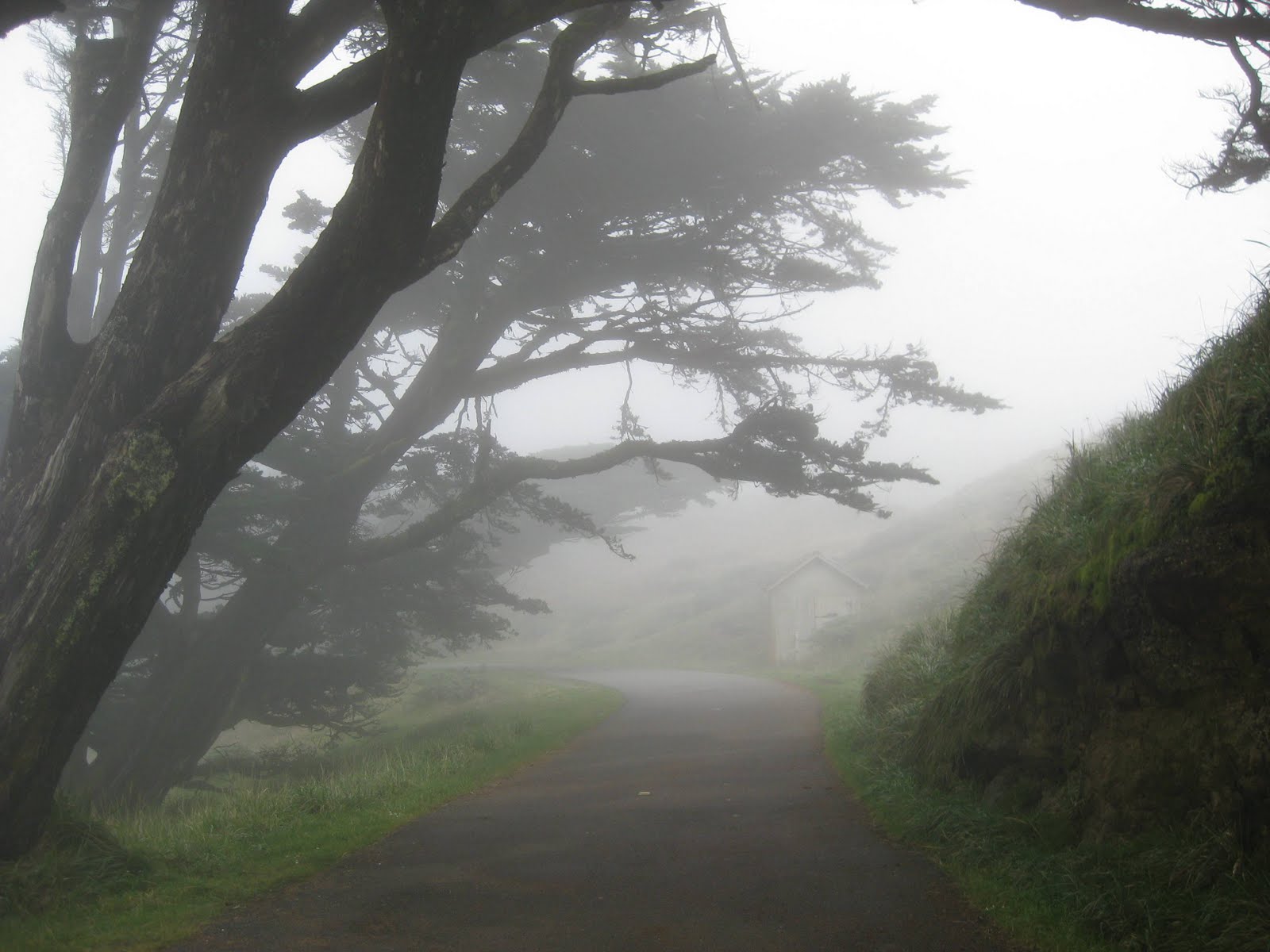
Most of the main shooting locations for THE FOG have been well-documented by Sean Clark over at Horror’s Hallowed Grounds… but I note that when he visited Point Reyes Lighthouse, it was annoyingly clear and sunny out. We, on the other hand, had plenty of natural atmosphere. In Carpenter’s film, lighthouse keeper Adrienne Barbeau takes a long drive through rolling coastline hills to get to her destination. Tourists face the same laborious trek. The drive through Point Reyes National Park was so long that we were worried we’d run out of gas on the way to our destination… and the closer we got, the more the fog rolled in. The lighthouse itself is an impressive sight, sitting on the westernmost edge of the California coast, at the bottom of a narrow 308-step staircase.
Afterwards, we made a valiant attempt to visit Muir Woods, just north of San Francisco… but the place was so crowded that we couldn’t find anywhere to park. Thus, inadvertently, we passed over Muir Woods just as surely as Hitchcock did. Originally, the director had intended to use the park as the location for his film VERTIGO, but he shot instead at Big Basin State Park, south of San Francisco… so that’s where we headed.
We breezed through San Francisco in the pouring rain – past Fort Point, where Jimmy Stewart rescues Kim Novak after she throws herself into the San Francisco Bay – and wandered up the rain-soaked hills to the oldest (and arguably the least inviting) state park in California. By the time we got there, it was nearly 4pm and the woods were eerily dark. (Most of the trees are so old, and their growth so thick, that they blot out the sky on the sunniest of days.) After an hour of driving – with no idea how far we were from the famed “circle of Redwoods” that Hitchcock featured in VERTIGO – we decided to turn around and head back to our hotel in Half Moon Bay.
The next morning, we set out again for our destination… and found the park to be infinitely more impressive in the early morning sunlight. As we drove, shafts of heavenly light (look at the photos – there’s no other way to describe it) broke through the fog and lured us in. The Redwoods themselves were just as amazing – several of them towering 300 feet above us, and boasting 2,000 years more life experience than any of us will ever have.
Being there brought to life one of my favorite scenes in any Hitchcock film – a brief bit in VERTIGO where Kim Novak muses on her death and resurrection. In a haunting whisper, she traces the years between her two lives via rings on a cross-section of a giant Redwood. “Here I was born,” she says, “and here I died.” The scene has such ethereal lighting that I’d always assumed Hitchcock used some kind of filter in this scene – like the kind old studio directors used on aging actresses, to soften their features. After visiting Big Basin, I now realize that the ethereal quality of the scene has much to do with the way that the fog naturally diffuses the sunlight there.
We managed to catch more Hitchcock location on our trip… but this one came as a complete surprise. For a couple of years, I’d been eager to visit Point Lobos State Park in Monterey – even since I saw a couple photos of the place in a travel guide. One was a photo of a grove of twisted cypress trees, looking like something out of a childhood fairy tale, and the other was a photo of a stone stairway beside a wall of strange succulents. I was even more captivated by some of the stories I’d read about the park’s mythic inhabitants, The Dark Watchers. Over the years, many visitors (including John Steinbeck!) have claimed that the Watchers are real… and that Point Lobos is a natural hub of psychic energy.
I’m a sucker for these things, so I fell in love with Point Lobos immediately. When we stopped at an old whaling cabin on the shores of the park, I learned (via a museum exhibit) that Alfred Hitchcock had the same reaction. In fact, he shot his first American film, REBECCA (1940), here. In an interview with Francois Truffaut, Hitch explained that when he came to the States he was eager to incorporate specific American landscapes into his stories. If he had made REBECCA in England, he said, “the house would not have been so isolated because we’d have been tempted to show the countryside and the lanes leading to the house. But if the scene had been more realistic, and the place of arrival geographically situated, we would have lost the sense of isolation.”Almost twenty years later, Jimmy Stewart and Kim Novak visited the same site for a pivotal scene in VERTIGO (1958). It is, not coincidentally, the moment when Stewart finally embraces the illusion that will destroy him.
Point Lobos conveys the sense that one has reached the end of the earth... or maybe fallen over the edge. Whether that’s due to the strange sights all around the place or to the presence of Dark Watchers, who can say? Either way, it was a perfect end to the trip.