Showing posts with label Planet of the Apes. Show all posts

Wednesday, April 25, 2012

FOUR CORNERS TOUR, Part 3: Page & Lake Powell


Driving into Page, Arizona, is a surreal experience.  Amidst miles and miles of open desert, the last thing you expect to see is a giant body of water.  The city of Page sits at the base of man-made Lake Powell, and practically glows with its unique combination of bright blue water and bright orange sandstone formations.  Just north of the lake is Glen Canyon National Recreation Area.  Further north and east is the Grand Staircase-Escalante National Monument. To the south and east are the Navajo and Hopi Nations.   In other words, this city is nestled in the hub of some of the most vast and beautiful scenery in the American southwest.  It’s hard not to feel a bit awe-struck here.

So it should come as no surprise that this is where Hollywood decided to re-tell THE GREATEST STORY EVER TOLD.  The Biblical epic, starring Max von Sydow as Jesus Christ and a young Charlton Heston as John the Baptist, began filming while the Glen Canyon dam was still under construction in the early 1960s.  According to James V. D’Arc’s When Hollywood Came to Town, the first shots were made at the Crossing of the Fathers site on Lake Powell.  A few years later, Heston returned to Lake Powell... only this time it was known as the PLANET OF THE APES.  The opening scenes were shot on the banks of Warm Creek Bay. 


I found that the best way to see these sites was to take a boat tour from Wahweap Marina.  The destination of that tour wasn’t too shabby either.  After two hours on the meandering “lake,” we entered a narrow cove and saw Rainbow Bridge, one of the seven natural wonders of the world.  This 230-foot-tall arch was created a few hundred millions years ago by a combination of wind (on top) and water (underneath).  To the Native Americans, it is a sacred religious site -- a rainbow turned to stone.  For that reason, tourists are no longer allowed to pass beneath it.  Regardless, the sight leaves one speechless.  (It was a very quiet boat ride back to Wahweap Marina.)  


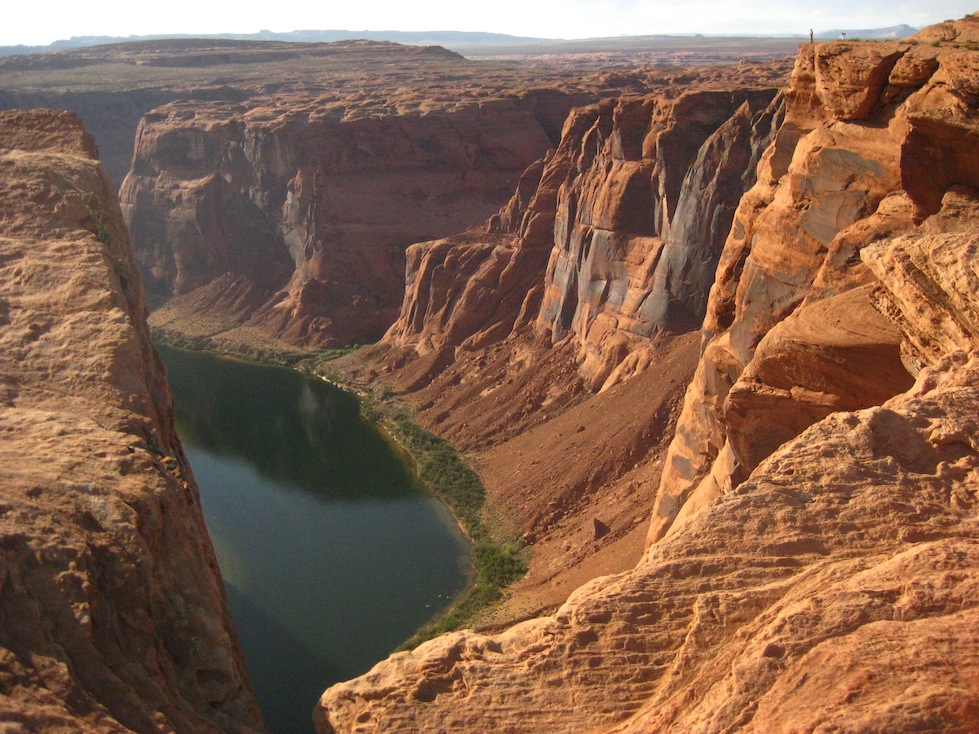
Just south of Page is another staggering work of nature: a bend in the Colorado River that has produced a giant monolith.  From the cliffs above the ancient riverbed, it is frankly terrifying to look over the edge.  The drop is roughly 1,000 feet.   I found it almost impossible to get a camera perspective on the scene that effectively illustrates the scale.  Only a couple of photos that feature other visitors (one standing on the edge of the cliff, one in a tiny boat on the beach below) give it the proper perspective.   After looking up Horseshoe Bend on Wikipedia, I realize that none of my photos captured its beauty. 

 
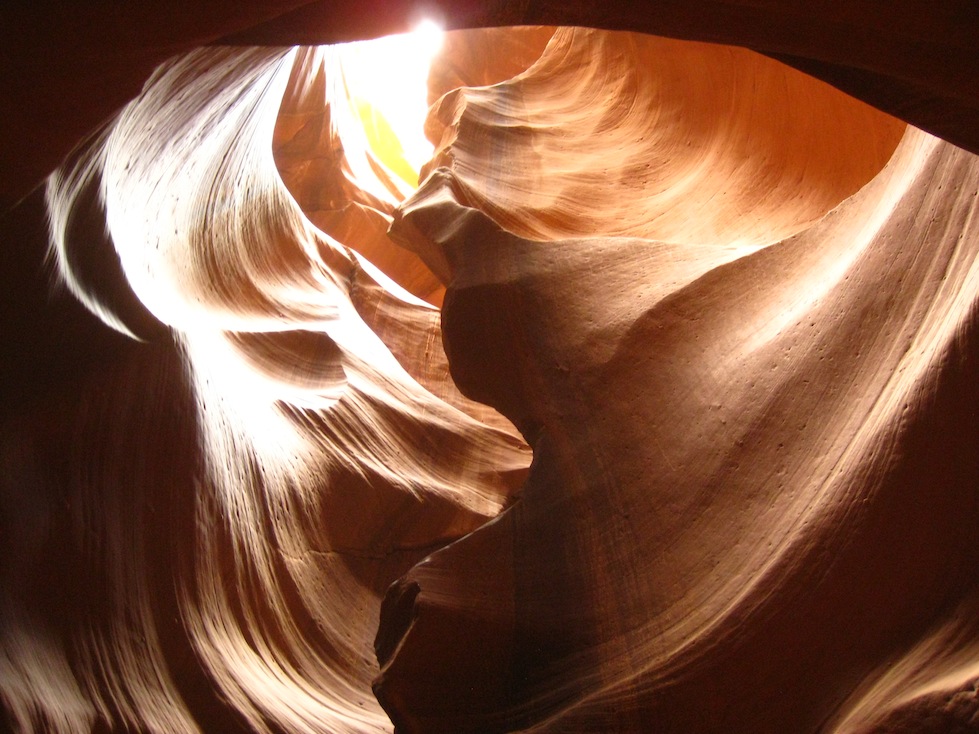
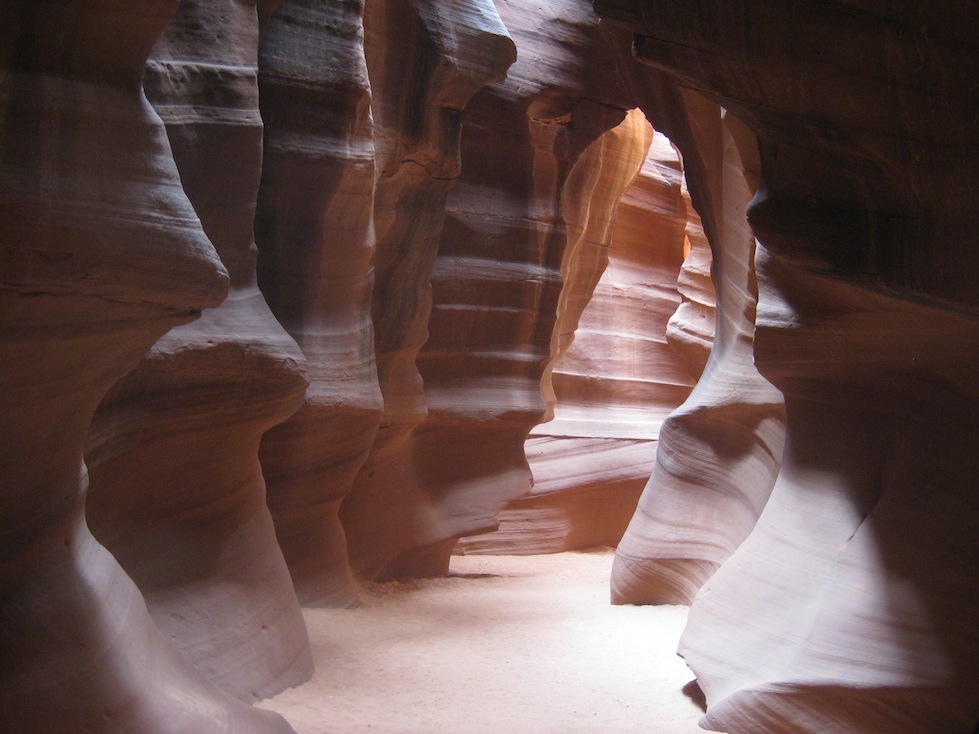
This was not, however, the most breathtaking thing I saw in Page.  My favorite part of last week’s trip may have been a brief Navajo-led tour of Antelope Canyon.   My tour guide Bonnie had an obvious passion for the place, pointing out every significant feature she’d ever noticed inside the narrow slot canyon, and even telling a few stories about their meanings to the Navajo people.  I learned that nature is never an object to the natives.  The sky, the trees and, yes, even the rocks are every bit as alive as we are.  Standing in Antelope Canyon, this was not at all difficult to comprehend.  On that note, maybe I should let the photos speak for themselves.

Tuesday, December 25, 2007

Merry Christmas from Mars!

L’s family has an unlikely tradition of going to the desert on Christmas Eve. I think the rationale is something like this: “If you can’t have a winter wonderland, might as well seek out scenery that’s equally exotic.” Last year, we went to Joshua Tree. This year, we drove north into the Mojave Desert to see the Trona Pinnacles.


This is a surreal sight to come upon in the middle of a huge dry lake bed – some five hundred calcium carbonate stalagmites rising out of the earth. The pinnacles were formed 10,000 to 100,000 years ago, when they were at the bottom of Searles Lake – a link in a chain of lakes stretching from Mono Lake to Death Valley. The Trona Pinnacles were designated as a national natural landmark in 1968, and have since been featured, appropriately enough, in several science fiction movies – including “Star Trek 5: The Final Frontier” (where Kirk talks to God) and Tim Burton’s remake of “Planet of the Apes.” Of course, neither the films nor these photos can do justice to the grandeur of this site.

A few months ago, I read a book called “The Desert,” by an art historian named John C. Van Dyke. In 1898, Van Dyke wandered alone into the unsettled Colorado Desert, accompanied only by his faithful dog. When he returned, he had written a beautiful book about the strange appeal of the forbidding landscape he encountered. I can think of no better words to accompany these photos.


"How often have we wondered why the sailor loves the sea, why the Bedouin loves the sand! What is there but a strip of sky and another strip of sand or water? But there is a simplicity about large masses – simplicity in breadth, space and distance – that is inviting and ennobling… The waste places of the earth, the barren deserts, the tracts forsaken of men and given over to loneliness, have a particular attraction of their own. The weird solitude, the great silence, the grim desolation, are the very things with which every desert wanderer eventually falls in love. You think that very strange perhaps? Well, the beauty of the ugly was sometimes a paradox, but to-day people admit its truth; and the grandeur of the desolate is just as paradoxical, yet the desert gives it proof."


“What is it that draws us to the boundless and the fathomless? Why should the lovely things of earth – the grasses, the trees, the lakes, the little hills – appear trivial and insignificant when we come face to face with the sea or the desert or the vastness of the midnight sky? Is it that the one is the tale of things known and the other merely a hint, a suggestion of the unknown? Or have immensity, space, magnitude a peculiar beauty of their own? Is it not true that bulk and breadth are primary and essential qualities of the sublime in landscape? And is it not the sublime that we fell in immensity and mystery? If so, perhaps we have a partial explanation of our love for sky and sea and desert waste. They are the great elements. We do not see, we hardly know if their boundaries are limited; we only feel their immensity, their mystery, and their beauty.”

Monday, July 23, 2007

Happy Trails

Someone asked me this week what I’m trying to accomplish with this blog. It started out, a little over a year ago, as a genealogy forum – a way to share photos and information related to my own family history. Within a few months, I had pretty much exhausted that subject. Around the same time, I took a trip to New England to do some genealogy research, and visit sites associated with some of my literary heroes. When I got home, I posted photos from the trip. Since then, this has become mostly a travel-blog, with occasional detours into movie geek ranting. In October, I charted my cross-country move to Los Angeles. I’ve been writing about Southern California ever since. I am continually fascinated by the overlap of fact and fiction in Los Angeles, and I’ll probably keep blogging about it until my site-meter tells me that nobody cares anymore.

This weekend was another reminder of why I love this city. On Saturday morning, we went to Malibu Creek. This state park was one of our first stops when we visited L.A. last August. We made the mistake of starting a hike to the old M*A*S*H shooting location in the heat of the day. On Saturday, we started out a bit earlier and followed a different route to another famous filming location: the Rock Pool.

Along the way, we stopped by the Visitor’s Center, where we found information on hundreds of films that have been shot in the park since 1927. At that time, the land belonged to the Crags Country Club, but 20th Century Fox bought 2,000 acres in 1946 and turned it into a backlot. The studio built a Welsh mining village on a hill near the main parking lot for John Ford’s 1940 Oscar-winner “How Green Was My Valley.” The parking lot didn’t exist at the time. It was created as downtown “Pleasantville” for the 1998 film of the same name. And before it was Pleasantville, it was the ranch in Elvis Presley’s feature film debut, “Love Me Tender.”

Malibu Creek was also home to the original “Planet of the Apes.” Along the main path to the Rock Pool (Crags Road), we passed a climbing wall. In his book Hollywood Escapes, Harry Medved points out that “this is where Charlton Heston, Linda Harrison, and other humans are caged in the first Apes movie. The wall itself is visible in the last Apes movie, where Claude Akins tries to take control of the simian forum.” The Rock Pool appeared in “Planet of the Apes” (when Charlton Heston and his fellow astronauts go skinny dipping), “Battle for the Planet of the Apes” (the final scene), and the feature film “Logan’s Run” (when Logan and Jessica see the “real world” of the 23rd century for the first time). I also remember it from Disney’s “Swiss Family Robinson” – one of the first movies my family owned on videodisc. Further up Crags Road is the original site of the Apes Village – one of the cages is still there. The M*A*S*H site is about a mile beyond that. Sadly, none of the sets survived a 1982 fire that wiped out 42,000 acres in the park. All that remains are the charred husks of a jeep and an ambulance.

After our hike, we decided to take it easy and go to the movies… at Hollywood Forever Cemetery. For six summers now, a group called Cinespia has been screening movies on the wall of a large mausoleum near the graves of Hollywood legends like Douglas Fairbanks, Rudolph Valentino and Cecil B. DeMille. Every week, the event draws about 2,000 people, who arrive with blankets, pillows, and all the essentials for a late-night picnic. When we got to the cemetery – an hour and a half before the film was supposed to start – there were already hundreds of people lined up to see Dario Argento’s “Suspiria.” Personally, I can think of no better way to see this film than on the side of a mausoleum in a dark cemetery. It gave me chills to hear the pulse-pounding Goblin soundtrack echoing off of the tombstones, loud enough to… well, you know.

I could tell by the laughter and the gasps in the audience that quite a few people were seeing the film for the first time, which made me remember the first time I’d seen it. I first ran across the name Dario Argento in Dennis Fischer’s book Horror Film Directors, 1931 – 1990. That volume, more than any other individual work, introduced me to international horror cinema – from the gialli of Mario Bava and Dario Argento to the Euro-horror of Lucio Fulci, Jess Franco and Amando de Ossorio. Though I’d read all about it, that first viewing of “Suspiria” blew me away. Never had I seen a horror film that looked so exotic, or heard a horror film score that was so unrelenting.

A few years ago, I had the same reaction to the first fifteen minutes of Argento’s film “Sleepless.” Unfortunately, the rest of it didn’t live up. The director’s films are, admittedly, hit and miss: they feature some of the horror genre’s most memorable set pieces, as well as some of its most ludicrous plot devices. I haven’t seen his two most recent films (“The Card Player” and “Do You Like Hitchcock?”), but they’re in the Netflix queue… and I’m eager to see the conclusion of the “Three Mothers” trilogy that began with “Suspiria.” It’s supposed to be released in Italy on Halloween.

Last night, we went to another location that’s far too beautiful to avoid Hollywood cameras. The beginning of “Grease” and the end of “True Romance” were shot among the rocks at El Matador State Beach, up the coast of Malibu. We had planned to stay until sunset, but a serious-looking fog bank rolled in. And if there’s one thing John Carpenter has taught me…

Malibu Creek State Park (view from the parking lot)

How Green Was My Valley (not very)

Malibu Creek in the foreground, Rock Pool gap in the distance

Planet of the Apes wall


Rock Pool


M*A*S*H jeep

M*A*S*H ambulance

Century Lake

Hollywood Forever


El Matador

Sunday, June 17, 2007

Psycho Beach Party

This weekend, I started reading a book called Hollywood Escapes: The Moviegoer’s Guide to Exploring Southern California’s Great Outdoors (St. Martin’s Griffin, 2006), which prompted me to head for the beaches of Malibu. And not just to soak up the sun.

Along some thirty-odd miles of coastline between Santa Monica and Santa Barbara, there are more than a dozen beaches where several memorable (and some not-so memorable) feature films have been shot. The Creature from the Black Lagoon (1954) first came ashore at Will Rogers Beach. Clarence and Alabama vacationed on El Matador State Beach at the end of Quentin Tarantino’s True Romance (1994). Frankie Avalon and Annette Funicello performed musical numbers on the Malibu beaches in AIP’s “lovably inane” Beach Party series, shot in and around Paradise Cove.

I confess I have never seen any of the famous Malibu beach party films – I prefer AIP’s experiments with Roger Corman, which brings us to the rocky shores of Leo Carrillo State Beach. This is where Corman directed portions of Attack of the Crab Monsters (1954), The Saga of the Viking Women and Their Voyage to the Waters of the Great Sea Serpent (1957), and Jack Nicholson’s LSD opus The Trip (1967). The beach is also featured in the Corman-produced Monster from the Ocean Floor (1954), The Terror (1963), and Peter Bogdanovich’s Voyage to the Planet of Prehistoric Women (1968). (It’s also where Mr. Miyagi taught Daniel how to “crane kick” in The Karate Kid.)

Years of erosion have created sea caves in the rock just below Lifeguard Station #3 – making it look like the perfect place to find a prehistoric crab monster… or hide from a prehistoric monster (see the 1959 adaptation of Journey to the Center of the Earth)… or bury a body (Benicio del Toro ended up here at the end of The Usual Suspects). Independent of their ominous screen history, the caves convey a real sense of danger during high tide. I couldn’t help thinking of a segment I produced for Survive This!, about an unwitting tourist who got swept into a sea cave off the coast of Oahu and couldn’t get out: the incoming waves kept slamming him against the jagged rock wall at the back of the cave until he was too tired to swim out. Thankfully, when we visited Carrillo State Beach, the tide was low… so we walked right into the caves.

Further south, we visited Point Dume – the site of one of film history’s most iconic moments. Point Dume is a 35-acre natural preserve, sitting on top of a 200-foot-tall triangular headland that juts out into the ocean. On the north side is Zuma Beach, which has been featured in the finales of several offbeat films: Robert Aldrich’s classic film noirs Kiss Me Deadly (1955) and What Ever Happened to Baby Jane? (1963), and the Coen Brothers’ Barton Fink (1993) and The Big Lebowski (1998). On the south side is Pirate’s Cove, recognizable as “the forbidden zone” from the closing moments of Planet of the Apes (1968). At the far south end of the cove is the site where Charlton Heston saw the remains of the Statue of Liberty.

We took a long, winding way home on Mulholland Highway, to catch a glimpse of one more famous filming location. Malibou Lake sits in the center of an exclusive neighborhood, not far from the Paramount Ranch. It looks just as serene as it did in James Whale’s Frankenstein (1931), when the Monster accidentally drowned an innocent girl there.
That’s a lot of film history to cover in one day, but it barely skims the surface of Hollywood Escapes.


Malibou Lake


Leo Carrillo State Beach


Corman’s Cave


Westward Beach


Pirate’s Cove (looking south)


north end of Pirate’s Cove


view from above


south end of Pirate’s Cove