Showing posts with label Steven Spielberg. Show all posts

Sunday, January 16, 2011

MOVIES MADE ME #2: POLTERGEIST


Second title, and already a theme... Seriously, nobody grew up in the 1980s without being influenced by Steven Spielberg.

Of course, there's the old debate over whether or not POLTERGEIST is more of a Spielberg movie or more of a Tobe Hooper movie... John Muir has written (in his book Horror Films of the 1980s) that it's a Spielberg movie until Tangina (Zelda Rubenstein) announces "this house is clean"; after that the story veers off the rails into Hooper's more surrealistic head-space. This is a sound argument, but as I was watching the movie a few nights ago I kept thinking that POLTERGEIST is not quite so stylistically coherent.

First things first: POLTERGEIST is NOT a ghost story. The storytellers don't seem to know much of anything about the pseudo-scientific phenomenon known as poltergeist activity. Instead, this is a movie about aliens disguised as ghosts. It has all the child-like, other-worldly speculation of Spielberg's CLOSE ENCOUNTERS OF THE THIRD KIND or Tobe Hooper's INVADERS FROM MARS, but ghosts - instead of aliens - are providing the loose justification for the wide array of strange images and events. Even if you genuinely believed in ghosts, POLTERGEIST is pretty tough to swallow. The best way to approach the film may be to try and watch it the way a child would.

I was about seven when I saw POLTERGEIST for the first time, and film affected me just as powerfully as JAWS. In some ways, even more so... because JAWS (like CLOSE ENCOUNTERS OF THE THIRD KIND) is about a family that's separated by monsters. In JAWS, Roy Scheider pursues the shark even though he could have easily stayed at home with his wife and kids. (I'm with Gil Scott-Heron on this one.) In CLOSE ENCOUNTERS, Richard Dreyfus blatantly chooses aliens over his wife and son. In POLTERGEIST, however, Craig T. Nelson and JoBeth Williams do everything in their power to protect their children.

Of course, they're hopelessly outmatched... because the "poltergeist" in this movie can do anything and everything a 7-year-old's wandering mind can think of. Carol Anne's "TV People" not only stimulate hallucinations, rattle walls and move furniture... but they can also possess trees, conjure tornadoes, eject corpses from the ground, and turn an ordinary clothes closet into a magnetic Sarlac pit.

A few years ago I worked on a TV series about allegedly true ghost stories, and while I'm not going to suggest that everything in that show really happened, we did try to adhere to the popular theories about ghosts and demons that are espoused by paranormal experts. In POLTERGEIST, the only rule is that hauntings revolve around places (and can continue for years) while poltergeist activity revolves around people (and usually doesn't last very long). Based on the fact that a young girl has been ghost-napped, the experts in this film conclude that the family is dealing with poltergeist activity. Then, inexplicably, they start flip-flopping on whether or not it's a good idea for the lost girl (who has... what? dematerialized?) to "go into the light."

If memory serves, renowned ghost hunter and author Hans Holzer was the one who first claimed that poltergeist activity is the result of psychokinesis in pubescent girls (and occasionally boys). The thing is: Carol Anne, the little girl in POLTERGEIST, is pre-pubescent... and psychokinesis doesn't explain how she manages to disappear, via the family television set, into a parallel dimension... only to emerge days later from the living room ceiling like an aborted fetus from an alien spaceship. In several years of researching and talking to people about allegedly true experiences with ghosts and demons, no one even came close to telling me a whopper like this. (I wish they had, because we would have embraced it.) Reflecting on the film now, I'm reminded of Harlan Ellison's scathing review of BACK TO THE FUTURE, in which he lambasted the filmmakers for ignoring the most basic concepts of time travel. Paranormal investigators must feel the same way about POLTERGEIST.

Despite all of these problems, I can't be too hard on POLTERGEIST. This was a movie that really piqued my curiosity about death and the afterlife. I'm still captivated by the sequence in which Dr. Lesh (Beatrice Straight) tells Robbie about "the other side." Their entire conversation takes place in the dark, in whispers. Robbie, contemplating the idea of ghosts for the first time, worries that maybe the house is haunted by a bully from his school who got hit by a car. (You'd think that a kid who had just been half-ingested by a tree would already have bigger fears than bullies from school... but I digress.) Dr. Lesh calmly reassures him with stories about a "beautiful white light," while John Williams's music swells. It's pretty simplistic stuff, but that's the beauty of the thing. This scene is a supernatural variation on the boat scene in JAWS... it pulls us into a realm where anything is possible, if only for a moment.

As a 7 or 8 year old kid, it wasn't at all difficult for me to believe in man-eating trees, killer clown dolls, or the possibility that a person's entire face could melt off. (I had nightmares for weeks about that one.) Likewise, it wasn't difficult for me to believe in that white light. The beauty and the terror associated with "the other side" were all mixed up in my imagination, and they were - for the duration of the film - much more real than the world around me. Even now, I can't watch POLTERGEIST without re-experiencing a little bit of that childhood awe. I've had the same experience when visiting locations associated with the film - the neighborhood in Agoura Hills that doubled as Cuesta Verde, and the house in Simi Valley where the Freelings beat the devil.

I also recently visited the cemetery in Westwood where Heather O'Rourke, the actress who played Carol Anne, and Dominique Dunne, the actress who played Carol Anne's older sister, are both buried. Dunne was murdered just a few short months after POLTERGEIST was released in 1982. O'Rouke died tragically a few years later, during the making of POLTERGEIST 3. She was only 12 years old, and her loss traumatized the cast and crew. (You can read more about the trials of the production here.) Real-life tragedy aside, POLTERGEIST 3 was a troubling film because it separated Carol Ann from the family that literally went to hell and back to protect her in POLTERGEIST 1 & 2. Apparently, the filmmakers didn't realize that those earlier films worked precisely because of the family dynamic. The love of the parents for their children proved powerful enough to overcome fear and even death... and that's what I took away from that first viewing of POLTERGEIST.

The Pierce Brothers Memorial Park in Westwood is home to quite a few actresses who died young - including Marilyn Monroe, Natalie Wood and Dorothy Stratten. I visited the cemetery on a Saturday morning, and the place was crawling with movie fans in search of their favorite stars. With so many famous people buried there, the cemetery - like POLTERGEIST - inspires more wonderment than fear or sadness. Since none of us really knows what's on "the other side," that seems completely appropriate to me.


Sunday, January 09, 2011

MOVIES MADE ME #1: JAWS


One of my all-time favorite books is Geoffrey O'Brien's THE PHANTOM EMPIRE: MOVIES IN THE MIND OF THE 20TH CENTURY - a wonderfully geeky exploration of the idea that the movie-watching experience affects many of us just as deeply as real life experience. O'Brien writes:

Films get their hooks into you by propping up memory, or perhaps more accurately by substituting for memory. You can trace each image back to an original encounter; various rooms, theaters, even nations exist primarily as the place where a particular image first emerged. "Ankara is where I first saw PILLOW TALK." More than anything the pictures serve as reminders of the people who watched them. That's the post-apocalyptic science-fiction movie about giant cockroaches in Los Angeles that so deeply and inexplicably disturbed Michael. That's the doomed starlet on whom Frieda modeled her youth. That's the sentimental wartime fantasy that Dave has spent his adult life attempting to reenact. That's the comedy that Patrick watched on Channel Nine the night before he jumped. There were movies endured during all-night sieges of insomnia, movies left on while making love, movies clung to in the wake of disaster as a substitute for grieving. There were movies used as a focus point, to give the group something to laugh at or to dream about, or simply to allow them a brief respite from being so endlessly involved with one another...

I thought about this a lot while I was making my documentary on horror films -- in fact, it's the note that I ended on: Movies and reality are hopelessly conflated in the minds of many contemporary viewers. Most of us will always remember where we first saw our favorite films, who we saw them with, and exactly how we reacted to key scenes. My favorite films are burned into my brain - not necessarily because they're brilliant pieces of art (some are; some most definitely are not), but because they caught me at a particular time and place in my life, and held me there for two memorable hours. By the time the end credits rolled, those movies had become part of who I am as a living, breathing, thinking human being. This might sound a little over the top, but I'm going to try to show you what I mean.

A few months ago I changed the title of my blog to MOVIES MADE ME, with the idea of devoting this space to a series of essays on my favorite films. My plan is to work my way down a long list in the upcoming year or so. I'm kicking things off with a movie that's been a formative influence in the lives of countless moviegoers: Steven Spielberg's JAWS.

JAWS didn't keep me away from the beaches as a kid. In fact, just the opposite. I used to watch JAWS on video at the beginning of each summer -- it was my way of preparing for our annual trip to Virginia Beach, and a ritualistic way of ringing in the season. That's probably because, when I first saw the film, I wasn't half as captivated by the shark as I was by the three characters who hunt it. For me, JAWS was less of a horror movie and more of a heroic epic -- a modern-day version of MOBY DICK or 20,000 LEAGUES UNDER THE SEA. In high school, I even wrote a paper comparing JAWS to BEOWULF.

The key difference between JAWS and those other epic adventures is that Quint - the modern-day equivalent of Ahab, Captain Nemo and Beowulf - is not the main hero. The hero in JAWS is Police Chief Martin Brody, an everyman and a very sympathetic father-figure. I remember thinking, even as a six year old, that he wasn't that different from my own dad. How could anyone fail to love him after the scene where he's sitting at the dinner table with his son, making faces for the boy to mimic? God bless Roy Scheider.

Here's how I remember it: My father had just gotten a membership at the new video store in my hometown. After recognizing how I gravitated to the horror section of the store, he rented MICHAEL JACKSON'S THRILLER and JAWS. I think he chose the former because it featured a long making-of documentary. Those behind-the-scenes features showed his ridiculously impressionable six-year-old son that movie monsters are simply the result of makeup and special effects. I'm not sure why he chose to rent JAWS... maybe to test my nerve. All I know is that, when it came time to watch the second feature, the rest of my family disappeared to a back bedroom and left me alone in the living room to tackle JAWS.

About a year ago, an interviewer for Fangoria TV asked me to identify my favorite horror movie scare scenes. The interviewer suggested "the scene in JAWS where the shark pops out of the water for the first time." I responded that those kind of "jump scenes" aren't usually what scare me in horror movies. I explained that the scene in JAWS that affected me most profoundly is the one where Quint, Brody and Hooper are on Quint's boat at night, sharing war stories. I still think this is one of the most brilliant sequences in modern film history.

There are basically four parts to this sequence. The first part begins with the otherworldly sounds of a whale song -- a subtle cue that we've crossed over into a kind of mythic realm. Quint and Hooper begin comparing "battle wounds," prompting us to think about the possible repercussions of a shark attack while keeping things disarmingly light with their competitive humor. The conversation culminates with Hooper's drunken reference to the girl who broke his heart. Then the tone shifts suddenly as Quint recounts his experience on the U.S.S. Indianapolis. For me, Quint's monologue was more unsettling than the scene where a kid gets attacked by a shark and erupts in a geyser of blood - because it haunts the imagination rather than simply shocking the eyes.

I remember listening to Quint's story for the first time, and imagining myself in his situation. At the time, I was sitting in an old recliner in the middle of the living room floor. To a six year old, that living room was HUGE... I might just as well have been in the middle of the ocean. And it was dark. In the hour since I had begun watching the movie, night had fallen outside and suddenly the only light in the room was coming from the television. The only light in my world was the light on that boat... and Quint was slowly stealing it away with his haunting memories of being alone in the water at night, while hungry sharks were circling around him.

Spielberg lets the tension in the scene build for an excruciatingly long time. Then, because he's a master craftsman, he lets us down gently... A few moments later, the jovial atmosphere returns and all three heroes start singing drunkenly. That's when the shark finally attacks - literally pummeling the boat and prompting us to expect the worst. A slight leak suggests that the boat is far from unsinkable, and at that point our brains can't help gnawing on the fresh details of Quint's story... particularly the part about waiting to die. The heroes listen and wait. We, the audience, listen and wait. The night is silent. After a few moments, it becomes clear that we've survived... for now. But the drinking games are over, and you can bet that no one on that boat or in the audience will be sleeping too peacefully in the hours that follow.

It was only after that scene ended that I realized how immersed in the film I really was. I had lost all sense of self-awareness. I had surrendered my own reality in favor of the story's reality. Right away, I realized how effectively the storyteller was manipulating my emotions. For me, that moment of realization was profound. If I had to identify a single moment when I became a movie geek, that would be it.

How did I respond? I eagerly dove back into the movie and didn't come up for air until it was over. At that point, with my adrenaline finally starting to wane, I felt utterly euphoric. After JAWS, I was like a 6-year-old heroin addict, eager for more... and to this day, every time I sit down to watch a movie, I'm still waiting for my next fix.

(Note: The JAWS illustration above is by Justin Reed. You can check out his amazing portfolio on his website, Justin Reed Art.)

Sunday, February 01, 2009

Harlan Ellison's Watching


Reading Harlan Ellison’s Watching (M Press, 2008 - reissue), I couldn’t help thinking that it must be exhausting to be Harlan Ellison. Despite his unimpeachable credentials as one of the greatest living science fiction / fantasy writers of our time (he has produced 7 novels, 6 graphic novels, hundreds of memorable short stories, and served brief stints on The Outer Limits, the original Star Trek series and the mid-80s Twilight Zone resurrection), he is perhaps best known to the younger generation as an outspoken curmudgeon who seems to fault with everything.

Over the years, he has made more than his fair share of enemies in Hollywood by speaking his mind about the sorry state of the American cinema, and his published opinions are gathered together in this omnibus of “essays in the realm of film criticism.” The goal of the essays, Ellison says, is not to evaluate films for their entertainment value or storytelling ability (though he rightly blasts Stanley Kubrick’s 2001 for its utter failure to tell a story) but as art and artifacts of our distinct culture. “No film is ever made in a vacuum,” he claims, “It is a murky shadow in the cultural mirror.” Suffice it to say that he doesn’t always like what he sees in the mirror, which leads to a fair amount of fire-breathing.

Ellison’s career as a film critic began in the late 1960s, with attacks on popular films that he felt were “lying” to the American public – presenting old-fashioned values that contradicted the zeitgeist of a new age. He hit his stride as a critic over a decade later, when he began railing against the mindless blockbuster fantasies that defined the children of the 80s. Throughout the decade, his criticism is unusually incisive – as when he points out an undercurrent of mean-spiritedness in a string of family-oriented films from Steven Spielberg (Indiana Jones and the Temple of Doom, Gremlins and The Goonies). He responds to dishonest filmmaking as if it was intended as a personal attack against him, and does so with an always-entertaining sense of humor.

In his very first film review, he notes that John Frankenheimer’s The Train is “unlike much of what makes money these seasons” in that it “does not pass through the viewer like beets through a baby’s backside.” A few articles later, a lesser film “has all the appeal of attendance at a snails’ convention.” One actress receives a particularly harsh drubbing: he compares her singing to “the pathetic burbling of a titmouse drowning in a milk pitcher.” Entertaining as it is, one cannot say that the humor is lighthearted. Who else but Harlan Ellison could get so angry over Back to the Future? He calls Robert Zemeckis’s time-travel fantasy “flapdoodle,” “ka-ka,” a “piece of drippy dreck,” and “a celluloid thing as trivial as a twinkie.” His main reason for hating the film: “The lofty time paradox possibilities are reduced to the imbecile level of a sitcom.”

He’s right, of course. Even as a child I realized that the repercussions of time travel, as explained in the film itself, should be more complicated than the plot demonstrates. Such cop-outs, for Ellison, are symptomatic of brain-dead “sci-fi” (a term he loathes), and they undermine his willingness to suspend disbelief. Obviously, that was not a problem for the children of the 80s… but this comes as no surprise to Ellison, who dismisses most of that generation as “Know-Nothing Tots” raised on MTV’s sound and fury signifying nothing. With his trademark acerbic wit, he condescendingly instructs his readers on the lost art of satire, dismisses the silly pretentiousness of the auteur theory (Peter Bogdanovich serves as whipping boy in several essays) and lambasts the contradictory laziness of homage. At the end of the day, he is far more committed to criticizing mainstream American moviegoers than any particular movie. At times, Ellison’s writing on film sounds like Hunter Thompson’s writing on sports – it’s more rant than review, and need not stick to the topic at all. That’s the initial appeal of his criticism: entertainment. But, like Thompson, Ellison is not just funny – he’s also whip-smart, and leaves you thinking.

He explains his critical method as follows: Good criticism is comprised of four elements – background information, general knowledge, sophisticated judgment, and (above all) affection for your subject. The last component is visible early in the collection when he discusses the influence of RKO producer Val Lewton, who cemented his love of the cinema at an early age. Ellison explains, “When I draw my last breath, and finally buy it… I’m going to pass up meeting Hemingway and Shakespeare and W.C. Fields and Bogart and Marta Toren first thing on my arrival, and ask to be directed to the alabaster palace in which Val Lewton is spending a happy eternity…. Oh, yeah. He’ll be in a palace. Got to be. Nobody who produced films like The Leopard Man… could be treated less respectfully by a benevolent God.” Generally, Ellison praises “people stories,” “films that cast some new light on the human condition.” This, he explains, is what makes great science fiction / fantasy. (Think of Ray Bradbury turning Sherwood Anderson’s Winesburg, Ohio into The Martian Chronicles.)

Which brings us to what he hates... a list so long that we have to confine ourselves to hitting only the highest notes. Steven Spielberg – as well his buddy George Lucas – take the most lumps in Watching. Ellison’s essay on Star Wars is bitter, ruthless, and thought-provoking. “The characters are comic strip stereotypes,” he complains, adding that the young audience won’t learn anything practically useful from them the way he learned from the fantasy serials of his own childhood. This is a highly debatable point, but it certainly offers an interesting critical stance from which to approach the original film and its sequels… and, if one is inclined, the state of American cinema since the rise of the summer blockbuster.

The comparably few 80s fantasies of which Ellison approves are certainly worth another look: Dune (one chapter deals with the making of this commercially-disastrous epic), Labyrinth (“a film made by adults that renews and revitalizes the perception of the world we had as children, yet operates on many other levels”), Return to Oz and Star Trek 4: The Voyage Home (which Ellison claims is the best in the series!). I may not agree with everything he says, but I’m happy to follow up on the recommendations of anyone who can be both passionate and organized in their thinking… not to mention anyone who has spent as much time creating memorable stories as he has criticizing them. Like the best of the films he discusses, Harlan Ellison’s Watching is worth thinking and talking about afterwards.

While I’m on the subject of good criticism, let me also point you toward the latest issue of a very worthwhile new online journal: The Modest Proposal

Monday, November 27, 2006

Plastic Fantastic Universal Studios

This weekend, L. and I went to Universal Studios... which made me question whether or not I’m too old to truly appreciate amusement parks. When I was a kid, I loved going to King’s Dominion and Busch Gardens in Virginia – my family would buy season passes, and we’d go every other week throughout the summer. I was a little disappointed to find that, at Universal Studios, there is nothing to compare with the rollercoasters at King’s Dominion or Busch Gardens. The Revenge of the Mummy rollercoaster is too short, and the Jurassic Park water ride is tame by comparison.
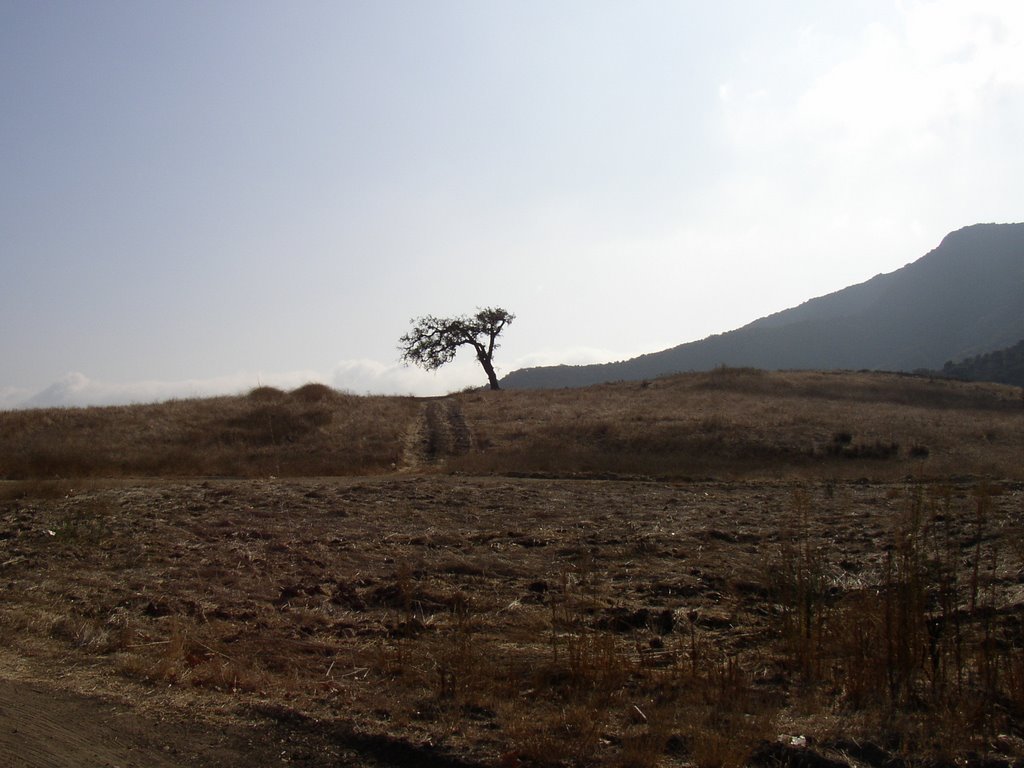
The main attraction for me, of course, was the studio tour… but I have to say that I have much prefer self-designed tours of random shooting locations in and around Los Angeles. Just this past Friday, I went to visit a friend in Agoura Hills and made a detour through the neighborhood where they shot exterior establishers for Poltergeist. (The main house is in Simi Valley.) As I wandered, I could practically hear the theme song in my head. On the edge of the neighborhood, there was also a random shooting location from Phantasm. Being there made the movies seem more real.
I learned about these locations from a guy named Sean Clark, who runs a website called “Horror’s Halloween Grounds.” He writes: “When we as fans visit these locations it is not unlike returning to a childhood home we haven’t seen in decades. They hold a special place in our lives. A piece of nostalgia from a classic moment in time. Even though you may have never been there before, you feel at home.”

I saw Poltergeist for the first time when I was seven years old and my mother was in the hospital. That movie scared the bejesus out of me. I still remember sitting in a darkened room while the credits rolled across the screen, listening to that ethereal theme music and feeling completely disoriented, as if I was only half awake. I knew that the things that happened in the movie couldn’t really happen… but scary movies served as a safe, friendly reminder that bad things could happen. Oftentimes, when people ask me why I like horror movies, I think of that particular time when I was learning to cope with the realization that bad things could happen. Driving through the neighborhood of Agoura Hills (called Cuesta Verde in the movie), I remembered how real the movie had been for me when I saw it for the first time.

I had a completely different reaction to the Universal tour. The back lot made everything seem fake. You may be protesting: "Of course it seemed fake. Sets on a back lot are fake." Often, they’re just wood and foam façades – one or two sides of a building, with nothing behind them. This came as no surprise to me, but it was still a little disappointing to imagine some of my favorite films being shot in such a sterile environment.

Universal films have always been known for their grandeur. When Carl Laemmle founded the company during the silent film era, he aspired to create “the entertainment center of the world.” The studio’s first major success was the extravagant Lon Chaney feature The Hunchback of Notre Dame (1923). They followed up with The Phantom of the Opera (1925), which necessitated the building of the first front lot stage (now known as #28). These two films became templates for the Universal monster movies of the 1930s – Dracula (1931), Frankenstein (1931), The Mummy (1932) and The Invisible Man (1933) – which kept the studio going strong through the Great Depression. Many of these horror films (as well as portions of the 1929 Best Picture All Quiet on the Western Front) were shot on the back lot’s “Little Europe,” which we passed on the tram tour. Sadly, the films were mentioned only briefly by the tour guide (“Hey look, there goes the Invisible Man…. Just kidding.”)
Despite the fact that the Psycho house and the Bates Motel loom large on the tour, they also got short shrift on the way to a much more “dazzling” sight: a suburban neighborhood devastated by a crashed airliner from the Tom Cruise vehicle War of the Worlds. We slowed to a crawl through that set, so I had to turn backwards to get decent photographs of Norman Bates’ home.

The tour organizers have obviously determined that most visitors would rather hear about newer blockbusters and television programs… Courthouse Square, made famous by Back to the Future, has been rendered unrecognizable for TV’s “The Ghost Whisperer.” The set on which Charlton Heston parted the red sea in The Ten Commandments is now little more than a storage place for miniatures from Peter Jackson’s King Kong. The home of “The Munsters” is now part of the suburban hell from “Desperate Housewives.” And then there’s Whoville… one of the most elaborate (and surely among the most hideous) sets ever created.

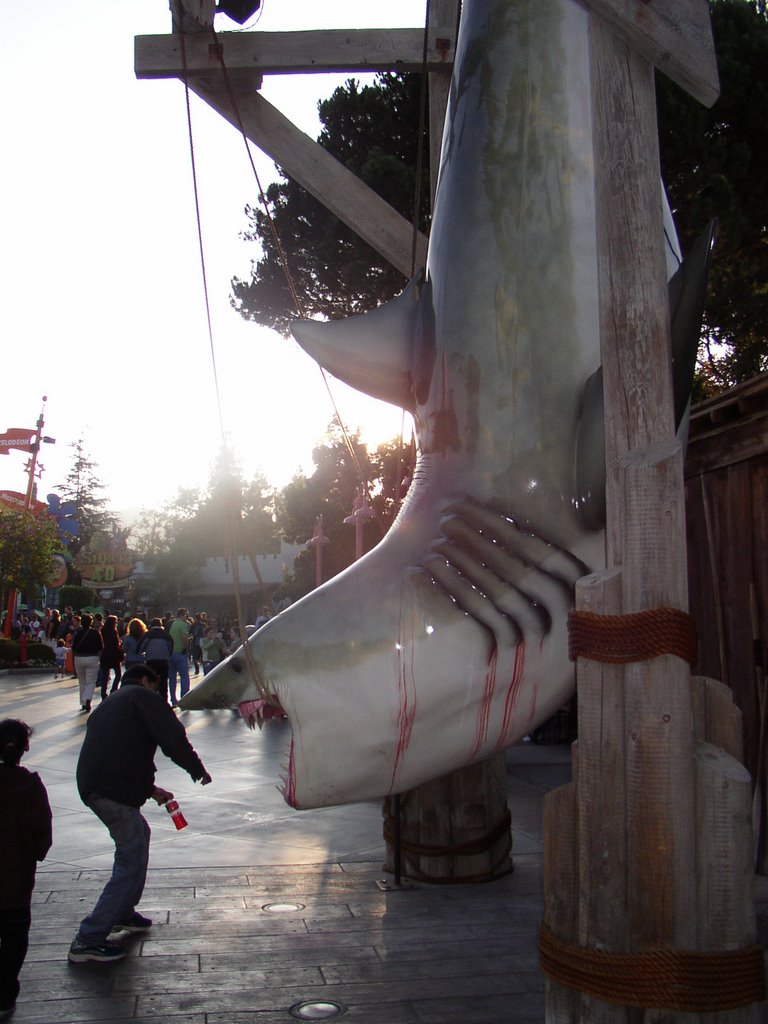
It was exciting to see Bruce the Mechanical Shark from Jaws in good working condition, after all the trouble he caused during filming. But then the tour guide gently informed us that this model of the shark was actually from Jaws: The Revenge.

That’s it, I thought, the bubble has been burst. Why mention a movie that nobody liked?
Universal goes to great lengths to immerse the casual visitor in the world of classic films – through the tour, interactive rides, actor lookalikes, and the constant blaring of familiar theme songs. But throughout the tour, I wanted nothing so much as to go home and watch the movies instead.
In the afternoon, we abandoned the amusement park and went to see the new James Bond movie. Somehow, this is the first time we’ve managed to make it to the cinema since we arrived in L.A. Even more shocking: This particular movie wasn’t a half-hearted effort at nostalgia. Daniel Craig actually manages to reinvent what had become a one-note character. (In my opinion, the new Bond has a touch of Steve McQueen.)

At the end of the day, I decided that I probably am too old to truly appreciate amusement parks - at least, the way I used to. I may also be too old to appreciate the current incarnation of the decades-old Universal tram tour... But I still had fun, mainly because I love being reminded of just how real some movies are to me. Even the actual locations and actors who brought a story to life don’t seem as real as the films themselves, because those fictional worlds have taken on a completely independent life in my memory.
That’s the magic of Hollywood.

The Hanging Tree - from "Phantasm"

Welcome to Cuesta Verde (Agoura Hills)

Welcome to Cuesta Verde (Agoura Hills)

In the foreground, you can see Universal's back lot. In the distance: Warner Brothers studio.

Universal Studios

... where you can ride the movies.


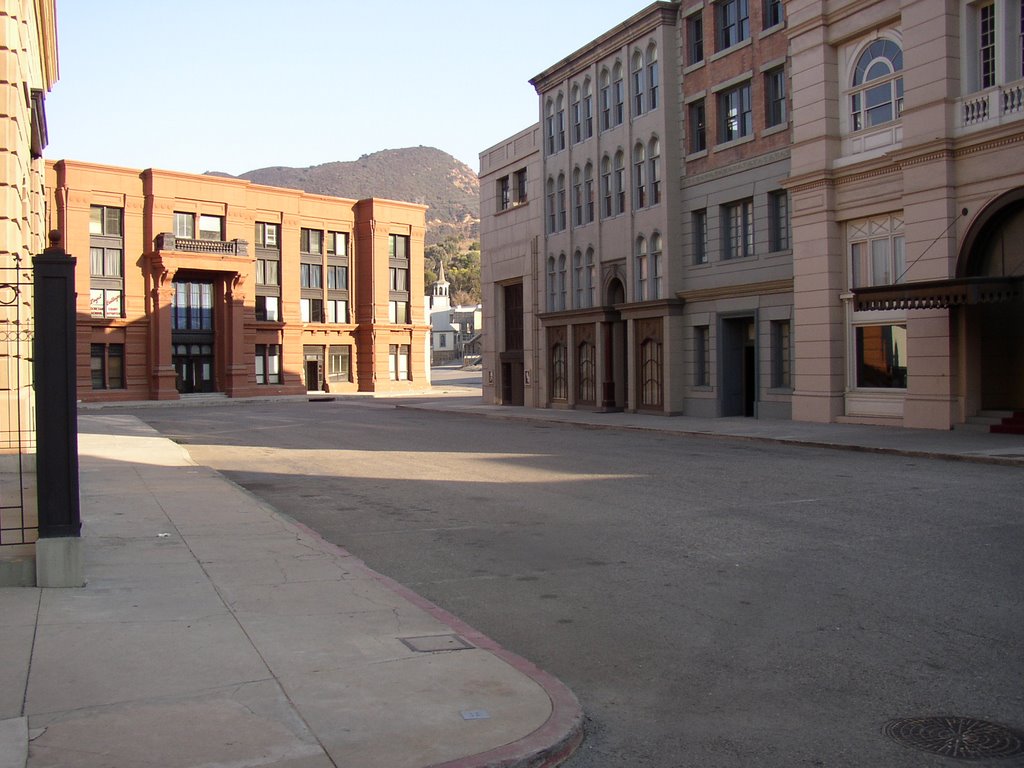
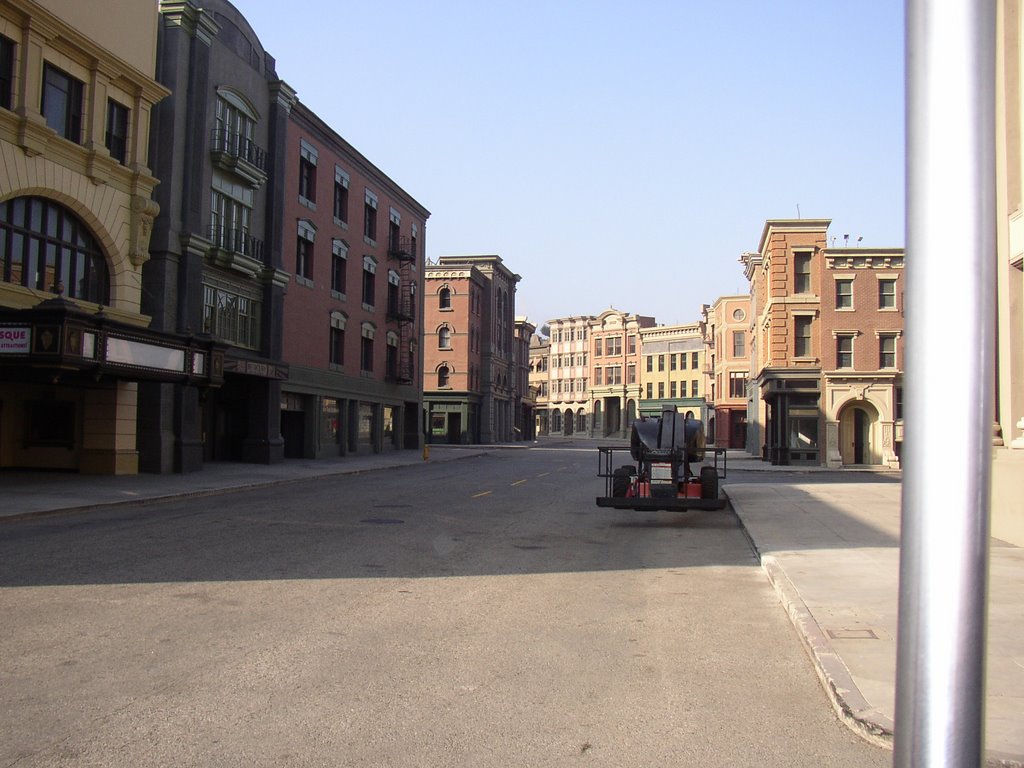
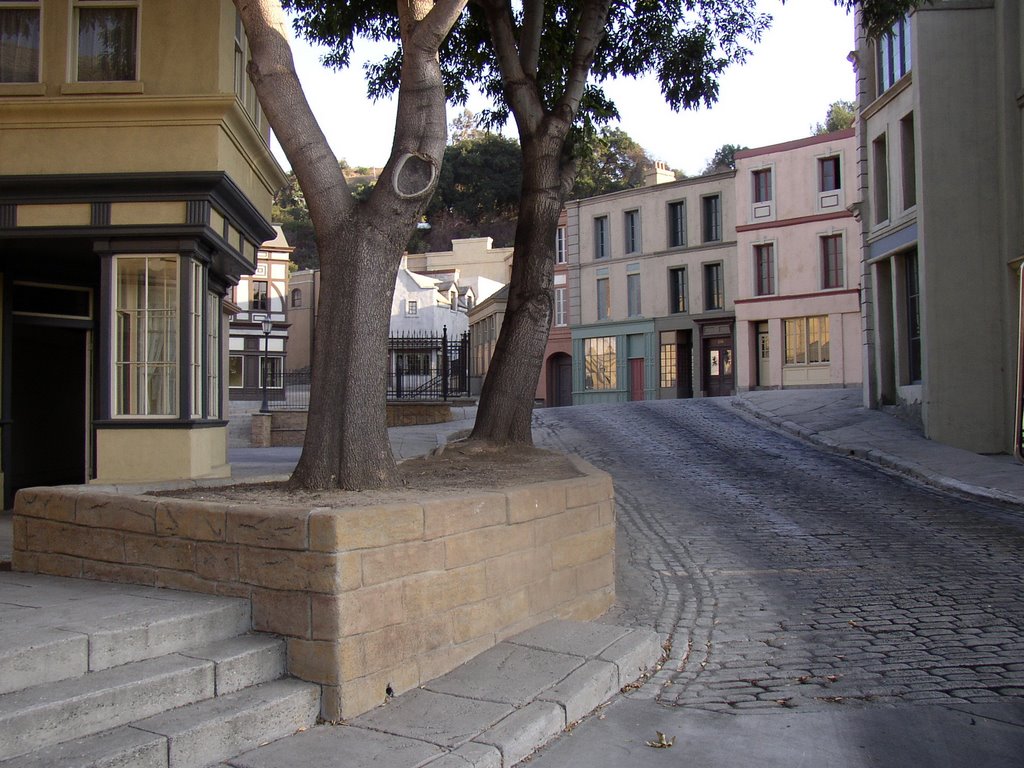
Brownstones, looking east

Brownstones, looking west

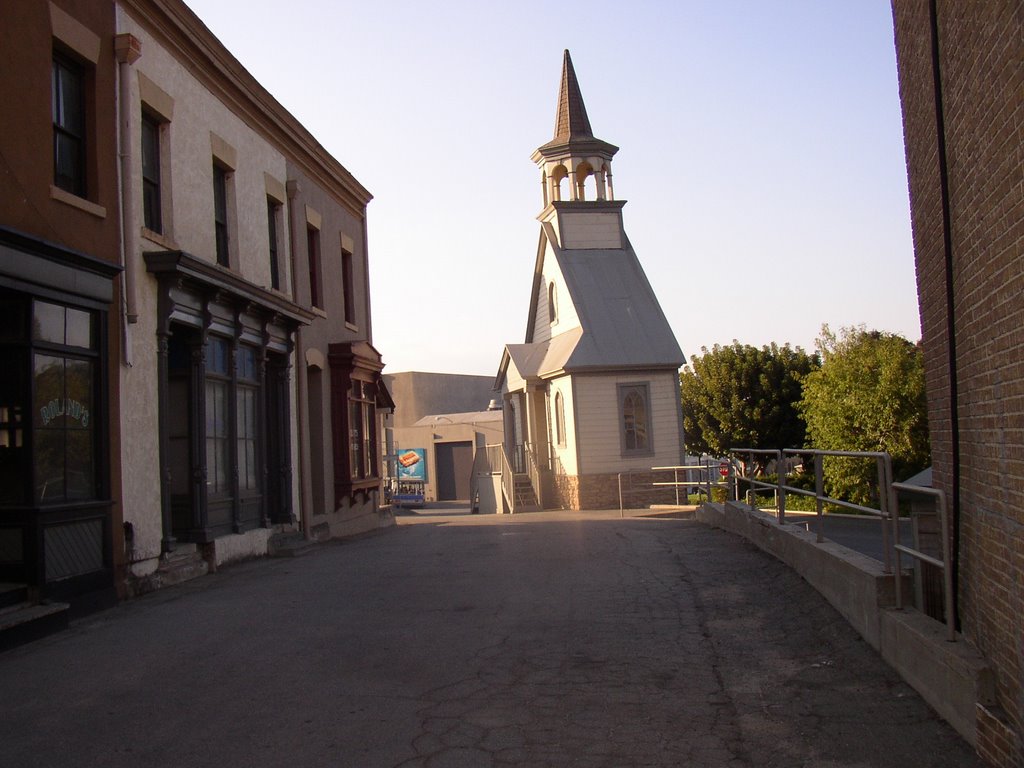
Church facade

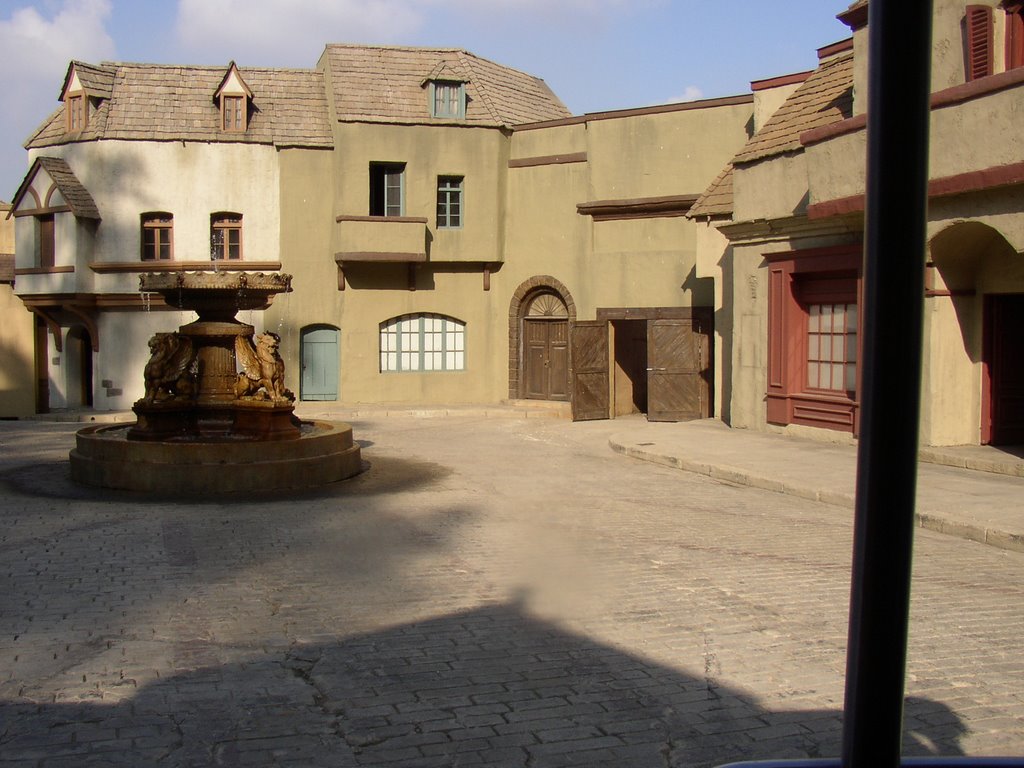
Town square from "The Hunchback of Notre Dame"

"Little Europe"

"Little Europe"

After the filming of "Psycho 3," the house and motel were restored to their appearance in the original film. The oblong monstrosity above the motel is part of Whoville from the live-action "How the Grinch Stole Christmas"

Bedroom window of Mama Bates

The airplane crash set from "War of the Worlds" is directly behind the "Psycho" house

The Courthouse Square from "Back to the Future" (clock tower absent from the main building on the right), dressed for "The Ghost Whisperer"

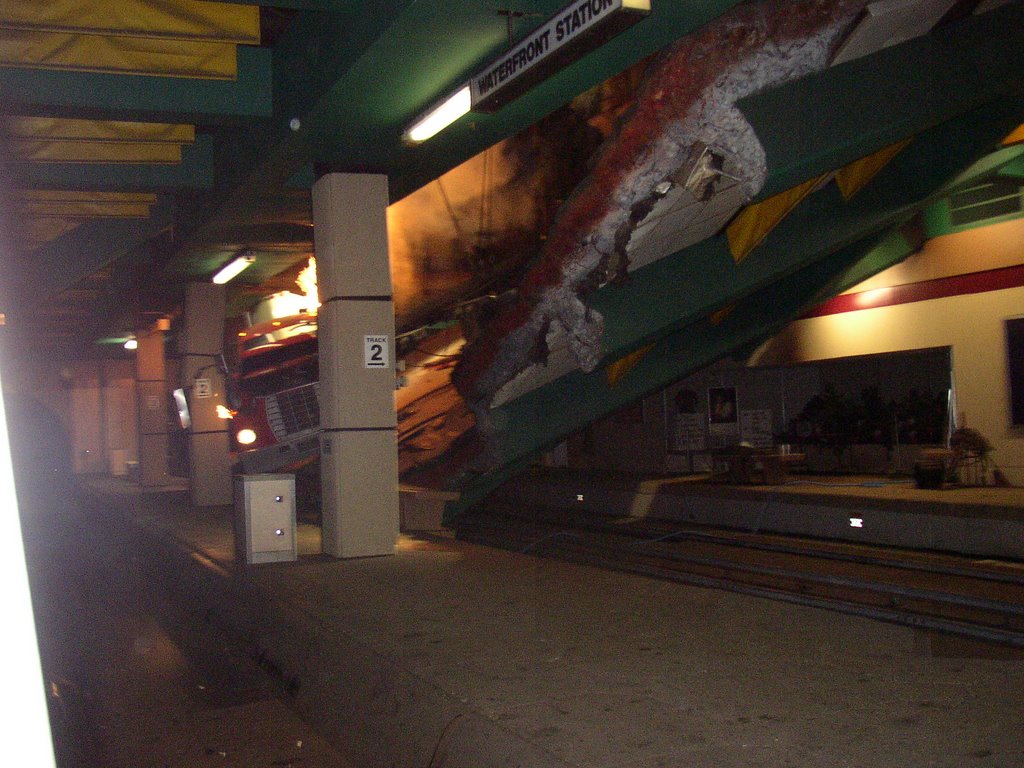
Stage 50 is rigged for earthquake special effects.

Stage 55 is rigged for exploding cars.

Just in case you don't know, this is a hovercraft from Joss Whedon’s “Serenity.”

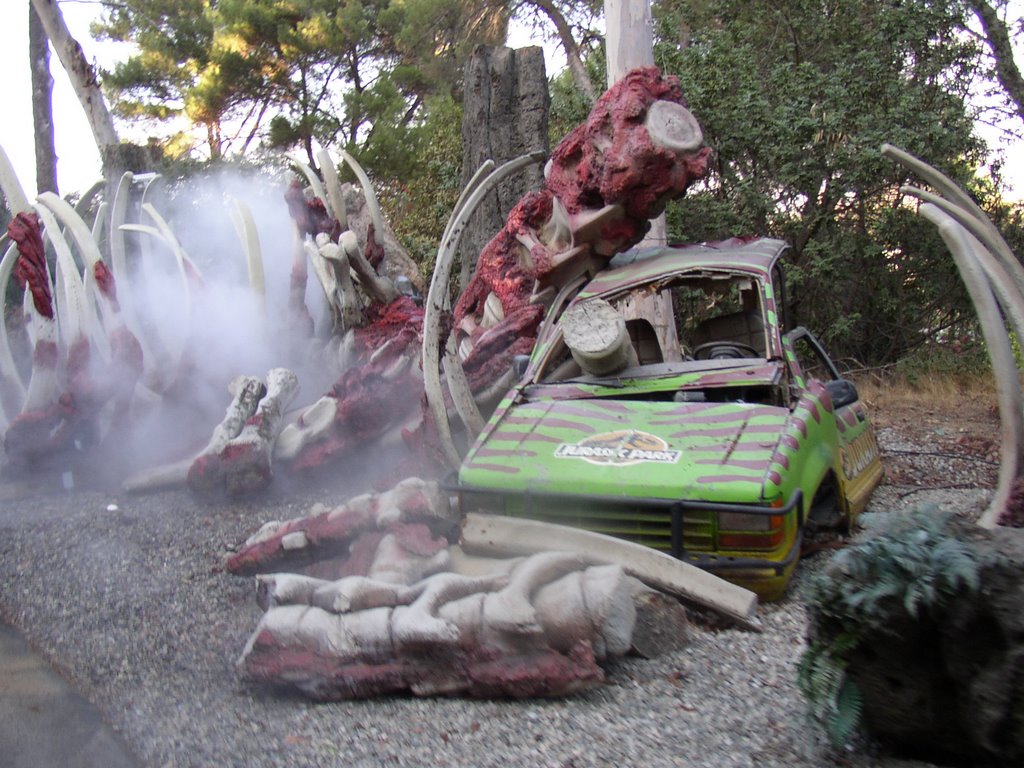
Our tour guide said that "Jurassic Park 4" is in the works.... but it looks to me like this franchise is pretty much played out.

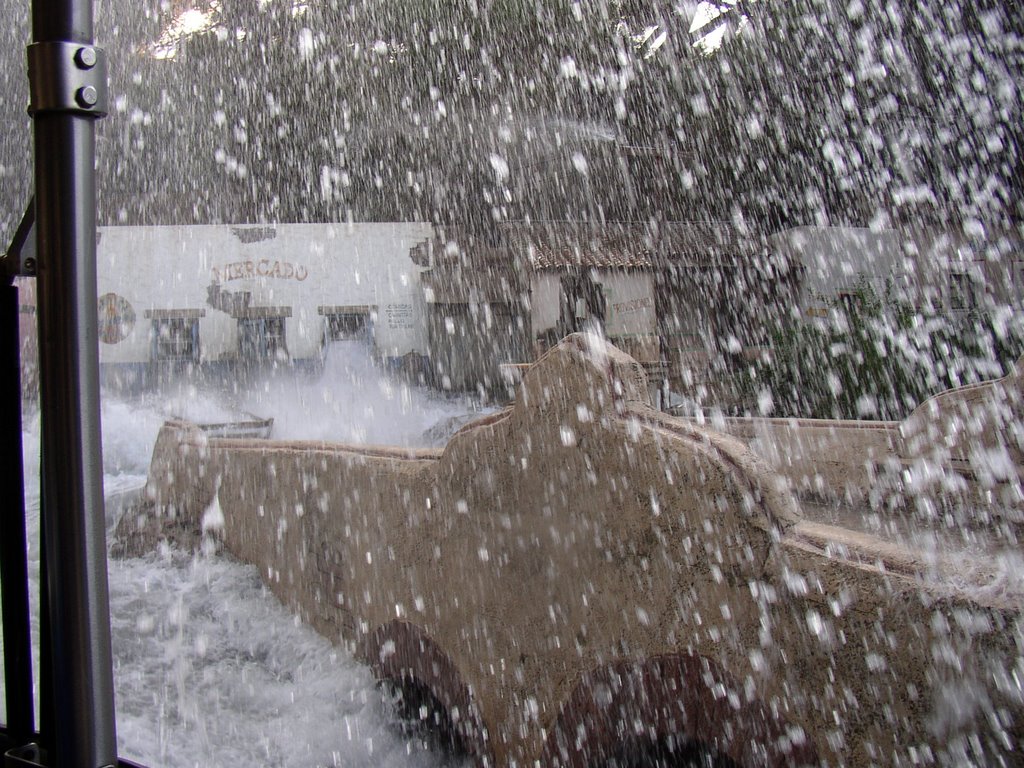
This is why I don't have very many action photos. One minute, you're in "Little Mexico" admiring the view....

... the next minute, you're shielding your camera from flash flood waters that are headed directly for you...

It seems like every attraction at Universal Studios is designed to get you soaked.

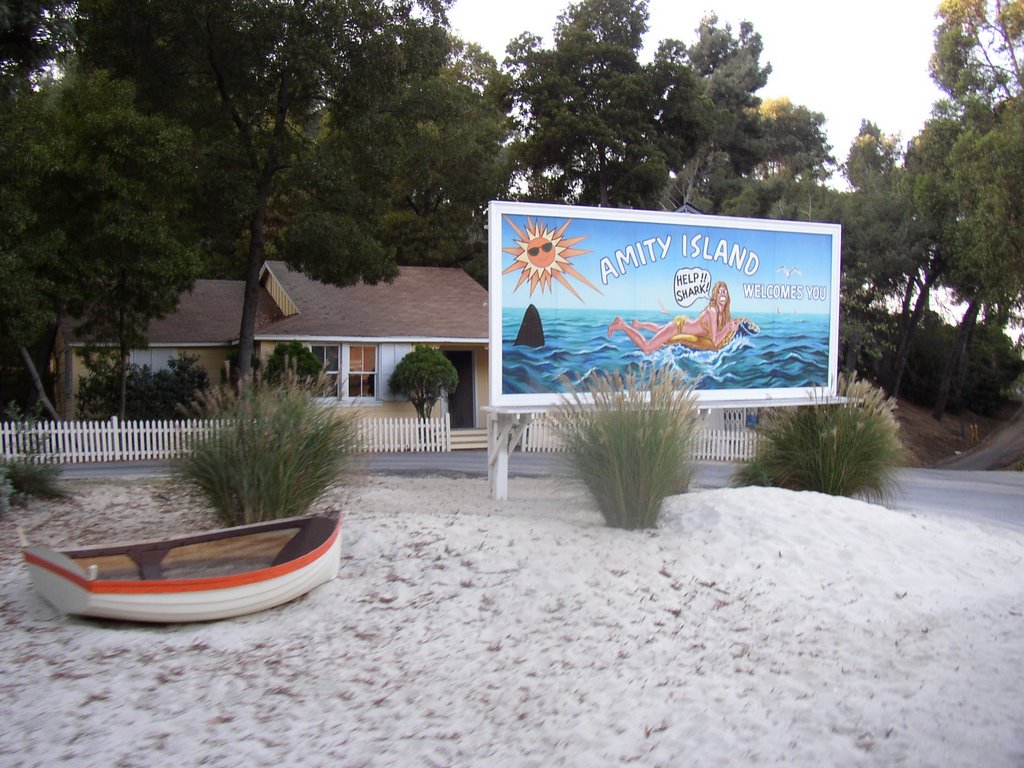
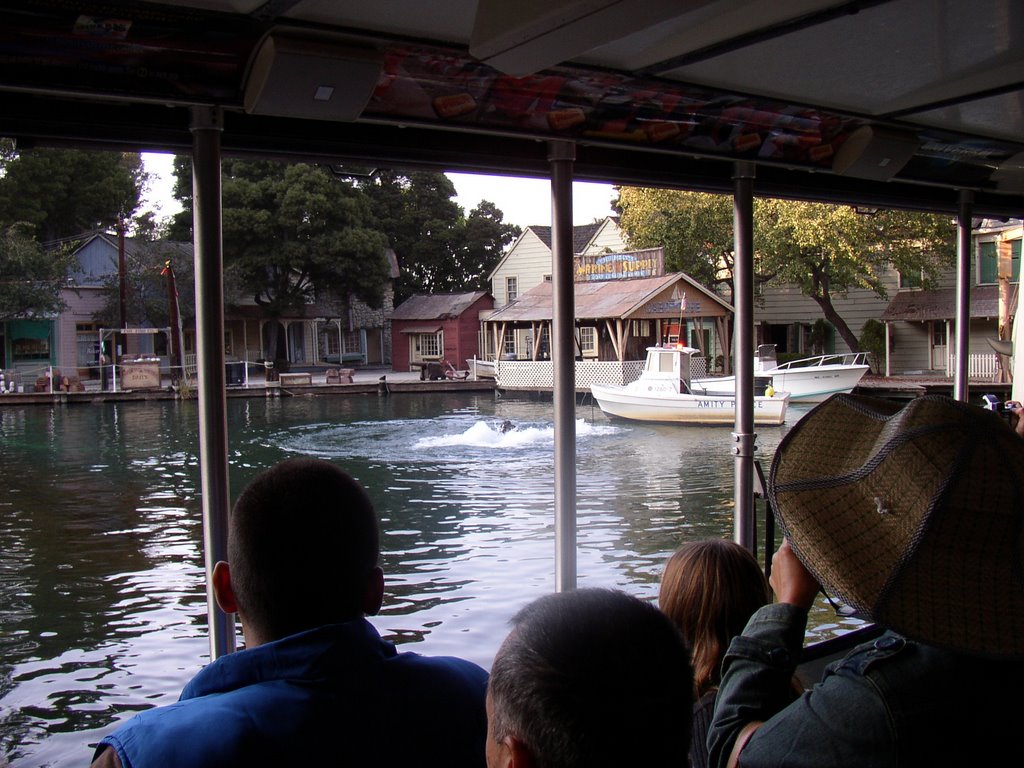
Just when you thought it was safe....

Troubled waters

Bruce Almighty

Bruce gets hung out to dry

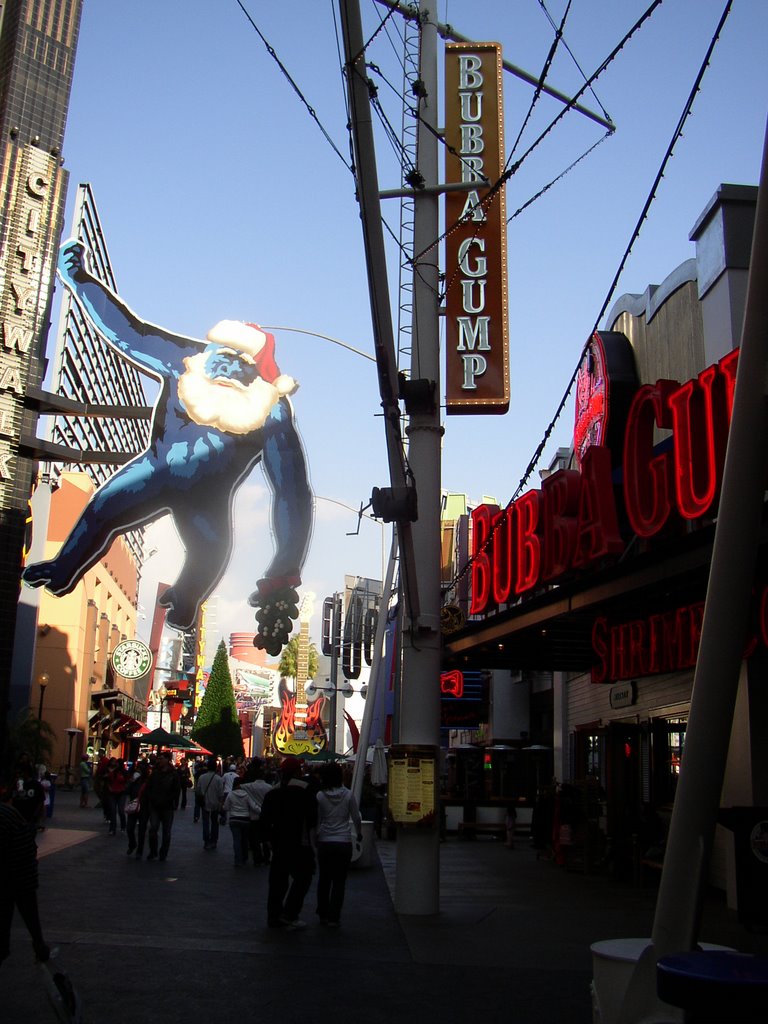
Nothin' says Christmas like a big blue monkey.