“There was a desert wind blowing that night. It was one of those hot dry Santa Anas that come down through the mountain passes and curl your hair and make your nerves jump and your skin itch. On nights like that every booze party ends in a fight. Meek little wives feel the edge of the carving knife and study their husbands’ necks. Anything can happen. You can even get a full glass of beer at a cocktail lounge…”
- Raymond Chandler, “Red Wind” (1938)
One night a few weeks ago, hurricane-force winds blew over the San Gabriel mountains, toppling trees and leaving thousands of homes without power. It was the beginning of “winter” in Los Angeles, heralded by the almost mythic power of the seasonal Santa Ana winds (though, according to one news reporter, they weren’t technically Santa Anas because the air came from the Great Basin instead of the Mojave Desert). On the night of the storm, my wife and I sat inside, listening to the howling wind with reverent silence. We usually usually think of this as a “weatherless” city. It’s not often that weather makes itself known in L.A., but when it does…
Just a few days before the storm, I started reading a 2002 anthology called Writing Los Angeles, edited by David L. Ulin. A praiseworthy collection, it gathers work by more than a hundred writers (famous and not so famous) into roughly 900 pages, revealing countless layers of myth and fact about the semi-fictional city of Los Angeles. In one quote-worthy essay, Joan Didion re-defines Raymond Chandler’s “red wind” as a foehn wind. I was unaware of the term until I read Herman Hesse’s first novel, where the main character remembers the foehn winds of his youth in the Swiss Alps. “A native of the mountains can study philosophy and natural history, and even dispense with God altogether,” Hesse writes, “but when he experiences the Foehn or hears an avalanche crash through the forest, his heart trembles and he thinks of God and death.” Didion is equally dramatic about the Santa Anas (which, not coincidentally, derive their name from the Spanish word for devil)…
“A few years ago an Israeli physicist discovered that not only during such winds, but for the ten or twelve hours which precede them, the air carries an unusually high ratio of positive to negative ions. No one seems to know exactly why that should be; some talk about friction and others suggest solar disturbances. In any case the positive ions are there, and what an excess of positive ions does, in the simplest terms, is make people unhappy.”
Didion concludes her essay by declaring that the Santa Ana winds are a reminder to Angelenos of “how close to the edge we are.” She is not the first and she certainly won’t be the last the last writer to describe Los Angeles as a city on the verge of natural disaster, to say nothing of identity crisis. In addition to her ode to the east wind, Didion writes about the apocalyptic wildfires (often fueled by the Santa Anas.) in her first novel Play It As It Lays. There, wildfires provide a psychic backdrop for the main character’s emotional collapse. At the end of the novel, it seems as if the entire city is destined to burn to the ground. But would that be a blessing or a curse?
In another essay from Writing Los Angeles, Evenlyn Waugh predicts that drought will be the eventual undoing of Los Angeles. John McFee, on the other hand, argues that “debris flow” is the most terrifying natural disaster for residents of the L.A. foothills. Oddly enough, none of the writers in this collection says much about the perennial threat of earthquakes… perhaps because that’s such a well-worn cliché. Check out Curt Gentry’s novel The Late Great State of California (1968).
Why do writers envision Los Angeles as such an apocalyptic locale? Is it because, as Simone de Beauvior notes, we are “surrounded by indomitable nature”- countless parks dividing us from our neighbors, and endless rugged mountains towering over us? Is it because, as Stewart Edward White points out, the modern city was partly founded by religious cranks (“clairvoyants, palm readers, Hindu frauds, crazy cults, fake healers, Chinese doctors”… to say nothing of filmmakers)? Or maybe it’s because the identity of Los Angeles, in the public imagination, has always been rooted in idealistic visions of “Hollywood” that are simply too good to be true. I recently read a book by a successful screenwriter, who offered this bit of practical advice for those aspiring to a career in the entertainment industry: “Think of Hollywood as a sexy young cheerleader with a great pair of legs and Alzheimer’s disease.”
Personally, I’m most interested in two kinds of L.A. writers – the kind who fall in love with the fantasy side of Hollywood and then write about it from on “high,” and the kind who get so disillusioned by the chasm between the fantasy and the reality that they ended up re-imagining “reality” as a much darker fantasy. What would L.A. fiction be, after all, without dark fantasies? Nathanael West’s The Day of the Locust (1939) is surely the best-known – and probably the most acidic – “Hollywood novel” (though my personal favorite is Carl Van Vechten’s Spider Boy). Combined with the wry detective thrillers of writers like Raymond Chandler and James M. Cain, it dictates the recipe for “classic” detective noir, set in a city of shadows and fear. Civic corruption runs rampant, everyday people teeter on the edge of violent eruption, and the night is endless.
Filmmaker Paul Schrader claims [in an essay reproduced elsewhere] that detective noir reflects the disillusionment and moral ambiguity of the post-war generation: “a delayed reaction to the Thirties” expressing “the loss of public honor, heroic conventions, personal integrity and, finally, psychic stability.” The stories show us a culture defined by the demoralizing suspicion of every individual and every institution, and an overwhelming fear of the future. Another film historian sets the scene this way: “A dark street in the early morning hours, splashed with a sudden downpour. Lamps form haloes in the murk. In a walk-up room, filled with the intermittent flashing of a neon sign from across the street, a man is waiting to murder or be murdered…” For a resident of Los Angeles in Santa Ana season, how about this instead? A winding mountain road baking in the sun, cracks in the pavement appearing like blisters, reminders that the earth is alive and restless. In the distance, the hills are ringed with fire and plumes of smoke choke the sky. Heading home he wonders if there is still such a place.
What is it that’s so dreadful about Los Angeles? Why do so many of its authors write about endless night in a city with 350 days of sunshine a year? Cain explains: “Nothing changes… Life takes on a dreadful vacuity here.” The main character of Didion’s Play It As It Lays suffers from this affliction (the French call it “ennui”); she can’t adjust to a place without seasons. The monotony of the weather drives her crazy… at least, it drives her to a kind of spirit-crushing boredom. Life is perfect, but it’s life in stasis… so who cares? As Orson Welles once said, “The terrible thing about L.A. is that you sit down, you’re twenty-five, and when you get up you’re sixty-two.” Didion’s ennui has influenced a fair share of L.A. writers since the 70s… most obviously, Bret Easton Ellis in his debut novel Less Than Zero (1985), the opening pages of which might easily have been included in Writing Los Angeles.
Ennui is, I think, a fair reaction to life in L.A… but I’d argue that it’s only fair initially. Didion, after all, moved on from writing about “weatherless” L.A. to writing about apocalyptic L.A… and many of the other transplanted writers in Ulin’s connection seem to fall in love with Los Angeles in spite of themselves. Why? Once you’ve been here for a while, you begin to pick up the nuances that make it real. As Carey McWilliams explains in his seminal book Southern California: An Island on the Land, one begins to recognize that there are actually many seasons: “two springs, two summers and a season of rain.” You start to anticipate the Santa Anas and the fire and the rain. You prepare for them, mentally and physically. You won’t be as lucky about anticipating earthquakes, but you’ll learn to take them (the small ones) in stride… and, oddly enough, you’ll start to feel proud about “living on the edge.” Again I’m reminded of Herman Hesse’s first novel, in which he writes, “Toward the end of each winter the Foehn approached with a roar. The terrified people of the Alps listened to it, trembling; yet, when away from home, they always long to hear it.”
Hesse’s peer Aldous Huxley was among the first generation of Hollywood outsiders to publicly lambast the city of angels. In a 1923 essay, he called it the City of Dreadful Joy, and described “the joy of rushing about, of always being busy, of having no time to think, of being too rich to doubt… of being always in a crowd, never alone…” Huxley took his criticism even further in his 1939 novel After Many a Summer Dies the Swan. By then, he was a permanent resident of Los Angeles. It seems he couldn’t bring himself to leave.
Huxley’s compatriot Christopher Isherwood does a good job of explaining the appeal of Los Angeles for outsiders. For him, it is the same as the appeal of America in general, to an Englishman. In 1939, Isherwood writes, “In my sane moments, I love this country. I love it just because I don’t belong. Because I’m not involved in its traditions, not born under the curse of its history. I feel free here. I’m on my own. My life will be what I make of it.” Quite a few of the works anthologized in Writing Los Angeles rhapsodize about freedom, which is synonymous with life in L.A. The city was built on one basic principle: Anything goes. Edmund Wilson writes about the emblematic “mixturesque beauty” of the city’s art and architecture. Of course, not everyone sees that endless variety as beautiful.
Truman Capote calls L.A. “the noplace of everywhere… a dumping ground for all that is most exploitedly American.” (This includes, of course, Truman Capote, who died and was buried here in 1984.) In On the Road, Jack Kerouac called it “the loneliest and most brutal of American Cities” (though one wonders how Kerouac, an infrequent visitor to Los Angeles and a notoriously impulsive writer, could have formed more than a superficial opinion). Writing just a few years later, Norman Mailer dismisses L.A. as the “land of the pretty-pretty,” concluding, “Los Angeles is the home of self-expression, but the artists are middle-class and middling-minded.” The truth of that statement depends, I suppose, on which artists he was thinking of. It’s a big city and just about everyone in it is a dreamer… You can look for your niche or create your own private island, as Charles Bukowski explained in his forward to the 1972 Anthology of L.A. Poets:
“I think it is important to know that a man or woman, writer or not, can find more isolation in Los Angeles than in Boise, Idaho. Or, all things being far, he can with a telephone (if he has a telephone) have 19 people over drinking and talking with him within an hour and a half. I have bummed the cities and I know this – the great facility of Los Angeles is that one can be alone if one wishes or he can be in a crowd if he wishes. No other city seems to allow this easy double choice as well. This is a fairly wonderful miracle, especially if one is a writer.”
Bukowski, unlike Kerouac, was grateful to be condemned to freedom. He didn’t feel the need to explain Los Angeles. He let it be, the way the city let him be. I, on the other hand, am frequently guilty of trying to reduce vast, complex subjects to simple organizational schemes or theories, and I’ve been tempted to do the same thing with my thoughts on Los Angeles. As Ulin’s book proves, I’m not the only one. But the longer I live here, the more the city (if we can even call it that) resists classification.
In 1947, Simone de Beauvior describes Los Angeles as “a phantom city… a kaleidoscope… a hall of mirrors.” She explains, “It isn’t a city at all but a collection of villages, residential neighborhoods, and encampments separated by woods and parks.” This reminds me of Carey McWilliams’ assertion that Los Angeles is really eight-eight different cities, each of which must be explored and considered independently. In 1959, English writer Gavin Lambert muses, “Los Angeles is not a city, but a series of suburban approaches to a city that never materializes…. How to grasp something unfinished yet always remodeling itself, changing without a basis for change?” He concludes that Los Angeles – like “Hollywood” – is an imaginary construct. That’s okay, because “in America, illusion and reality are still often the same thing. The dream is the achievement, the achievement is the dream.”
Many writers have chosen to narrow their focus to sub-cities and ethnic enclaves. No doubt that makes the subject of defining Los Angeles more manageable, and it probably seems like the most natural approach to natives who’ve grown up in specific neighborhoods and discovered the greater city without a foreigner’s preconceptions. They can internalize the dream-like qualities of Los Angeles without dissecting them. Sometimes, even a foreigner can do this. I’ve always been a huge fan of John Fante for this reason. He opens his arms to the city and accepts everything it has to offer, good and bad, with courage and good humor. Bukowski followed his lead. I’d also argue that Ray Bradbury captures the essence of L.A. He inadvertently sums up the city in three words: “Mars is Heaven.”
Other writers, understanding that the whole is more than the sum of its parts, search for real-life symbols around which to build expansive theories. Umberto Eco’s essay on Disneyland presents the idea of Los Angeles as a giant amusement park. John Gregory Dunne re-christens L.A. “Autopia,” noting that the freeways are its lifeblood. (Dunne’s essay is an interesting counterpoint to a 1933 essay by James M. Cain, in which Cain enthusiastically declares that traffic control in L.A. is “perfect.”) Jan Morris argues that the Watts Towers commemorate the “failing faith” of a visionary settlement. Pico Iyer chooses LAX airport as his symbol, calling the city a concrete “caesura.” David Thomson is even more poetic in his essay on Mulholland Drive, which he compares to Marilyn Monroe’s naked body. He writes, “Imagine Marilyn Monroe, fifty miles long, lying on her side, half-buried on a ridge of crumbling rock, the crest of the Santa Monica Mountains, with chaparral, flowers and snakes writhing over her body, and mists, smog or dreams gathering in every curve…” What could possibly be a more intimate ode to the city?
Cees Nooteboom is the writer who gets right to the heart of the matter. He writes, “Humanity, including its more sensitive members, falls into two groups: haters and lovers.” It seems as if Los Angeles is a litmus test, showing which type of person you are. As Jan Morris points out, everybody complains about the problems of the city -- overcrowding, traffic, air quality, earthquakes, floods, fires, etc. -- but nobody wants to leave. I guess it’s a city people love to hate. Wanda Coleman blames it on “smog addiction.” A friend of mine, who grew up in Los Angeles, says that the smog is actually much better now than it was when he was growing up in the 60s and 70s, and couldn’t run through his neighborhood without coughing and wheezing… I know he’d be just as likely to make the “smog addiction” joke, because that’s the kind of joke you make when you’ve embraced – or at least internalized – Los Angeles, warts and all. It’s sort of like that mock-celebratory Randy Newman song:
Look at that mountain
Look at those trees
Look at that bum over there, man,
He’s down on his knees…
Everybody’s happy
‘Cause the sun is shining all the time
For my money, the most poignant essay in Writing Los Angeles is Lawrence Weschler’s “L.A. Glows.” The title sums it up. Weschler writes about nuances of the city’s famous “airlight”: winter shadows in the desert (I like to think of them as a precursor to the Celtic Twilight), melancholy sunsets (Faulkner’s “golden land”) and astoundingly clear nighttime skies (likewise attributable to the dreaded “thermal inversion” that traps the smog in the L.A. basin). Weschler’s friend Don Waldie is even more analytical. He describes four different types of L.A. light:
(1) the “cruel actinic light” of summer
(2) the “gunmetal-gray light” of winter
(3) the meditative light of fall (which he says is “the light the tourists come for – the light, to be more specific, of unearned nostalgia”)
On a recent trip, I noted that this is the same light that suffuses the afternoon sky in Rome around this time of year… and since the city of Los Angeles is barely 150 years old, maybe that’s the sort of comparison that provoked Waldie to use the phrase “unearned nostalgia.”
(4) the ideal light after the spring rains, when the sky is “clear as stone-dry champagne”
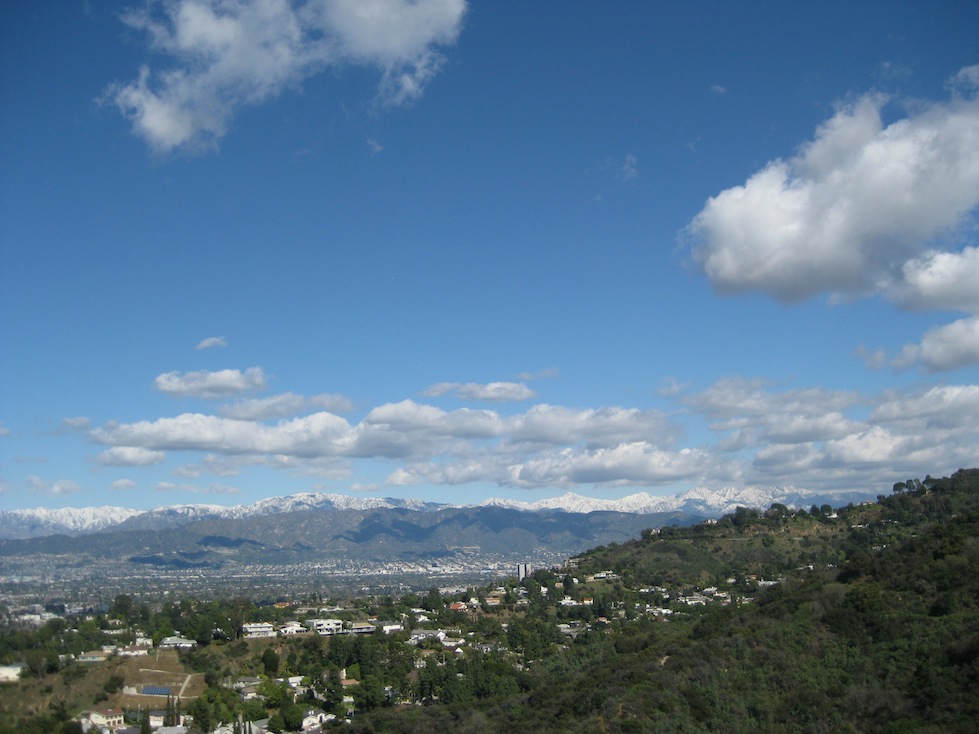
Waldie prefers the fourth, and rarest, of these lights – claiming that this is when you can see the real beauty of Los Angeles, beyond all the illusory haze. On days like that (we just had one a few days ago, following a seasonal rainstorm), it’s tempting to climb to the top of the nearest hill and stare out at the city in silent revery. Then again, for me, that’s worthy doing on just about any day… in any light.
Bottom line: You could write forever, but there's always more to say.
Showing posts with label Bret Easton Ellis. Show all posts
Sunday, December 18, 2011
Sunday, April 25, 2010
Mr. Sardonicus: Bret Easton Ellis at the Los Angeles Times Festival of Books
When I was writing fiction in college, Bret Easton Ellis was a demigod – a controversial writer who had published his first novel while he was still in college himself. His first four novels, beginning with LESS THAN ZERO (pub. 1985) and culminating with AMERICAN PSYCHO (pub. 1991), were savage and funny… but there seemed to be some question in the critical community about the author’s intentions. Were the novels intended as criticisms of self-destructive behavior or were they simply explorations of it? Was AMERICAN PSYCHO a work of genuine existential angst or a cool satire of Wall Street life in the 1980s? Was the author trying to be sincere or funny? Mr. Ellis’s appearance yesterday at the Los Angeles Times Festival of Books offered an answer to these questions: All of the above.
Ellis said that his earliest draft of LESS THAN ZERO was much more autobiographical and strongly influenced by Joan Didion’s 1970s essays on Los Angeles culture. He was, he said, playing the role of a reporter. Over winter vacation during his freshman year of college, he wrote a draft that moved away from the details of his own life and became more “novelistic.” The central character of Clay took on a life of his own. Ellis continued to edit for the next two years, under the tutelage of his writing professor Joe McGinniss, until he had a publishable novel. McGinniss wanted to call the book WINTER VACATION. Ellis opted instead of LESS THAN ZERO, naming his debut novel after an Elvis Costello song about “the rise and acceptance of fascism in the UK,” which seemed to have “parallels” with Clay’s story. This explanation of the title suggests that Ellis instinctively believed that the novel had a “message” to impart, but for the narrator that message is impossible to extract from the overwhelming ennui. Again, the model seems to be Joan Didion, particularly her L.A.-based novel PLAY IT AS IT LAYS (pub. 1970). Ellis readers should instantly recognize stylistic similarities in the following passages from Didion’s work:
She walked back to the car and sat for a long while in the parking lot, idling the engine and watching a woman in a muumuu walk out of the Carolina Pines Motel and cross the street to a supermarket. The woman walked in small mincing steps and kept raising her hand to shield her eyes from the vacant sunlight. As if in a trance Maria watched the woman, for it seemed to her then that she was watching the dead still center of the world, the quintessential intersection of nothing...
...In the aftermath of the wind the air was dry, burning, so clear that she could see the ploughed furrows of firebreaks on distant mountains. Not even the highest palms moved. The stillness and clarity of the air seemed to rob everything of its perspective, seemed to alter all perception of depth, and Maria drove as carefully as if she were reconnoitering an atmosphere without gravity...
...She imagined herself driving, conceived audacious lane changes, strategic shifts of gear, the Hollywood to the San Bernadino and straight on out, past Barstow, past Baker, driving straight on into the hard white empty core of the world. She slept and did not dream.
PLAY IT AS IT LAYS ends with the main character’s desperate flight from L.A. LESS THAN ZERO begins with the main character’s reluctant return.
By the time LESS THAN ZERO was published, the author had nearly completed his second novel, THE RULES OF ATTRACTION (pub. 1987) – a companion piece with the same sensibilities (mainly, ennui) but a more assured narrative voice. Contrary to everyone’s low expectations – the publisher printed only a few thousand copies – LESS THAN ZERO was a huge success. Word of mouth made the author a celebrity within the year. Soon after, Hollywood was making a film adaptation of LESS THAN ZERO. Ellis says he didn’t want to be involved until he read the first draft of the screenplay, and by then it was too late. The final film was more like a sequel to ST. ELMO’S FIRE than an adaptation of Ellis’s novel. But, the author adds, “I’ve grown fond of it over the years… even sentimental about it.” He seems to be generally nostalgic about that time period in his life, when the success and attention were new and exciting. But he admits that, ultimately, he was not ready for all the attention.
One day, he realized “I was dying and this thing called Bret Easton Ellis is taking over.” Henceforth, he had to grapple with the reality that he would be defined by a persona, largely imagined and created by the public. It took him a long time, he says, to accept this as a reality. And to learn not to take the persona seriously. One can see the change in Ellis’s writing. THE INFORMERS (pub. 1994) is a transitional work – half of it exists in the world of disaffected youth that Ellis explored in his first two novels; the other half is more violent, more horrific, focused on the soul-stealing reality of fame. For the first time, the author is unwilling to choose a single narrator. “I tend to give the novels over to my narrators,” he admits, “and they inform a great deal of how the book is structured, how it reads, what the sentences are like.” Thus THE INFORMERS is fragmented.
Ellis’s next novel AMERICAN PSYCHO completely embraces the soulless narrator. It started out, he says, with a lot of “extremely pretentious ideas… the book I was imagining was much more self-important.” In a sense, Bret Easton Ellis is Patrick Bateman. He is not violent. (The violence in AMERICAN PSYCHO, he says, came mostly from what he was reading at the time: graphic novels rather than conservative literary fiction.) But he does exist in two worlds, just like his fictional creation. In one world, Ellis can be himself. In another world – speaking in front of 400 readers at the L.A. Times Festival of Books, for instance – he must play the role of author “Bret Easton Ellis.” A lot of people don’t know how to distinguish between the two. We assume we know more about Bret Easton Ellis than we really do. “You have to separate the art from the artist,” he insists.
Above all, this Q&A made me realize how intuitive Ellis is as a writer. He says he “gives the novels over” to his narrators, suggesting that his own “real” voice is suppressed. In his mind, the storyteller is not Bret Easton Ellis; it’s a fictional self. Ellis is certainly not the only writer whose creative process sounds a bit like automatic writing – I heard a number of other authors yesterday make similar statements: You have to surrender yourself to the process, and allow the voices of the characters to come through you. Ellis says this is a requirement for novel-writing, and he distinguishes it from screenwriting as follows: “A screenplay is just a blueprint. A novel comes from your unconscious, kind of like a dream.”
In AMERICAN PSYCHO, the narrator doubles back. The narrator Patrick Bateman realizes that he has become a different version of himself: a persona instead of a person. “I simply am not there,” he advises. No doubt this reflects the author’s original vision for the book, which was largely about his own struggle to preserve himself as a person, while his persona grew larger than life. (In college, we were taught to call this “meta-fiction.”) Of course, AMERICAN PSYCHO only added fuel to that particular fire. The book became so controversial that Bret Easton Ellis became a household name. The controversy began when his original publisher (Simon & Schuster) refused to publish the book, fearing that readers would find it purely sadistic and misogynistic. Vintage picked it up, and prompted the author to do another revision – which, Ellis says, ultimately helped the book by making it less self-important, funnier and faster-paced. (Perhaps it was this revision that made the subtle difference between sadism and satire.) Critics still roasted the author… but he says that’s their right and it doesn’t affect the work.
Nevertheless, the author had to face the charges. After AMERICAN PSYCHO, some people treated him like the Antichrist (whether they’d read the book or not). Others treated him like a hero, assuming that he was an anarchist who had consciously set out to explode the world of literary fiction. Personally, I can’t help thinking of T.S. Eliot, whose poem THE WASTE LAND did explode the world of English literature in the early 1920s… but who later dismissed his own work, saying that it was simply a personal “grouse about life.” Better still, what about Wes Craven’s LAST HOUSE ON THE LEFT, which shocked audiences and outraged critics in 1972? Craven has said that the film was a personal outlet for years of religious repression, but it also became (for the receptive audience) an outlet for repressed feelings about the Vietnam War: onscreen violence presented as a protest of real-life violence. AMERICAN PSYCHO, I think, was mostly Ellis’s personal catharsis. The fact that it resonated so strongly within American culture shows that a lot of people needed the same kind of catharsis – a belated reaction to the look-good, feel-good surface mentality of the 1980s, especially in New York. The book became a cultural touchstone for a new, psychoanalytic decade. It was a desperate attempt to peel back the persona and get to the person underneath… if indeed there was a person underneath.
A movie adaptation was inevitable. At first, David Cronenberg was slated to direct with Brad Pitt starring as Patrick Bateman (!). Ellis, who was at the time known as the most notorious “horror writer” in America, says he was nervous about meeting the famous horror director: “I was thinking, oh man this guy has made so many crazy, violent movies… he must be a total freak.” When Cronenberg turned out to be a normal guy, the meeting served as a reminder to Ellis that you can’t confuse the art with the artist. His meeting with Christian Bale, who ended up playing Patrick Bateman in the movie, went a little differently. Ellis says that Bale showed up at a restaurant and introduced himself as Patrick Bateman, and didn’t break character for a full ten minutes – at the end of which Ellis said, “You’ve got my approval… Just don’t hurt me.” The author suggests that maybe the actor internalized that character a bit too much. He’s been playing constant variations on the same over-intense persona ever since AMERICAN PSYCHO (onscreen and off?).
In person, Ellis is obviously (and admittedly) uncomfortable being the focus of so much attention. David Cronenberg and Wes Craven, perhaps because they are filmmakers rather than book-writers and therefore subjected to more media coverage, have a self-assuredness that Ellis lacks so far. As Bret Easton Ellis in writing, he can make bold jokes (like his recent Twitter post in which he rejoices that J.D. Salinger is finally dead). As Bret Easton Ellis the public speaker, he has a harder time balancing the writer and the person. When he makes a sincere statement in person, his readers often assume that he’s making a bold joke. “It’s a strange juggling act,” he says, but what can he do at this point besides accept the way the public sees him?
Perhaps the only thing he can do is to work through it in his writing. After his novel 1998 GLAMORAMA went further down the rabbit hole into meta-fiction insanity (and created more confusion than controversy), the author apparently felt a need to reinvent himself. In his real life, he moved from New York to L.A., where he has tried his hand at screenwriting. Perhaps encouraged by Roger Avary’s film adaptation of THE RULES OF ATTRACTION (which Ellis says is the best of the four films made from his work, in terms of “capturing my sensibility”), Ellis wrote the screenplay for THE INFORMERS (which he says is “undeniably the weakest of the four adaptations”). In his fictional life, Bret Easton Ellis became the main character and the narrator of his 2005 novel LUNAR PARK… but the Bret Easton Ellis on the page is NOT the real Bret Easton Ellis. He doesn’t represent the real author as a force within his story, the way Stephen King appears in his last DARK TOWER novel. And LUNAR PARK isn’t a fictive memoir, like Dave Eggars’s A HEARTBREAKING WORK OF STAGGERING GENIUS. The narrator of LUNAR PARK is an alternate universe version of Bret Easton Ellis. (The author spoke briefly about the possibility of a forthcoming film adaptation, starring Jude Law as Bret Easton Ellis… and reiterated that the character is “not really me…”)
If you think that’s confusing, get this… Ellis has just written a follow-up to his first novel LESS THAN ZERO, featuring Clay as the narrator. In the new novel, IMPERIAL BEDROOMS, Clay comments on LESS THAN ZERO, a novel written in the third person by his fictional self and a film featuring yet another fictionalized self. I’m not even sure we can classify this as meta-fiction. Ellis has gone from writing about himself as a fictional character to writing about a different fictional character writing about himself as a fictional character. When the Q&A moderator tried to disentangle this explanation, the author urged him to move on, saying, “Whatever… It’s Sunday morning. It’s early.” I can’t help thinking that it must make sense to him when he’s writing it – because he’s not trying to disentangle, but rather operating purely on intuition, doing what writers do. Whether it works for readers remains to be seen, but I’m hopeful because I’ve never been drawn to Ellis’s work because of the ideas but because of the narrator’s voice. I like getting lost with them.
The title IMPERIAL BEDROOMS also comes from Elvis Costello – it is the name of an 1982 album that, according to critics, reflected a new maturity in the singer/songwriter’s career. Bret Easton Ellis says he doesn’t think that IMPERIAL BEDROOMS reflects a new maturity in his own writing. “I see it actually as a kind of regression,” he adds, “which I embrace.” It’s a return to the minimalist prose of his early novels; an “un-funny Hollywood novel” influenced by Raymond Chandler. He maintains that he wrote it for one deeply personal reason: he wanted to know what ever happened to Clay. Since IMPERIAL BEDROOMS casts Clay as a screenwriter living in Los Angeles, it’s hard to escape the idea that Ellis is wondering what ever happened to the young man that wrote LESS THAN ZERO, after his long struggle between person and persona, writer and celebrity.
I, for one, am very eager to find out. IMPERIAL BEDROOMS will be released in June.
Ellis said that his earliest draft of LESS THAN ZERO was much more autobiographical and strongly influenced by Joan Didion’s 1970s essays on Los Angeles culture. He was, he said, playing the role of a reporter. Over winter vacation during his freshman year of college, he wrote a draft that moved away from the details of his own life and became more “novelistic.” The central character of Clay took on a life of his own. Ellis continued to edit for the next two years, under the tutelage of his writing professor Joe McGinniss, until he had a publishable novel. McGinniss wanted to call the book WINTER VACATION. Ellis opted instead of LESS THAN ZERO, naming his debut novel after an Elvis Costello song about “the rise and acceptance of fascism in the UK,” which seemed to have “parallels” with Clay’s story. This explanation of the title suggests that Ellis instinctively believed that the novel had a “message” to impart, but for the narrator that message is impossible to extract from the overwhelming ennui. Again, the model seems to be Joan Didion, particularly her L.A.-based novel PLAY IT AS IT LAYS (pub. 1970). Ellis readers should instantly recognize stylistic similarities in the following passages from Didion’s work:
She walked back to the car and sat for a long while in the parking lot, idling the engine and watching a woman in a muumuu walk out of the Carolina Pines Motel and cross the street to a supermarket. The woman walked in small mincing steps and kept raising her hand to shield her eyes from the vacant sunlight. As if in a trance Maria watched the woman, for it seemed to her then that she was watching the dead still center of the world, the quintessential intersection of nothing...
...In the aftermath of the wind the air was dry, burning, so clear that she could see the ploughed furrows of firebreaks on distant mountains. Not even the highest palms moved. The stillness and clarity of the air seemed to rob everything of its perspective, seemed to alter all perception of depth, and Maria drove as carefully as if she were reconnoitering an atmosphere without gravity...
...She imagined herself driving, conceived audacious lane changes, strategic shifts of gear, the Hollywood to the San Bernadino and straight on out, past Barstow, past Baker, driving straight on into the hard white empty core of the world. She slept and did not dream.
PLAY IT AS IT LAYS ends with the main character’s desperate flight from L.A. LESS THAN ZERO begins with the main character’s reluctant return.
By the time LESS THAN ZERO was published, the author had nearly completed his second novel, THE RULES OF ATTRACTION (pub. 1987) – a companion piece with the same sensibilities (mainly, ennui) but a more assured narrative voice. Contrary to everyone’s low expectations – the publisher printed only a few thousand copies – LESS THAN ZERO was a huge success. Word of mouth made the author a celebrity within the year. Soon after, Hollywood was making a film adaptation of LESS THAN ZERO. Ellis says he didn’t want to be involved until he read the first draft of the screenplay, and by then it was too late. The final film was more like a sequel to ST. ELMO’S FIRE than an adaptation of Ellis’s novel. But, the author adds, “I’ve grown fond of it over the years… even sentimental about it.” He seems to be generally nostalgic about that time period in his life, when the success and attention were new and exciting. But he admits that, ultimately, he was not ready for all the attention.
One day, he realized “I was dying and this thing called Bret Easton Ellis is taking over.” Henceforth, he had to grapple with the reality that he would be defined by a persona, largely imagined and created by the public. It took him a long time, he says, to accept this as a reality. And to learn not to take the persona seriously. One can see the change in Ellis’s writing. THE INFORMERS (pub. 1994) is a transitional work – half of it exists in the world of disaffected youth that Ellis explored in his first two novels; the other half is more violent, more horrific, focused on the soul-stealing reality of fame. For the first time, the author is unwilling to choose a single narrator. “I tend to give the novels over to my narrators,” he admits, “and they inform a great deal of how the book is structured, how it reads, what the sentences are like.” Thus THE INFORMERS is fragmented.
Ellis’s next novel AMERICAN PSYCHO completely embraces the soulless narrator. It started out, he says, with a lot of “extremely pretentious ideas… the book I was imagining was much more self-important.” In a sense, Bret Easton Ellis is Patrick Bateman. He is not violent. (The violence in AMERICAN PSYCHO, he says, came mostly from what he was reading at the time: graphic novels rather than conservative literary fiction.) But he does exist in two worlds, just like his fictional creation. In one world, Ellis can be himself. In another world – speaking in front of 400 readers at the L.A. Times Festival of Books, for instance – he must play the role of author “Bret Easton Ellis.” A lot of people don’t know how to distinguish between the two. We assume we know more about Bret Easton Ellis than we really do. “You have to separate the art from the artist,” he insists.
Above all, this Q&A made me realize how intuitive Ellis is as a writer. He says he “gives the novels over” to his narrators, suggesting that his own “real” voice is suppressed. In his mind, the storyteller is not Bret Easton Ellis; it’s a fictional self. Ellis is certainly not the only writer whose creative process sounds a bit like automatic writing – I heard a number of other authors yesterday make similar statements: You have to surrender yourself to the process, and allow the voices of the characters to come through you. Ellis says this is a requirement for novel-writing, and he distinguishes it from screenwriting as follows: “A screenplay is just a blueprint. A novel comes from your unconscious, kind of like a dream.”
In AMERICAN PSYCHO, the narrator doubles back. The narrator Patrick Bateman realizes that he has become a different version of himself: a persona instead of a person. “I simply am not there,” he advises. No doubt this reflects the author’s original vision for the book, which was largely about his own struggle to preserve himself as a person, while his persona grew larger than life. (In college, we were taught to call this “meta-fiction.”) Of course, AMERICAN PSYCHO only added fuel to that particular fire. The book became so controversial that Bret Easton Ellis became a household name. The controversy began when his original publisher (Simon & Schuster) refused to publish the book, fearing that readers would find it purely sadistic and misogynistic. Vintage picked it up, and prompted the author to do another revision – which, Ellis says, ultimately helped the book by making it less self-important, funnier and faster-paced. (Perhaps it was this revision that made the subtle difference between sadism and satire.) Critics still roasted the author… but he says that’s their right and it doesn’t affect the work.
Nevertheless, the author had to face the charges. After AMERICAN PSYCHO, some people treated him like the Antichrist (whether they’d read the book or not). Others treated him like a hero, assuming that he was an anarchist who had consciously set out to explode the world of literary fiction. Personally, I can’t help thinking of T.S. Eliot, whose poem THE WASTE LAND did explode the world of English literature in the early 1920s… but who later dismissed his own work, saying that it was simply a personal “grouse about life.” Better still, what about Wes Craven’s LAST HOUSE ON THE LEFT, which shocked audiences and outraged critics in 1972? Craven has said that the film was a personal outlet for years of religious repression, but it also became (for the receptive audience) an outlet for repressed feelings about the Vietnam War: onscreen violence presented as a protest of real-life violence. AMERICAN PSYCHO, I think, was mostly Ellis’s personal catharsis. The fact that it resonated so strongly within American culture shows that a lot of people needed the same kind of catharsis – a belated reaction to the look-good, feel-good surface mentality of the 1980s, especially in New York. The book became a cultural touchstone for a new, psychoanalytic decade. It was a desperate attempt to peel back the persona and get to the person underneath… if indeed there was a person underneath.
A movie adaptation was inevitable. At first, David Cronenberg was slated to direct with Brad Pitt starring as Patrick Bateman (!). Ellis, who was at the time known as the most notorious “horror writer” in America, says he was nervous about meeting the famous horror director: “I was thinking, oh man this guy has made so many crazy, violent movies… he must be a total freak.” When Cronenberg turned out to be a normal guy, the meeting served as a reminder to Ellis that you can’t confuse the art with the artist. His meeting with Christian Bale, who ended up playing Patrick Bateman in the movie, went a little differently. Ellis says that Bale showed up at a restaurant and introduced himself as Patrick Bateman, and didn’t break character for a full ten minutes – at the end of which Ellis said, “You’ve got my approval… Just don’t hurt me.” The author suggests that maybe the actor internalized that character a bit too much. He’s been playing constant variations on the same over-intense persona ever since AMERICAN PSYCHO (onscreen and off?).
In person, Ellis is obviously (and admittedly) uncomfortable being the focus of so much attention. David Cronenberg and Wes Craven, perhaps because they are filmmakers rather than book-writers and therefore subjected to more media coverage, have a self-assuredness that Ellis lacks so far. As Bret Easton Ellis in writing, he can make bold jokes (like his recent Twitter post in which he rejoices that J.D. Salinger is finally dead). As Bret Easton Ellis the public speaker, he has a harder time balancing the writer and the person. When he makes a sincere statement in person, his readers often assume that he’s making a bold joke. “It’s a strange juggling act,” he says, but what can he do at this point besides accept the way the public sees him?
Perhaps the only thing he can do is to work through it in his writing. After his novel 1998 GLAMORAMA went further down the rabbit hole into meta-fiction insanity (and created more confusion than controversy), the author apparently felt a need to reinvent himself. In his real life, he moved from New York to L.A., where he has tried his hand at screenwriting. Perhaps encouraged by Roger Avary’s film adaptation of THE RULES OF ATTRACTION (which Ellis says is the best of the four films made from his work, in terms of “capturing my sensibility”), Ellis wrote the screenplay for THE INFORMERS (which he says is “undeniably the weakest of the four adaptations”). In his fictional life, Bret Easton Ellis became the main character and the narrator of his 2005 novel LUNAR PARK… but the Bret Easton Ellis on the page is NOT the real Bret Easton Ellis. He doesn’t represent the real author as a force within his story, the way Stephen King appears in his last DARK TOWER novel. And LUNAR PARK isn’t a fictive memoir, like Dave Eggars’s A HEARTBREAKING WORK OF STAGGERING GENIUS. The narrator of LUNAR PARK is an alternate universe version of Bret Easton Ellis. (The author spoke briefly about the possibility of a forthcoming film adaptation, starring Jude Law as Bret Easton Ellis… and reiterated that the character is “not really me…”)
If you think that’s confusing, get this… Ellis has just written a follow-up to his first novel LESS THAN ZERO, featuring Clay as the narrator. In the new novel, IMPERIAL BEDROOMS, Clay comments on LESS THAN ZERO, a novel written in the third person by his fictional self and a film featuring yet another fictionalized self. I’m not even sure we can classify this as meta-fiction. Ellis has gone from writing about himself as a fictional character to writing about a different fictional character writing about himself as a fictional character. When the Q&A moderator tried to disentangle this explanation, the author urged him to move on, saying, “Whatever… It’s Sunday morning. It’s early.” I can’t help thinking that it must make sense to him when he’s writing it – because he’s not trying to disentangle, but rather operating purely on intuition, doing what writers do. Whether it works for readers remains to be seen, but I’m hopeful because I’ve never been drawn to Ellis’s work because of the ideas but because of the narrator’s voice. I like getting lost with them.
The title IMPERIAL BEDROOMS also comes from Elvis Costello – it is the name of an 1982 album that, according to critics, reflected a new maturity in the singer/songwriter’s career. Bret Easton Ellis says he doesn’t think that IMPERIAL BEDROOMS reflects a new maturity in his own writing. “I see it actually as a kind of regression,” he adds, “which I embrace.” It’s a return to the minimalist prose of his early novels; an “un-funny Hollywood novel” influenced by Raymond Chandler. He maintains that he wrote it for one deeply personal reason: he wanted to know what ever happened to Clay. Since IMPERIAL BEDROOMS casts Clay as a screenwriter living in Los Angeles, it’s hard to escape the idea that Ellis is wondering what ever happened to the young man that wrote LESS THAN ZERO, after his long struggle between person and persona, writer and celebrity.
I, for one, am very eager to find out. IMPERIAL BEDROOMS will be released in June.
Subscribe to:
Posts (Atom)