Showing posts with label Ray Bradbury. Show all posts

Friday, June 15, 2012

Ray Bradbury's Advice for Writers


1) Read the authors who write the way you hope to write, those who think the way you would like to think.  But also read those who do not think as you think or write as you want to write, and so be stimulated in directions you might not take for many years.

2) Read poetry every day of your life.  Poetry is good because it flexes muscles you don’t use often enough.  Poetry expands the senses and keeps them in prime condition.  It keeps you aware of your nose, your eye, your ear, your tongue, your hand.  And, above all, poetry is compacted metaphor or simile.  Such metaphors, like Japanese paper flowers, may expand outward into gigantic shapes.  Ideas lie everywhere through the poetry books, yet how rarely have I heard short story teachers recommending them for browsing.

Why all this insistence on the senses?  Because in order to convince your reader that he is there, you must assault each of his senses, in turn, with color, sound, taste, and texture.  If your reader feels the sun on his flesh, the wind fluttering his shirt sleeves, half your fight is won.  The most improbable tales can be made believable, if your reader, through his senses, feels certain that he stands in the middle of events.  He cannot refuse, then, to participate.

3) You must take long walks at night around your city or town, or walks in the country by day.  And long walks, at any time, through bookstores and libraries.  (Bradbury's mentor Dorothea Brande elaborates: "It will be worth your while to walk on strange streets, to visit exhibitions, to hunt up a movie in a strange part of town in order to give yoruself the experience of fresh seeing once or twice a week.  But any moment of your life can be used, and hte room that you spend most of your waking hours in is as good, or better, to practice responsiveness on as a new street.  Try to see your home, your family, your friends, your school or office, with the same eyes that you use away from your own daily route.")

4) I grew up reading and loving the traditional ghost stories of Dickens, Lovecraft, Poe, and later, Kuttner, Bloch, and Clark Ashton Smith.  I tried to write stories heavily influenced by various of these writers, and succeeded in making quadruple-layered mudpies, all language and style, that would not float, and sank without a trace.  I was too young to identify my problem, I was so busy imitating... It was only when I began to discover the treats and tricks that came with word association that I began to find some true way through the minefields of imitation.  I finally figured out that if you are going to step on a live mine, make it your own.  Be blown up, as it were, by your own delights and despairs.

5) Find a character, like yourself, who will want something or not want something, with all his heart.  Give him running orders.  Shoot him off.  Then follow as fast as you can go.  The character, in his great love, or hate, will rush you through to the end of the story.

6) Self-consciousness is the enemy of all art, be it acting, writing, painting, or living itself, which is the greatest art of all.  (Dorothea Brande elaborates: "The unconscious is shy, elusive and unwieldy, but it is possible to learn to tap it at will, and even to direct it.  The conscious mind is meddlesome, opinionated and arrogant, but it can be made subservient to the inborn talent through training.  By isolating as far as possible the funcitons of these two sides of the mind, even by considering them not merely as aspects of the same mind but as separate personalities, we can arrive at a kind of working metaphor, impossible to confuse with reality, but infinitely helpful in self-education.")

7) Make sure that if anyone gives you money [for work], they have the same ideas you have. If you love what you do and do what you love, it’s okay… but never work just for money.  

8) Love is the answer to everything. All of my books are things that I love. All my stories come out of my love… They don’t come from here [the head], they come from here [the heart].

9) You must stay drunk on writing so reality cannot destroy you.

10) Don’t talk about it.  Write!

Saturday, June 09, 2012

Remembering Ray Bradbury


As best I can remember, I read my first Ray Bradbury story in 7th grade.  I’m not actually sure which came first, “The Veldt” or “The Pedestrian.”  (Unlike Bradbury, who claimed to vividly remember the moment of his birth, I have rather vague memories of my childhood.)  I admit I was a little bit confused by those stories.  Bradbury wrote so casually about things I’d never seen or imagined that I couldn’t quite believe that he hadn't seen those things himself.  Somehow.  Somewhere.  I now realize that what was so startling to me was the fact that Bradbury wrote about the future as if he was writing about the past.  He was, in the words of biographer Sam Weller, a "nostalgic visionary."

I was particularly captivated by the idea of the virtual reality nursery in “The Veldt”... the idea that technology could take images out of a person’s head and turn them into concrete reality.   Some people say that Bradbury wrote the story as a conscious metaphor, warning parents not to use television as a nanny.  It is also a metaphor for Bradbury’s art.  Quite simply, he brought new ideas to life in the imaginations of millions of readers.  He added a fourth dimension to our world.  That’s what great writing does.

Ray Bradbury is best known as a science fiction author, but it’s his semi-autobiographical novel Dandelion Wine that I love best.   Published in 1957, when the author was 37, it’s the story of a 12-year-old boy’s summer vacation.   I was only a few years older than the protagonist when I read it for the first time, and the novel has become more meaningful to me every time I have re-read it.   It’s not enough to suggest that the novel induces a pleasant sense of nostalgia, because to me the word “nostalgia” suggests idle longing.  Dandelion Wine is never idle, because Bradbury doesn’t just remember the past.  He lives it again in the present.  The novel makes it clear that the author was able to perfectly preserve his childhood innocence well into his adult life... like a snowflake in the freezer at the height of summer. 

Bradbury says he “fumbled into” writing when he was in his early twenties.  This is how he describes his process starting out: “I simply got out of bed each morning, walked to my desk, and put down any word or series of words that happened along in my head.”  Eventually he began writing without bothering to distinguish between what was fact and what was fiction.  In his mind, it was all real.  He was making it even more real by writing it down.  

His career as a bestselling author began with the simple resolution to write every day, producing one short story per week for 52 weeks.  His first real success was a story entitled “The Lake."  It's the tale of a little boy who wishes for one more day with a recently deceased friend.  It is also the story of a grown man who is still that little boy when the wish is finally granted.  There are a million ways the writer could have conveyed the basic plot of this story -- a million variations, each with different characters and different tones.  The possibilities are endless.  What makes “The Lake” work is Bradbury’s ability to tell it in his own way.  My cursory plot synopsis makes it sound like a simple ghost story, but it’s not.  It's much more subtle, much more intimate.

So how did the writer find his all-important “voice”?  He started each day with a word association experiment... jotting down a collection of random words and phrases that conjured strong feelings associated with specific memories.  Then he let the feelings guide him as he wrote.  He allowed himself to be steered by the loves and hates of the people he was writing about, rather than by preconceived notions about what the plot should be.   When the characters led, the stories became pure and honest transmissions of feeling.  When the author tried to lead, the result was a collection of random words and phrases in search of a story.    That’s how he learned: The journey is everything.

Bradbury said: “I have not so much thought my way through life as done things and found what it was and who I was after the doing.  Each tale was a way of finding selves.  Each self found each day slightly different from the one found twenty-four hours earlier.”  The journey began one autumn day in 1932 when 12-year-old Bradbury met the famous Mr. Electrico, an illusionist who gave him two gifts.  First, Mr. Electrico presented the boy with the knowledge that he was reincarnated.  "You were my friend who died in World War I," the carnie explained, "and now here you are again in front of me."  Then Mr. Electrico touched the top of Bradbury’s head and said, “Live forever!”  Years later, the author reflected on this meeting as the pivotal moment in his life:

“I don’t know if I believe in previous lives, I’m not sure I can live forever.  But that young boy believed in both and I have let him have his head.  He has written my stories and books for me.  He runs the Ouija Board and says Aye or Nay to submerged truths or half-truths.  He is the skin through which, by osmosis, all the stuffs pass and put themselves on paper.  I have trusted his passions, his fears, and his joys.  He has, as a result, rarely failed me.  When it is a long damp November in my soul, and I think too much and perceive too little, I know it is high time to get back to that boy with the tennis shoes, the high fevers, the multitudinous joys, and the terrible nightmares.  I’m not sure where he leaves off and I start.”

That’s the magic of telling stories.  The writer experiences what he’s writing just as strongly as he experiences anything in life.  When he’s writing, he forgets the “real” world around him and becomes wholly immersed in the world of imagination.  He lives his stories.  When he comes out of that trance-like state, the words on the page are every bit as revelatory to the writer as they are to reader.  He can’t help but wonder: Did I really write that?  Where did that come from? 

Ray Bradbury was not the first to understand his art as a kind of “channeling.”  The Irish poet W.B. Yeats, one of Bradbury's idols, was intrigued by this idea.  Late in his life, Yeats produced a book (A Vision, published three years before the summer in Dandelion Wine) that he claimed to have written under the influence of disembodied spirits.  In a sense, this was nothing new for Yeats.  He had been doing a kind of “automatic writing” all his life.   In his 1898 essay “The Autumn of the Body,” the poet says: “Our thoughts and emotions are often but spray flung up from the hidden tides that follow a moon no eye can see.”  He goes on to argue that the world is changing; that the conventional ideas of Western science, politics and religion have produced a sadness in modern man which can only be cured by the arts.  Without art, he says, man will know only “the fading and flowering of the world” and his weariness will not end “until the last autumn, when the stars shall be blown away like withered leaves.”  It’s a perfect metaphor for growing old -- not in body, but in spirit.   Yeats reminds us that we need art to keep our spirits alive.

In Dandelion Wine, when a storyteller dies, Douglas Spaulding fears that all of the people, places and things from his stories will die with him. Ray Bradbury experienced the same fear when one of his own idols, Will Rogers, passed away.  His sense of loss was due in part to “the fact that I loved Will Rogers and his death diminished me.”   Both Bradbury and Spaulding eventually realized that the death of a storyteller doesn’t mean the death of his stories.  As long as there is longing in the world for innocence and wonder, the stories that renew our spirit will be immortal. 

Bradbury’s biographer Sam Weller writes that Bradbury “did not fear death itself; instead, he was frightened of being unable to write.”  The author's inevitable death may have silenced his typewriter, but death still has no power over the stories he wrote.  In his later years, Bradbury was consoled by the knowledge that his stories would outlive him.  Despite feeling that my world has been diminished by his death, I too am consoled by this thought.  "The thing that makes me happy,” Bradbury once said, “is that I know that on Mars, two hundred years from now, my books are going to be read.  They’ll be up on dead Mars with no atmosphere.  And late at night, with a flashlight, some little boy is going to peek under the covers and read The Martian Chronicles on Mars.”  May it be so.  

Live forever, Ray!


Sunday, December 18, 2011

Writing Los Angeles

“There was a desert wind blowing that night. It was one of those hot dry Santa Anas that come down through the mountain passes and curl your hair and make your nerves jump and your skin itch. On nights like that every booze party ends in a fight. Meek little wives feel the edge of the carving knife and study their husbands’ necks. Anything can happen. You can even get a full glass of beer at a cocktail lounge…”
- Raymond Chandler, “Red Wind” (1938)

One night a few weeks ago, hurricane-force winds blew over the San Gabriel mountains, toppling trees and leaving thousands of homes without power. It was the beginning of “winter” in Los Angeles, heralded by the almost mythic power of the seasonal Santa Ana winds (though, according to one news reporter, they weren’t technically Santa Anas because the air came from the Great Basin instead of the Mojave Desert). On the night of the storm, my wife and I sat inside, listening to the howling wind with reverent silence. We usually usually think of this as a “weatherless” city. It’s not often that weather makes itself known in L.A., but when it does…

Just a few days before the storm, I started reading a 2002 anthology called Writing Los Angeles, edited by David L. Ulin. A praiseworthy collection, it gathers work by more than a hundred writers (famous and not so famous) into roughly 900 pages, revealing countless layers of myth and fact about the semi-fictional city of Los Angeles. In one quote-worthy essay, Joan Didion re-defines Raymond Chandler’s “red wind” as a foehn wind. I was unaware of the term until I read Herman Hesse’s first novel, where the main character remembers the foehn winds of his youth in the Swiss Alps. “A native of the mountains can study philosophy and natural history, and even dispense with God altogether,” Hesse writes, “but when he experiences the Foehn or hears an avalanche crash through the forest, his heart trembles and he thinks of God and death.” Didion is equally dramatic about the Santa Anas (which, not coincidentally, derive their name from the Spanish word for devil)…

“A few years ago an Israeli physicist discovered that not only during such winds, but for the ten or twelve hours which precede them, the air carries an unusually high ratio of positive to negative ions. No one seems to know exactly why that should be; some talk about friction and others suggest solar disturbances. In any case the positive ions are there, and what an excess of positive ions does, in the simplest terms, is make people unhappy.”

Didion concludes her essay by declaring that the Santa Ana winds are a reminder to Angelenos of “how close to the edge we are.” She is not the first and she certainly won’t be the last the last writer to describe Los Angeles as a city on the verge of natural disaster, to say nothing of identity crisis. In addition to her ode to the east wind, Didion writes about the apocalyptic wildfires (often fueled by the Santa Anas.) in her first novel Play It As It Lays. There, wildfires provide a psychic backdrop for the main character’s emotional collapse. At the end of the novel, it seems as if the entire city is destined to burn to the ground. But would that be a blessing or a curse?

In another essay from Writing Los Angeles, Evenlyn Waugh predicts that drought will be the eventual undoing of Los Angeles. John McFee, on the other hand, argues that “debris flow” is the most terrifying natural disaster for residents of the L.A. foothills. Oddly enough, none of the writers in this collection says much about the perennial threat of earthquakes… perhaps because that’s such a well-worn cliché. Check out Curt Gentry’s novel The Late Great State of California (1968).

Why do writers envision Los Angeles as such an apocalyptic locale? Is it because, as Simone de Beauvior notes, we are “surrounded by indomitable nature”- countless parks dividing us from our neighbors, and endless rugged mountains towering over us? Is it because, as Stewart Edward White points out, the modern city was partly founded by religious cranks (“clairvoyants, palm readers, Hindu frauds, crazy cults, fake healers, Chinese doctors”… to say nothing of filmmakers)? Or maybe it’s because the identity of Los Angeles, in the public imagination, has always been rooted in idealistic visions of “Hollywood” that are simply too good to be true. I recently read a book by a successful screenwriter, who offered this bit of practical advice for those aspiring to a career in the entertainment industry: “Think of Hollywood as a sexy young cheerleader with a great pair of legs and Alzheimer’s disease.”

Personally, I’m most interested in two kinds of L.A. writers – the kind who fall in love with the fantasy side of Hollywood and then write about it from on “high,” and the kind who get so disillusioned by the chasm between the fantasy and the reality that they ended up re-imagining “reality” as a much darker fantasy. What would L.A. fiction be, after all, without dark fantasies? Nathanael West’s The Day of the Locust (1939) is surely the best-known – and probably the most acidic – “Hollywood novel” (though my personal favorite is Carl Van Vechten’s Spider Boy). Combined with the wry detective thrillers of writers like Raymond Chandler and James M. Cain, it dictates the recipe for “classic” detective noir, set in a city of shadows and fear. Civic corruption runs rampant, everyday people teeter on the edge of violent eruption, and the night is endless.

Filmmaker Paul Schrader claims [in an essay reproduced elsewhere] that detective noir reflects the disillusionment and moral ambiguity of the post-war generation: “a delayed reaction to the Thirties” expressing “the loss of public honor, heroic conventions, personal integrity and, finally, psychic stability.” The stories show us a culture defined by the demoralizing suspicion of every individual and every institution, and an overwhelming fear of the future. Another film historian sets the scene this way: “A dark street in the early morning hours, splashed with a sudden downpour. Lamps form haloes in the murk. In a walk-up room, filled with the intermittent flashing of a neon sign from across the street, a man is waiting to murder or be murdered…” For a resident of Los Angeles in Santa Ana season, how about this instead? A winding mountain road baking in the sun, cracks in the pavement appearing like blisters, reminders that the earth is alive and restless. In the distance, the hills are ringed with fire and plumes of smoke choke the sky. Heading home he wonders if there is still such a place.

What is it that’s so dreadful about Los Angeles? Why do so many of its authors write about endless night in a city with 350 days of sunshine a year? Cain explains: “Nothing changes… Life takes on a dreadful vacuity here.” The main character of Didion’s Play It As It Lays suffers from this affliction (the French call it “ennui”); she can’t adjust to a place without seasons. The monotony of the weather drives her crazy… at least, it drives her to a kind of spirit-crushing boredom. Life is perfect, but it’s life in stasis… so who cares? As Orson Welles once said, “The terrible thing about L.A. is that you sit down, you’re twenty-five, and when you get up you’re sixty-two.” Didion’s ennui has influenced a fair share of L.A. writers since the 70s… most obviously, Bret Easton Ellis in his debut novel Less Than Zero (1985), the opening pages of which might easily have been included in Writing Los Angeles.

Ennui is, I think, a fair reaction to life in L.A… but I’d argue that it’s only fair initially. Didion, after all, moved on from writing about “weatherless” L.A. to writing about apocalyptic L.A… and many of the other transplanted writers in Ulin’s connection seem to fall in love with Los Angeles in spite of themselves. Why? Once you’ve been here for a while, you begin to pick up the nuances that make it real. As Carey McWilliams explains in his seminal book Southern California: An Island on the Land, one begins to recognize that there are actually many seasons: “two springs, two summers and a season of rain.” You start to anticipate the Santa Anas and the fire and the rain. You prepare for them, mentally and physically. You won’t be as lucky about anticipating earthquakes, but you’ll learn to take them (the small ones) in stride… and, oddly enough, you’ll start to feel proud about “living on the edge.” Again I’m reminded of Herman Hesse’s first novel, in which he writes, “Toward the end of each winter the Foehn approached with a roar. The terrified people of the Alps listened to it, trembling; yet, when away from home, they always long to hear it.”

Hesse’s peer Aldous Huxley was among the first generation of Hollywood outsiders to publicly lambast the city of angels. In a 1923 essay, he called it the City of Dreadful Joy, and described “the joy of rushing about, of always being busy, of having no time to think, of being too rich to doubt… of being always in a crowd, never alone…” Huxley took his criticism even further in his 1939 novel After Many a Summer Dies the Swan. By then, he was a permanent resident of Los Angeles. It seems he couldn’t bring himself to leave.

Huxley’s compatriot Christopher Isherwood does a good job of explaining the appeal of Los Angeles for outsiders. For him, it is the same as the appeal of America in general, to an Englishman. In 1939, Isherwood writes, “In my sane moments, I love this country. I love it just because I don’t belong. Because I’m not involved in its traditions, not born under the curse of its history. I feel free here. I’m on my own. My life will be what I make of it.” Quite a few of the works anthologized in Writing Los Angeles rhapsodize about freedom, which is synonymous with life in L.A. The city was built on one basic principle: Anything goes. Edmund Wilson writes about the emblematic “mixturesque beauty” of the city’s art and architecture. Of course, not everyone sees that endless variety as beautiful.

Truman Capote calls L.A. “the noplace of everywhere… a dumping ground for all that is most exploitedly American.” (This includes, of course, Truman Capote, who died and was buried here in 1984.) In On the Road, Jack Kerouac called it “the loneliest and most brutal of American Cities” (though one wonders how Kerouac, an infrequent visitor to Los Angeles and a notoriously impulsive writer, could have formed more than a superficial opinion). Writing just a few years later, Norman Mailer dismisses L.A. as the “land of the pretty-pretty,” concluding, “Los Angeles is the home of self-expression, but the artists are middle-class and middling-minded.” The truth of that statement depends, I suppose, on which artists he was thinking of. It’s a big city and just about everyone in it is a dreamer… You can look for your niche or create your own private island, as Charles Bukowski explained in his forward to the 1972 Anthology of L.A. Poets:

“I think it is important to know that a man or woman, writer or not, can find more isolation in Los Angeles than in Boise, Idaho. Or, all things being far, he can with a telephone (if he has a telephone) have 19 people over drinking and talking with him within an hour and a half. I have bummed the cities and I know this – the great facility of Los Angeles is that one can be alone if one wishes or he can be in a crowd if he wishes. No other city seems to allow this easy double choice as well. This is a fairly wonderful miracle, especially if one is a writer.”

Bukowski, unlike Kerouac, was grateful to be condemned to freedom. He didn’t feel the need to explain Los Angeles. He let it be, the way the city let him be. I, on the other hand, am frequently guilty of trying to reduce vast, complex subjects to simple organizational schemes or theories, and I’ve been tempted to do the same thing with my thoughts on Los Angeles. As Ulin’s book proves, I’m not the only one. But the longer I live here, the more the city (if we can even call it that) resists classification.

In 1947, Simone de Beauvior describes Los Angeles as “a phantom city… a kaleidoscope… a hall of mirrors.” She explains, “It isn’t a city at all but a collection of villages, residential neighborhoods, and encampments separated by woods and parks.” This reminds me of Carey McWilliams’ assertion that Los Angeles is really eight-eight different cities, each of which must be explored and considered independently. In 1959, English writer Gavin Lambert muses, “Los Angeles is not a city, but a series of suburban approaches to a city that never materializes…. How to grasp something unfinished yet always remodeling itself, changing without a basis for change?” He concludes that Los Angeles – like “Hollywood” – is an imaginary construct. That’s okay, because “in America, illusion and reality are still often the same thing. The dream is the achievement, the achievement is the dream.”

Many writers have chosen to narrow their focus to sub-cities and ethnic enclaves. No doubt that makes the subject of defining Los Angeles more manageable, and it probably seems like the most natural approach to natives who’ve grown up in specific neighborhoods and discovered the greater city without a foreigner’s preconceptions. They can internalize the dream-like qualities of Los Angeles without dissecting them. Sometimes, even a foreigner can do this. I’ve always been a huge fan of John Fante for this reason. He opens his arms to the city and accepts everything it has to offer, good and bad, with courage and good humor. Bukowski followed his lead. I’d also argue that Ray Bradbury captures the essence of L.A. He inadvertently sums up the city in three words: “Mars is Heaven.”

Other writers, understanding that the whole is more than the sum of its parts, search for real-life symbols around which to build expansive theories. Umberto Eco’s essay on Disneyland presents the idea of Los Angeles as a giant amusement park. John Gregory Dunne re-christens L.A. “Autopia,” noting that the freeways are its lifeblood. (Dunne’s essay is an interesting counterpoint to a 1933 essay by James M. Cain, in which Cain enthusiastically declares that traffic control in L.A. is “perfect.”) Jan Morris argues that the Watts Towers commemorate the “failing faith” of a visionary settlement. Pico Iyer chooses LAX airport as his symbol, calling the city a concrete “caesura.” David Thomson is even more poetic in his essay on Mulholland Drive, which he compares to Marilyn Monroe’s naked body. He writes, “Imagine Marilyn Monroe, fifty miles long, lying on her side, half-buried on a ridge of crumbling rock, the crest of the Santa Monica Mountains, with chaparral, flowers and snakes writhing over her body, and mists, smog or dreams gathering in every curve…” What could possibly be a more intimate ode to the city?

Cees Nooteboom is the writer who gets right to the heart of the matter. He writes, “Humanity, including its more sensitive members, falls into two groups: haters and lovers.” It seems as if Los Angeles is a litmus test, showing which type of person you are. As Jan Morris points out, everybody complains about the problems of the city -- overcrowding, traffic, air quality, earthquakes, floods, fires, etc. -- but nobody wants to leave. I guess it’s a city people love to hate. Wanda Coleman blames it on “smog addiction.” A friend of mine, who grew up in Los Angeles, says that the smog is actually much better now than it was when he was growing up in the 60s and 70s, and couldn’t run through his neighborhood without coughing and wheezing… I know he’d be just as likely to make the “smog addiction” joke, because that’s the kind of joke you make when you’ve embraced – or at least internalized – Los Angeles, warts and all. It’s sort of like that mock-celebratory Randy Newman song:

Look at that mountain
Look at those trees
Look at that bum over there, man,
He’s down on his knees…

Everybody’s happy
‘Cause the sun is shining all the time


For my money, the most poignant essay in Writing Los Angeles is Lawrence Weschler’s “L.A. Glows.” The title sums it up. Weschler writes about nuances of the city’s famous “airlight”: winter shadows in the desert (I like to think of them as a precursor to the Celtic Twilight), melancholy sunsets (Faulkner’s “golden land”) and astoundingly clear nighttime skies (likewise attributable to the dreaded “thermal inversion” that traps the smog in the L.A. basin). Weschler’s friend Don Waldie is even more analytical. He describes four different types of L.A. light:

(1) the “cruel actinic light” of summer


(2) the “gunmetal-gray light” of winter


(3) the meditative light of fall (which he says is “the light the tourists come for – the light, to be more specific, of unearned nostalgia”)


On a recent trip, I noted that this is the same light that suffuses the afternoon sky in Rome around this time of year… and since the city of Los Angeles is barely 150 years old, maybe that’s the sort of comparison that provoked Waldie to use the phrase “unearned nostalgia.”

(4) the ideal light after the spring rains, when the sky is “clear as stone-dry champagne”


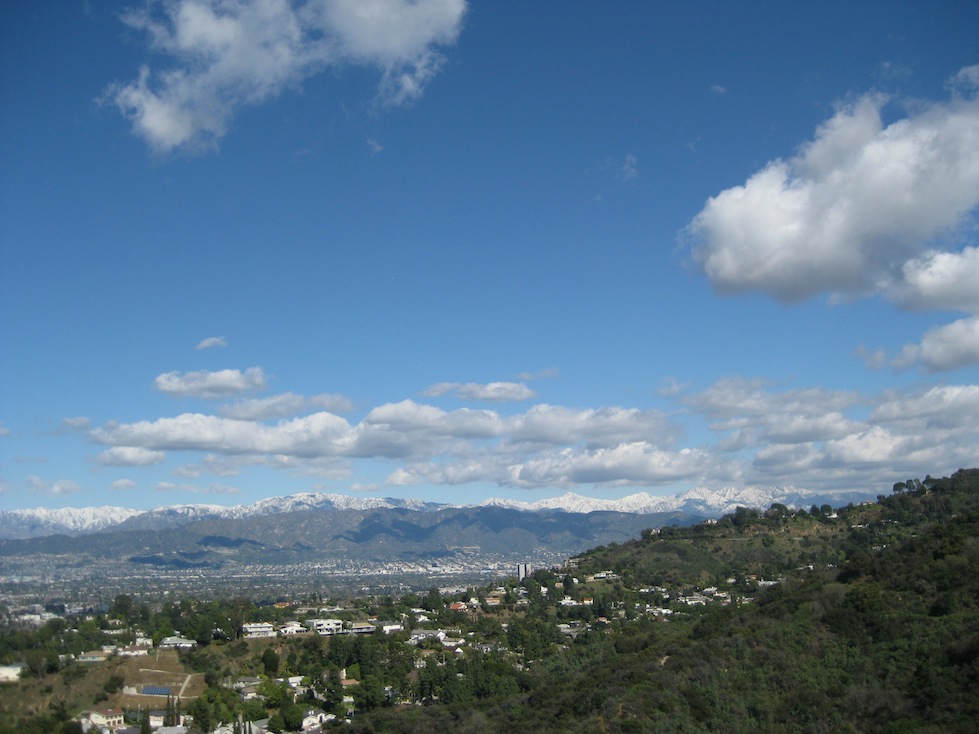
Waldie prefers the fourth, and rarest, of these lights – claiming that this is when you can see the real beauty of Los Angeles, beyond all the illusory haze. On days like that (we just had one a few days ago, following a seasonal rainstorm), it’s tempting to climb to the top of the nearest hill and stare out at the city in silent revery. Then again, for me, that’s worthy doing on just about any day… in any light.

Bottom line: You could write forever, but there's always more to say.

Sunday, June 21, 2009

Ray Bradbury Speaks!


Ever since I moved to L.A., I’ve been eager to hear Ray Bradbury speak in person. Usually I learn of his speaking engagements about 24 hours after they take place, but this weekend (thanks to L. and her obsession with the New York Times) I got some advance notice. Yesterday, Bradbury appeared at the Ventura College Theater as part of the campaign to save the H.P. Wright Library, which is being threatened by budget cuts.

The 88-year-old writer was wheeled onstage and sat expressionless as he was introduced. At first glance, I thought he looked tired and slightly aloof. Boy was I wrong. After a pregnant pause, he asked, “Are you ready for me?” Then he leaned toward the microphone and began: “I suppose you’re all wondering why I’ve called you here today…” Everyone laughed, because at that moment we realized that he was just using silence to draw us in. Before he’d said a word, he was holding us in the palm of his hand. Moments later, we fully understood that we were in the presence of a master storyteller.

For the next half hour, Ray Bradbury regaled us with stories about his life – his first kiss (he was 26, and so elated that he missed his bus stop on the way home), his decision to write weird tales (no matter what people said about his emulation of Edgar Allan Poe and Edgar Rice Burroughs), the sale of his first two novels The Martian Chronicles and The Illustrated Man (in the same day!), his confident foray into Hollywood screenwriting (see It Came from Outer Space), the week he spent in Rome with Federico Fellini (who, at the end of their visit, enthusiastically called him “MY TWIN!”). Time and time again, he kept coming back to the subject of libraries – because, he said, that was the center of everything. His life as a writer began with his early explorations at the neighborhood library in Waukegan, Illinois:

“Out in the world, not much happened. But here in the special night, a land bricked with paper and leather, anything might happen, always did. Listen! and you heard ten thousand people screaming so high only dogs feathered their ears. A million folk ran toting cannons, sharpening guillotines; Chinese, four abreast, marched on forever… This was a factory of spices from far countries. Here alien deserts slumbered. Up front was the desk where the nice old lady, Miss Watriss, purple-stamped your books, but down off away were Tibet and Antarctica, the Congo. There went Miss Wills, the other librarian, through Outer Mongolia, calmly toting fragments of Pieping and Yokohama and the Celebes. Way down the third book corridor, an oldish man whispered his broom along in the dark, mounding the fallen spices…”
[excerpt from Something Wicked This Way Comes]

Bradbury’s family moved to Los Angeles when he was 13 years old. His father was out of work for years and the family didn’t have any money for books, so the local library was his saving grace. After he graduated high school, Bradbury dismissed college in favor of the library – because, he explained, nobody tells you what to read there. Instead, you make your own choices based on what genuinely inspires you. He explained that, over the course of ten years, he went to the library for three full days every week until he had read “every damn book in the whole damn library.”

That’s how Ray Bradbury has lived his life: doing what he loves and loving what he does. That’s his secret to living forever and he urged us to learn from his example. Don’t invest in colleges and universities, he said, because they don’t need your money as badly as kindergartens and libraries. It’s through early childhood education and local libraries that we develop lifelong passions. If people aren’t passionate about discovering other worlds by the time they’re 12 or 13, he added, it’s too late. That’s why the libraries are so important.

“We live in strange times,” he said, when the preservation of libraries is not a top priority. We may not be burning books, like the fascists in his novel Fahrenheit 451, but we’re certainly undervaluing them. We’re also undervaluing the role that libraries play in our communities. During the presentation, I sat next to two older women, Gracie and Mary. Mary told me that she walked to the library from her house everyday, and didn’t know where she’d go if the library closed. Gracie, who looks remarkably youthful at age 91, seemed to draw much of her energy from a lifelong love of books. Both of these women were clutching copies of my favorite Bradbury novel (in fact, one of my favorite novels, period) Dandelion Wine – a meditation on the magic and wonder of youth that never dies.

Ray Bradbury’s mission is not just to help save libraries, but to help people save the most passionate part of themselves. He closed his speech with two pieces of sage advice:
1. “Make sure that if anyone gives you money [for work], they have the same ideas you have. If you love what you do and do what you love, it’s okay… but never work just for money… Tomorrow morning, if you get out of the bed and think about the people who oppose you and who don’t believe in what you’re doing, call them up and fire them.”
2. “Love is the answer to everything. All of my books are things that I love. All my stories come out of my love… They don’t come from here [the head], they come from here [the heart]. I must teach you to pay attention to your heart, and the library has got to be in the center of your being, the center of your heart, and your love for the future.”

So far, the “Save Wright Library” campaign has raised $80,000 – enough, the organizer says, to keep the library open until August and guarantee the existence of a summer reading program for neighborhood kids. But they’ve still got a long way to go to reach their goal of $280,000 by March 2010. To find out how you can help, visit their website. And tell them Ray sent you...

Sunday, July 01, 2007

L.A. Destroys Itself

“When Man entered the atomic age, he opened a door into a new world. What he eventually finds in that new world, nobody can predict.”

These are the final ominous lines of the 1954 monster movie Them! – which predicted that man would soon be challenged by giant… mutant… ants. The creatures emerge from the New Mexico desert, and eventually make their way to the underground sewers of Los Angeles. Government officials declare martial law, and bring in lots of flamethrowers… all the while wondering if this is just the beginning. Is L.A. doomed?

Today, I had a rare opportunity to see the film on the big screen, at the new Billy Wilder Theater in Westwood. Them! was presented as part of the 2007 L.A. Film Festival - the fourth entry in a (regrettably short) lineup of films called “L.A. Destroys Itself.” It was preceded by 1984’s Night of the Comet (if you haven’t seen it, think Night of the Living Dead meets Valley Girl), John Carpenter’s cult classic Escape from L.A. (1996), and the campy Chuck Heston disaster film Earthquake (1974), presented in Sensurround. Last on the roster is tonight’s screening of the apocalyptic romance Miracle Mile (1988).

Seeing all of these disaster flicks in such a short period of time makes me wonder: Why do Los Angeles filmmakers have such an obsession with destroying their city? There are plenty of titles that could have been added to the lineup... Mother Nature gave L.A. a pretty good beating in the recent blockbuster The Day After Tomorrow (2004), Martians did the damage in the original War of the Worlds (1953), and terrorists recently nuked the city in TV’s 24. If you want to dig a little deeper, there’s the all-consuming fire at the end of John Schlesinger’s The Day of the Locust (1975). That movie took its cue from the Nathanael West's immortal 1939 novel, which determined the tone of practically all fiction about Los Angeles.

Lured by the impossible promises of the city’s earliest “boosters,” West saw Los Angeles as a failed dream machine – a grotesque un-reality that could only be cured by its complete and utter destruction. He was not the first cynic to voice this opinion, nor was he the first to impose death on Hollywood’s iconic landscape. Raoul Whitfield’s 1931 novel Death in a Bowl had already imagined murder at the newly-built Hollywood Bowl.


Some say that this was the predecessor of the hardboiled detective novel, popularized by L.A. writers like Raymond Chandler and James M. Cain – who also liked to imagine that Angelinos were right on the edge of destruction, poised to crash into the ocean, get crushed by a landslide, burned alive in a brush fire or simply swallowed by the earth.

Perhaps this grim mentality was, to a degree, inevitable. After all, the west coast once represented the final frontier of western civilization… When it was settled, the dream was bound to die.

Except it didn’t.

A few months ago, I read an article by long-time Los Angeles resident Ray Bradbury, who said that people don’t come here for the city itself. They come for the freedom the city gives them – freedom to be who they want to be, and do what they want to do. While the nature-based myth of this final frontier might not be as pure as it once was (the land of eternal sunshine is now the land of eternal smog - a testament to overpopulation), Los Angeles is nevertheless a city of dreamers – people who are always creating new myths.

In fact, maybe that should be a theme for next year’s film festival. There are plenty of great films about life inside the dream machine. Allow me to recommend Sullivan’s Travels (1941), Sunset Boulevard (1950), The Bad and the Beautiful (1952), Grand Canyon (1991) Barton Fink (1991), Mulholland Drive (2001)…

In the meantime, I'm happy to keep watching those lovable mutant ants...